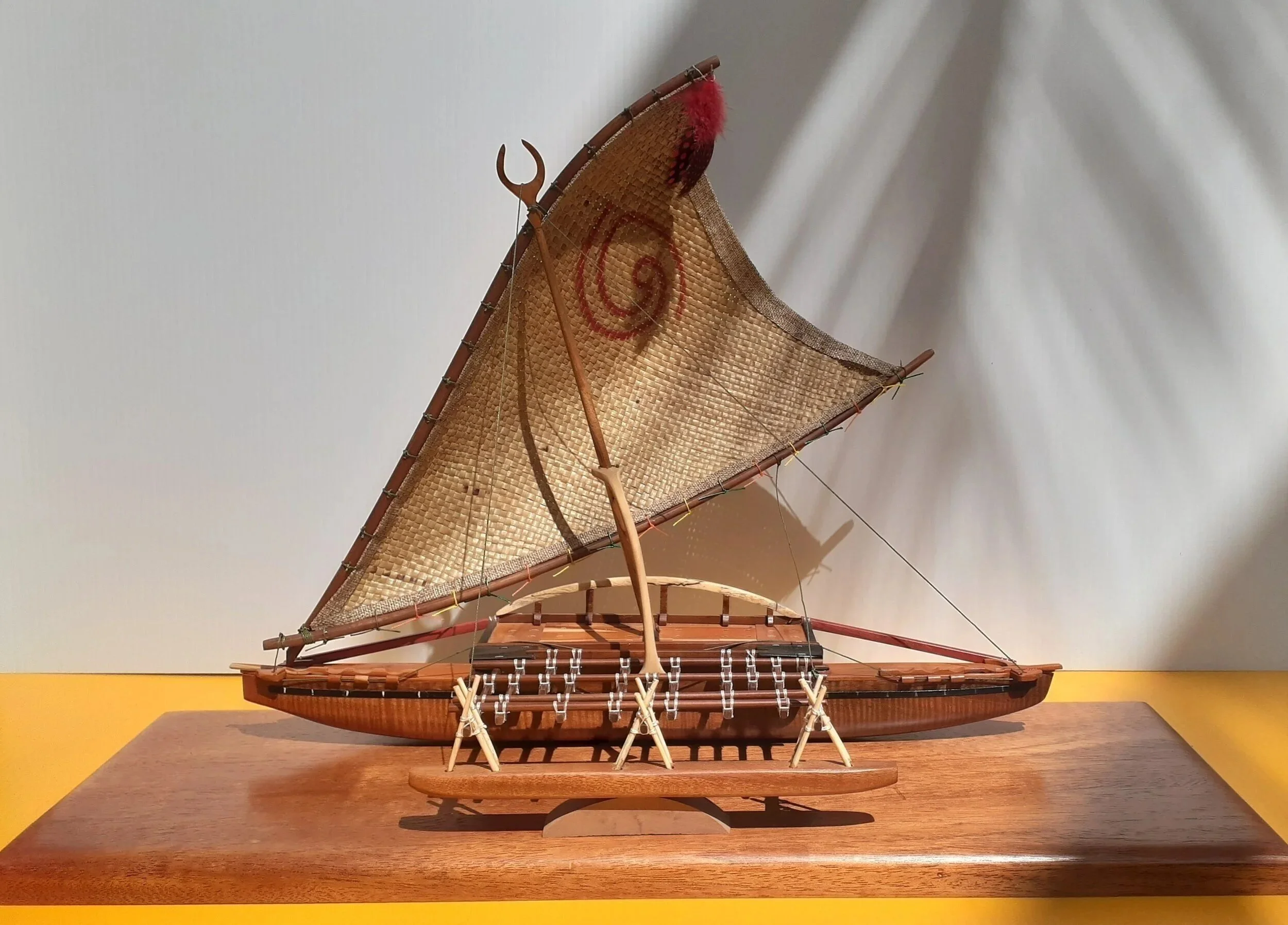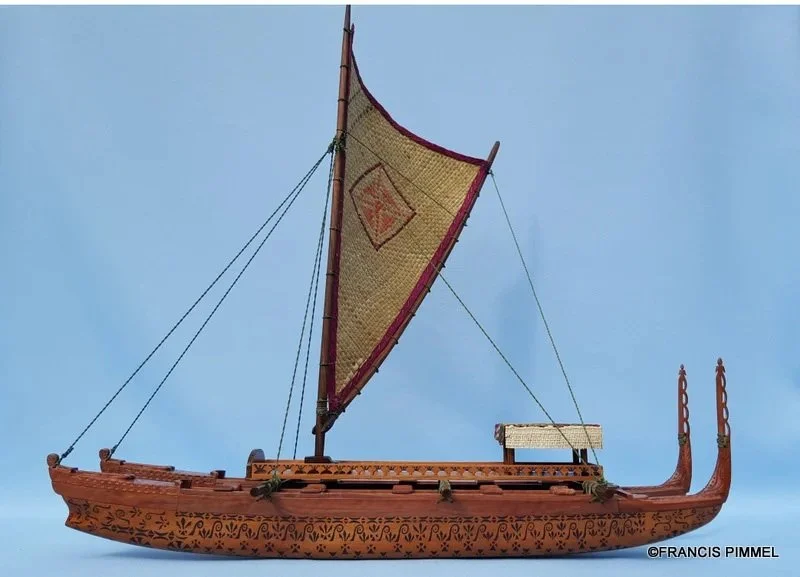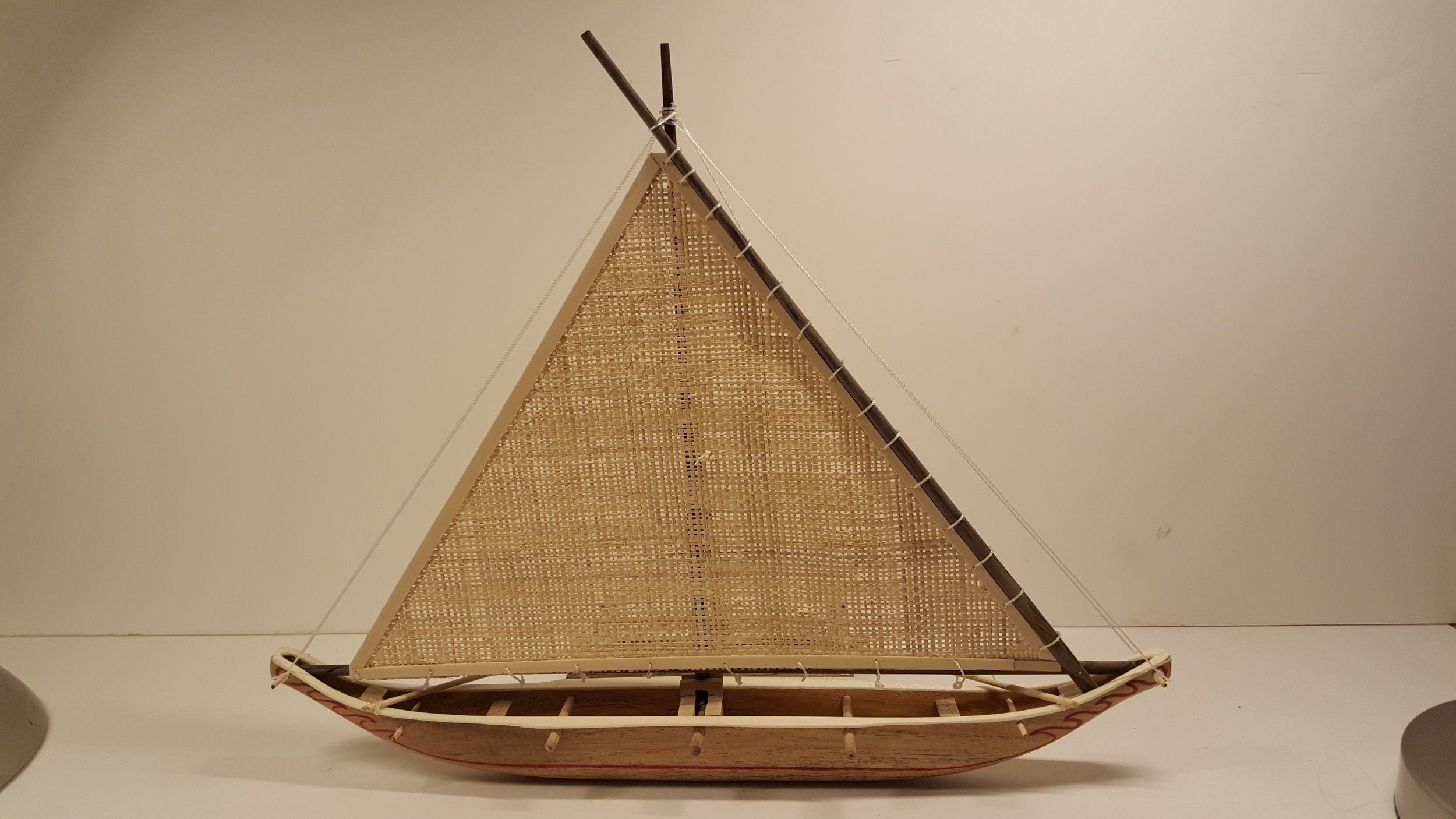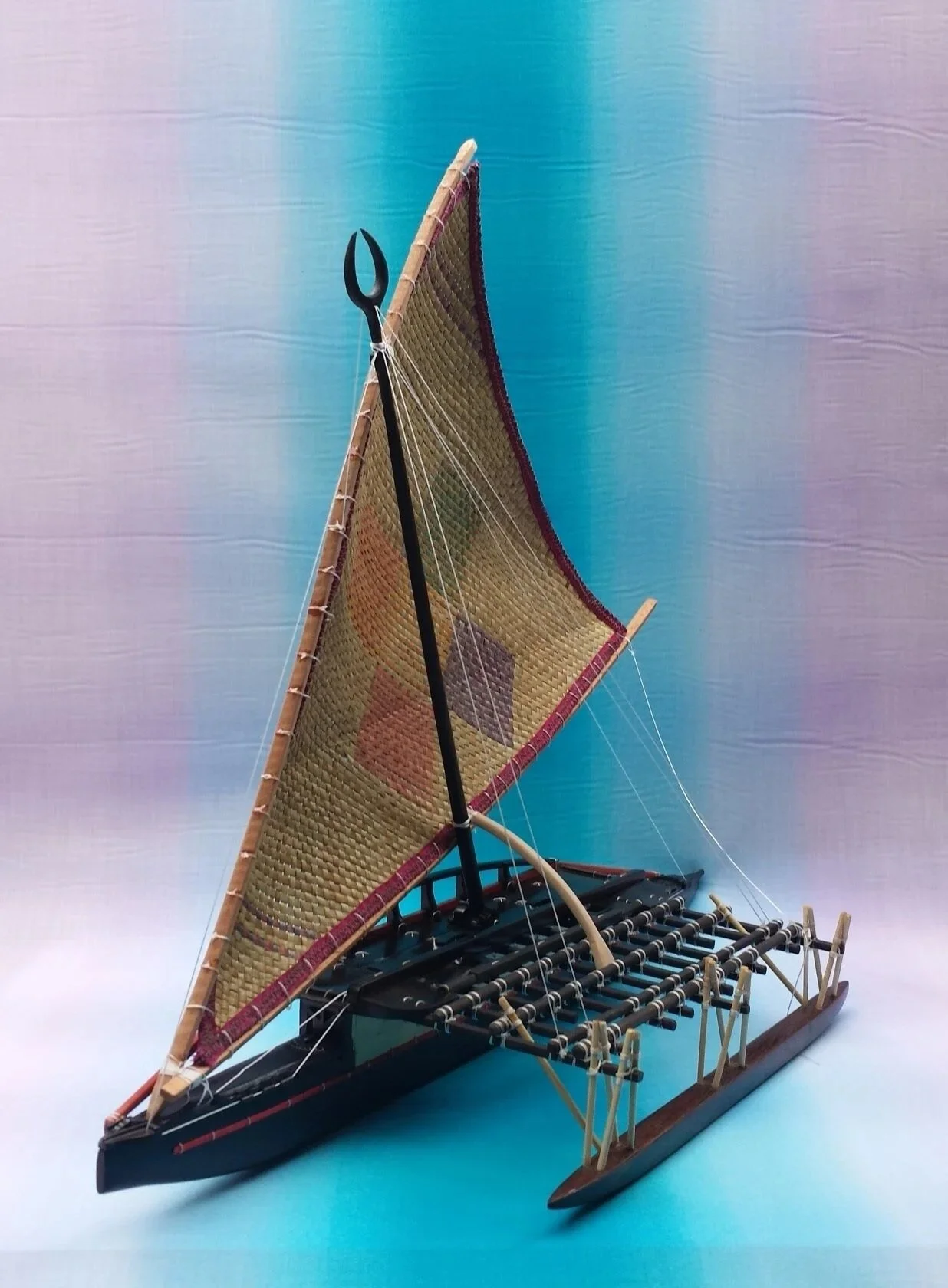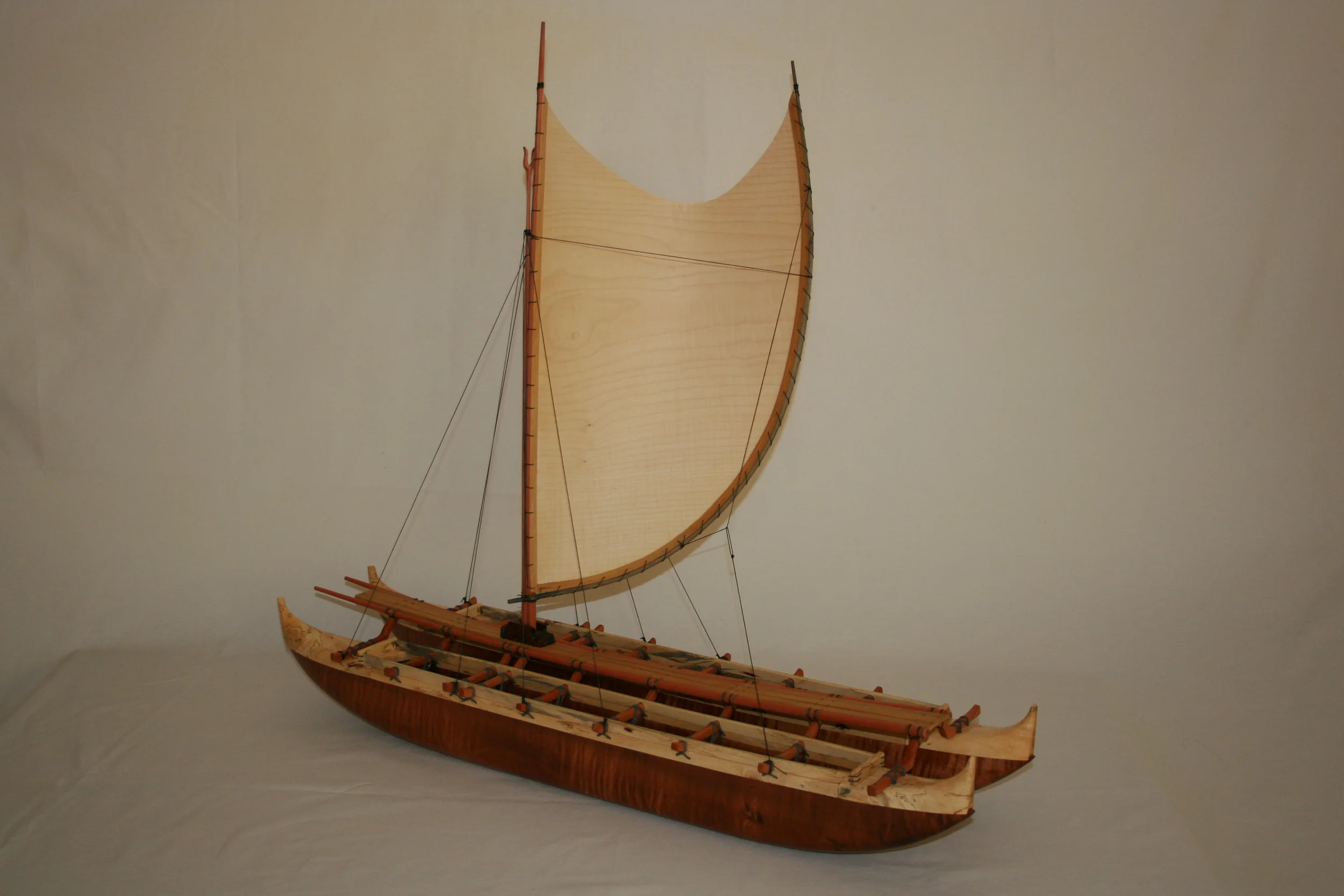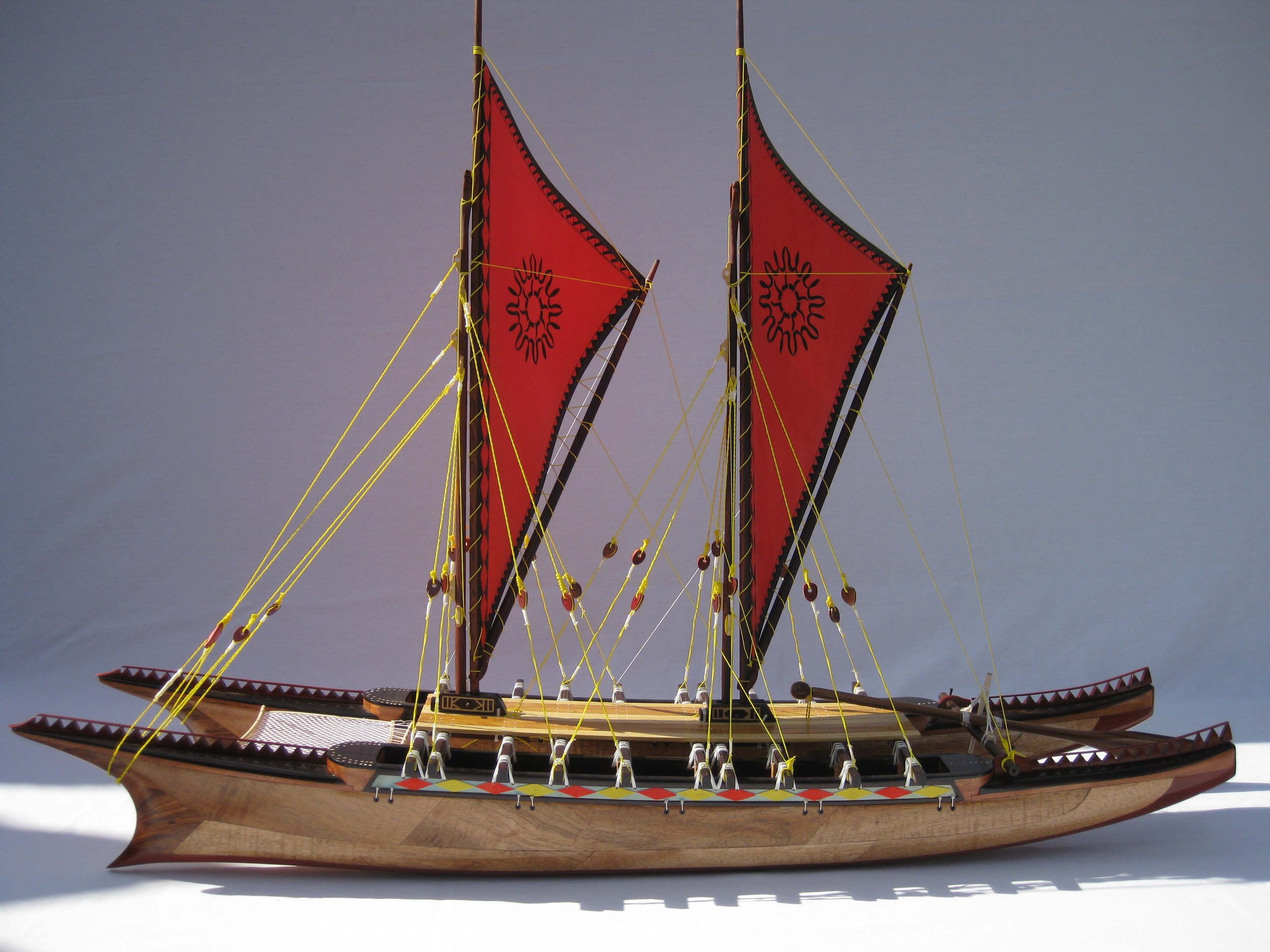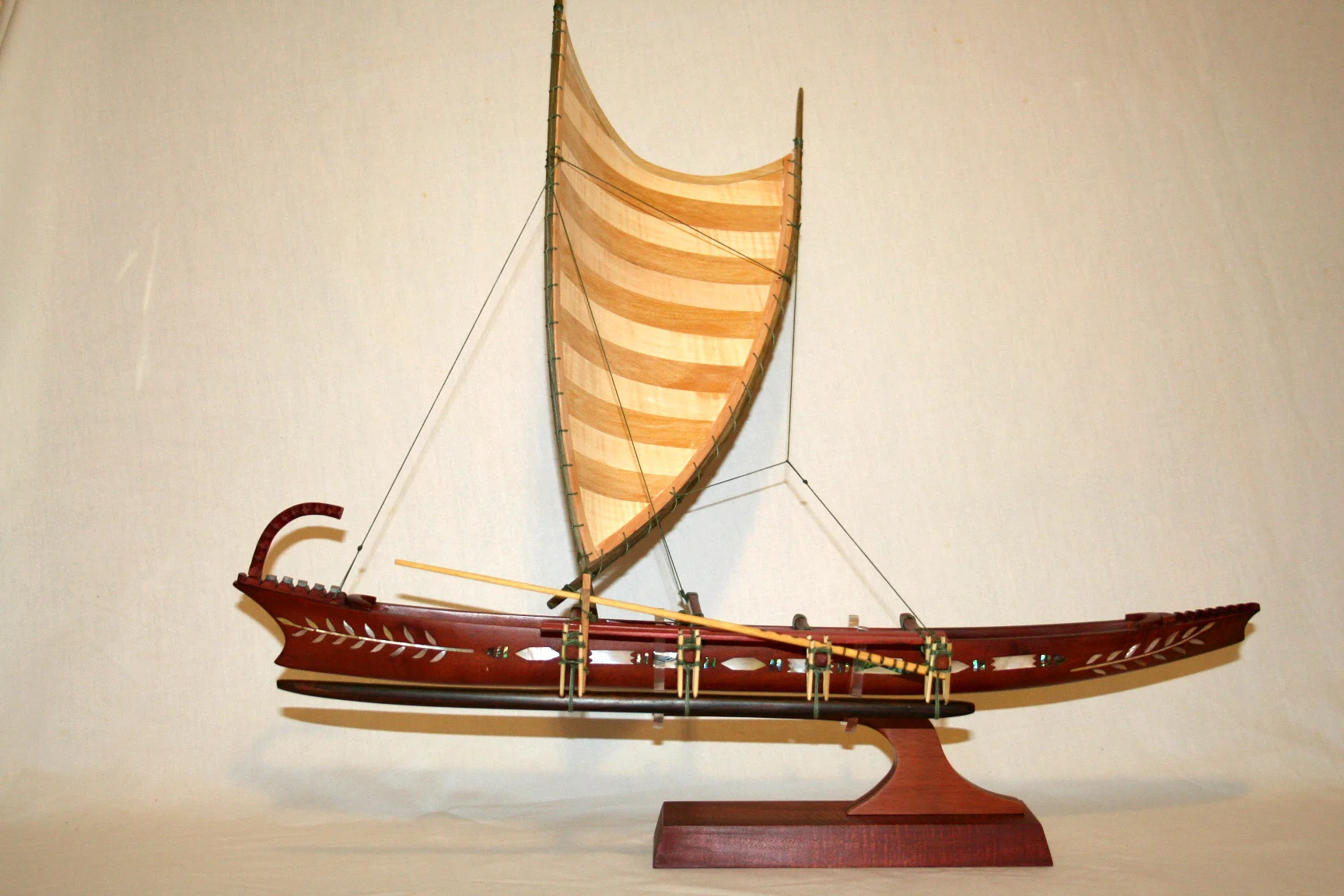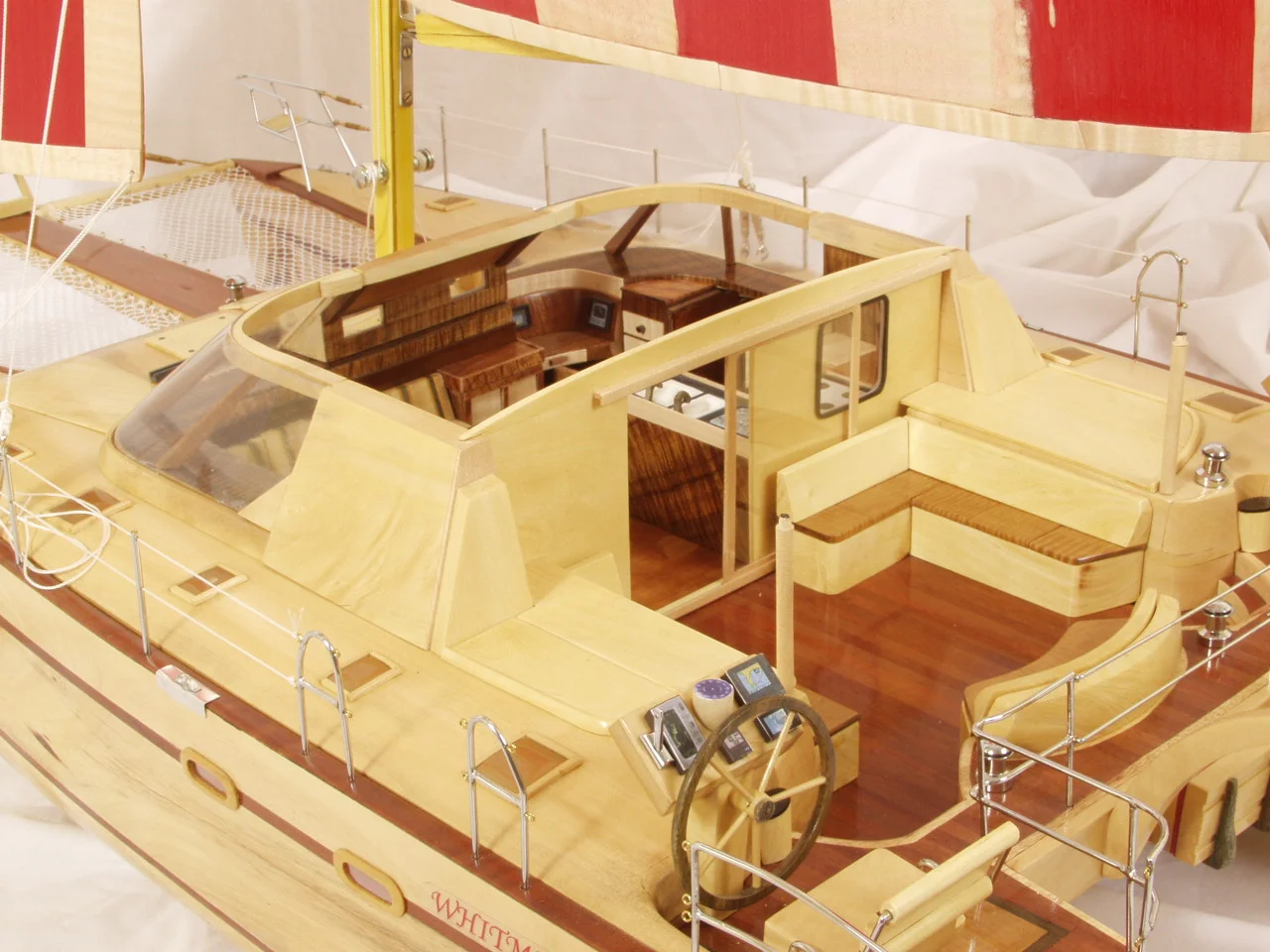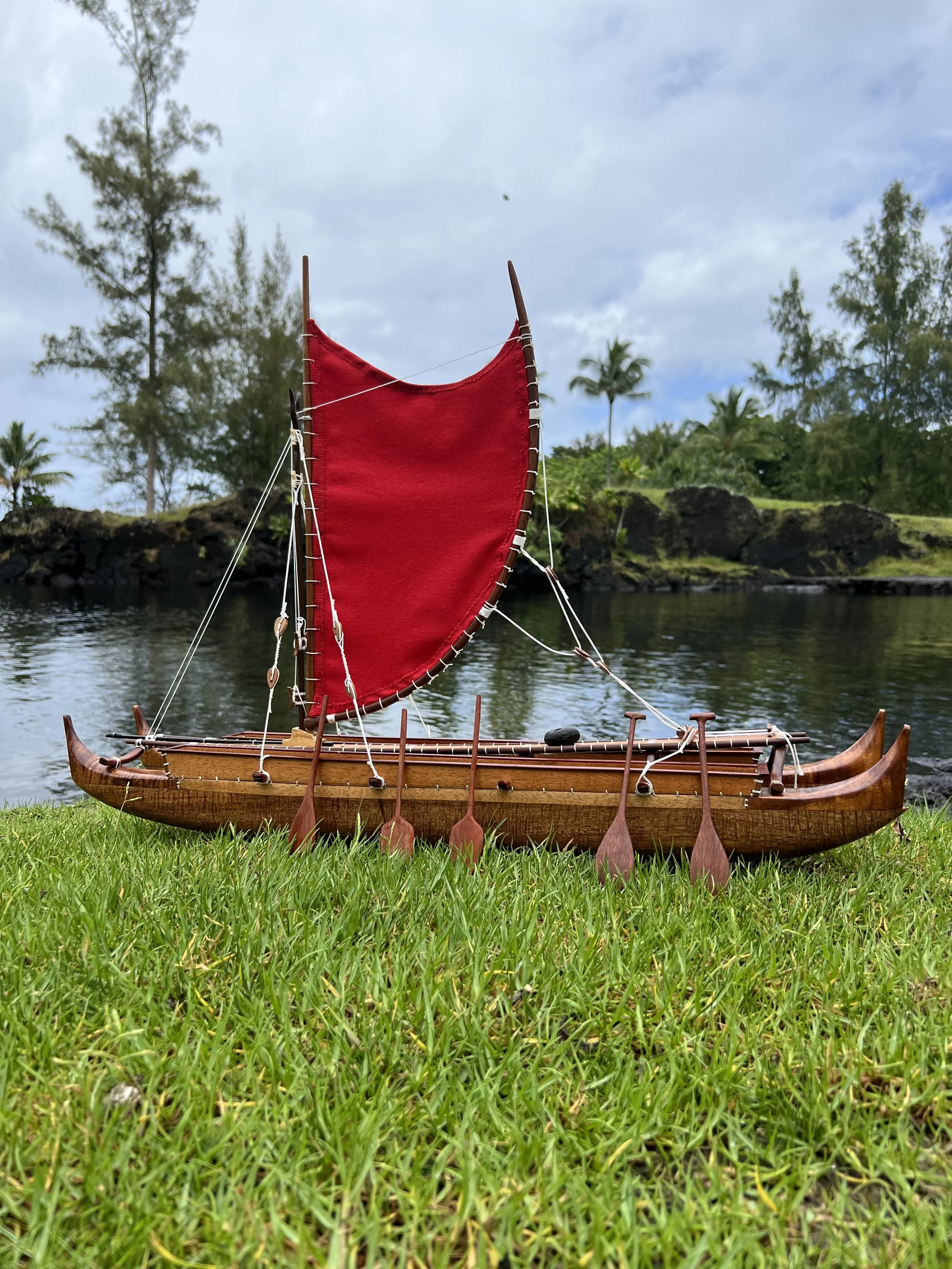
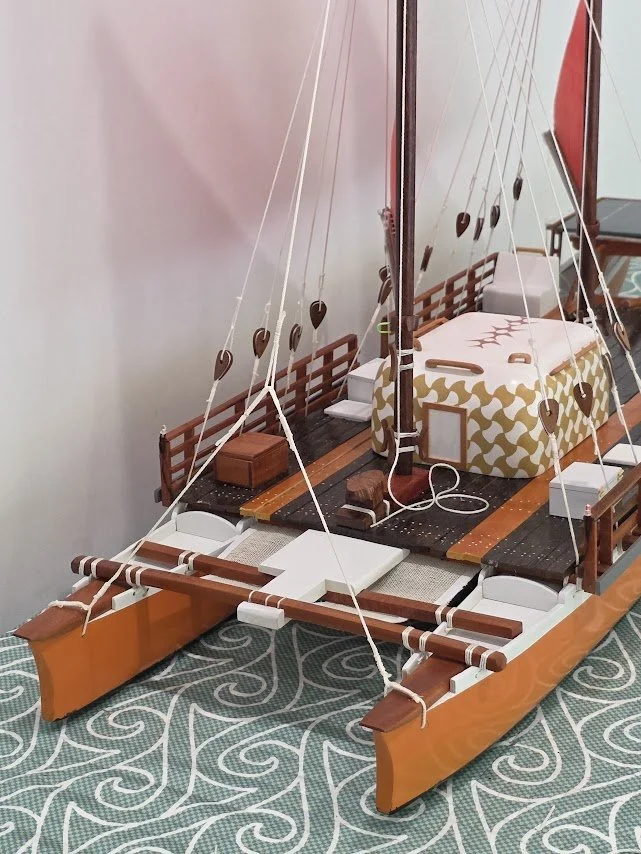
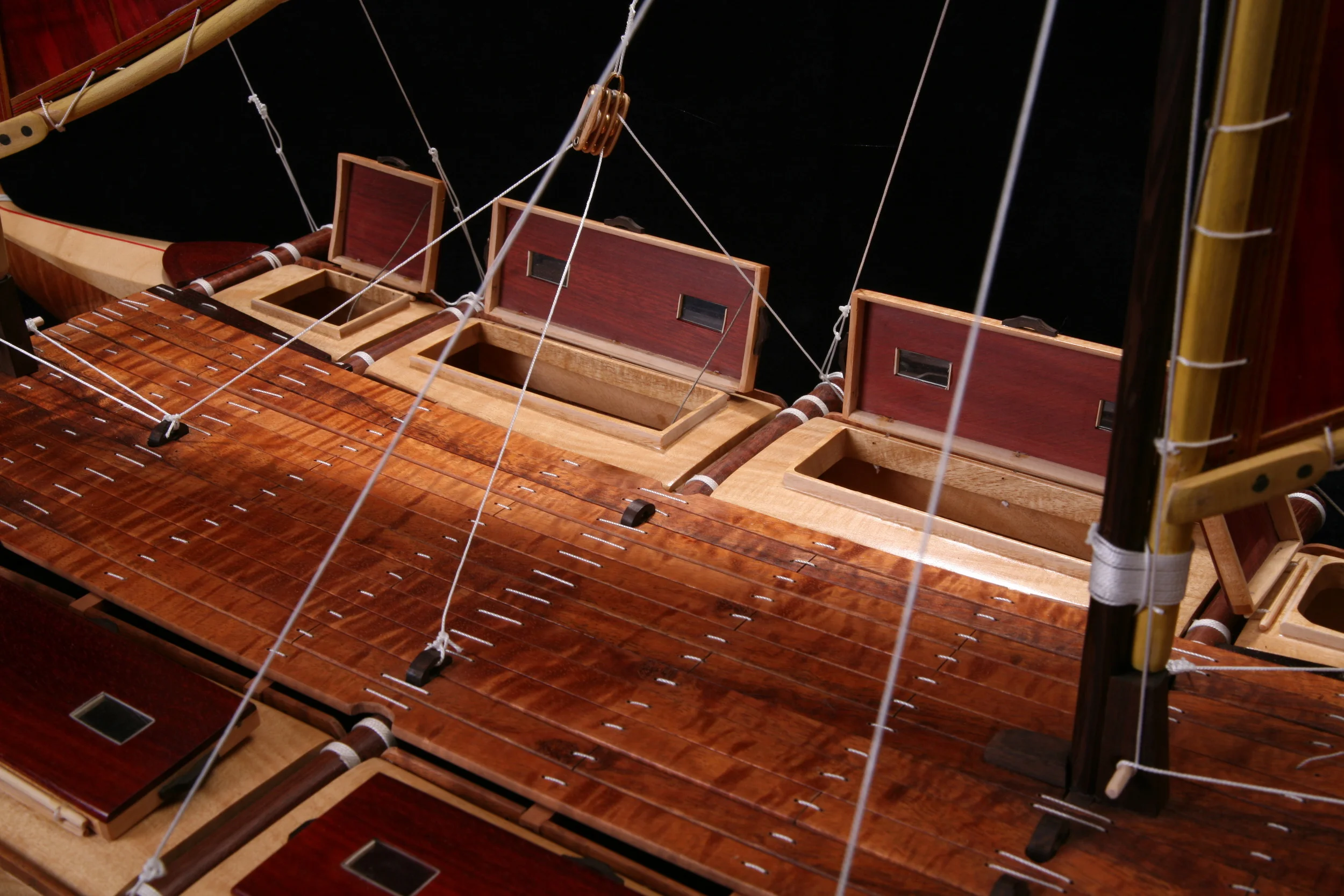
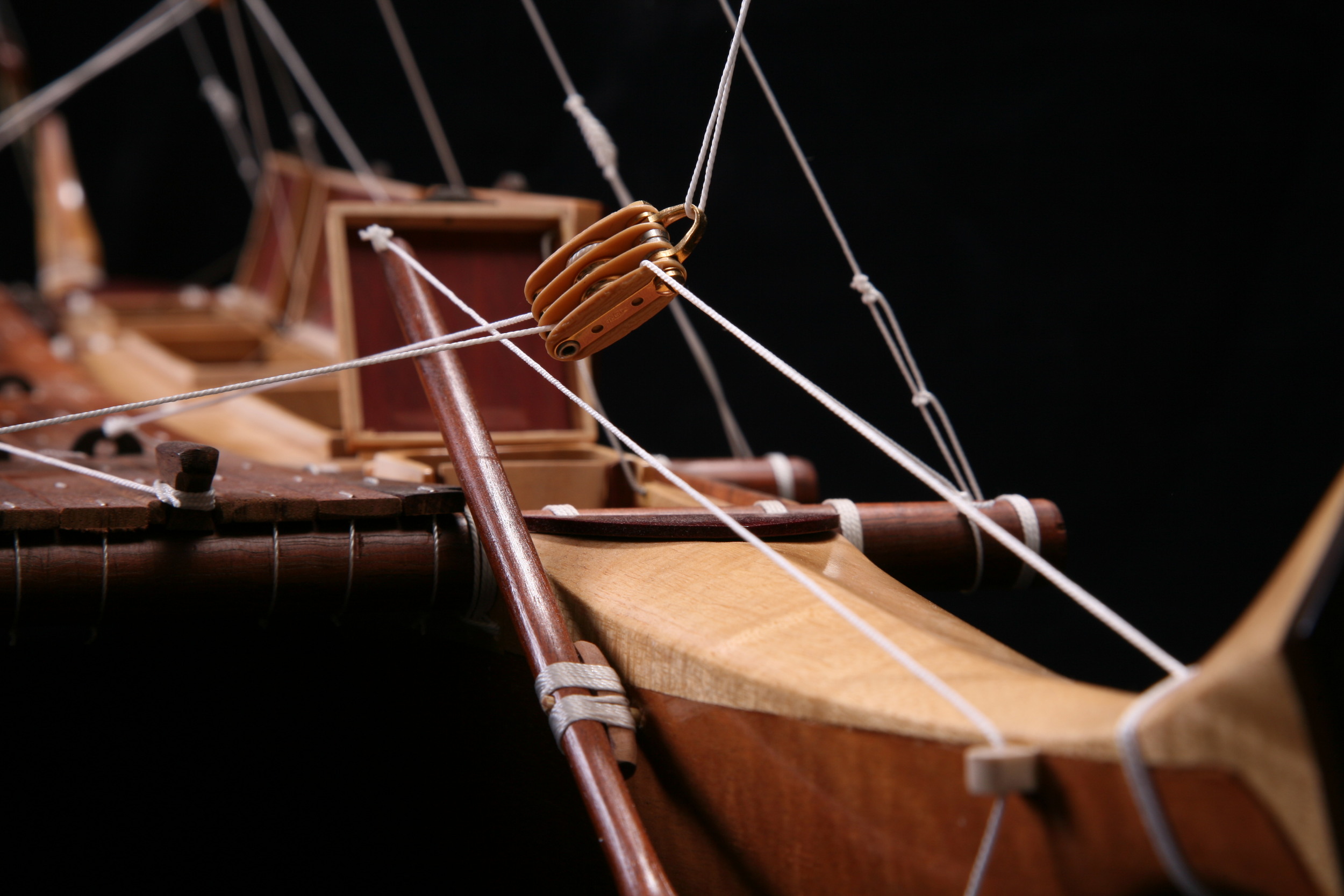
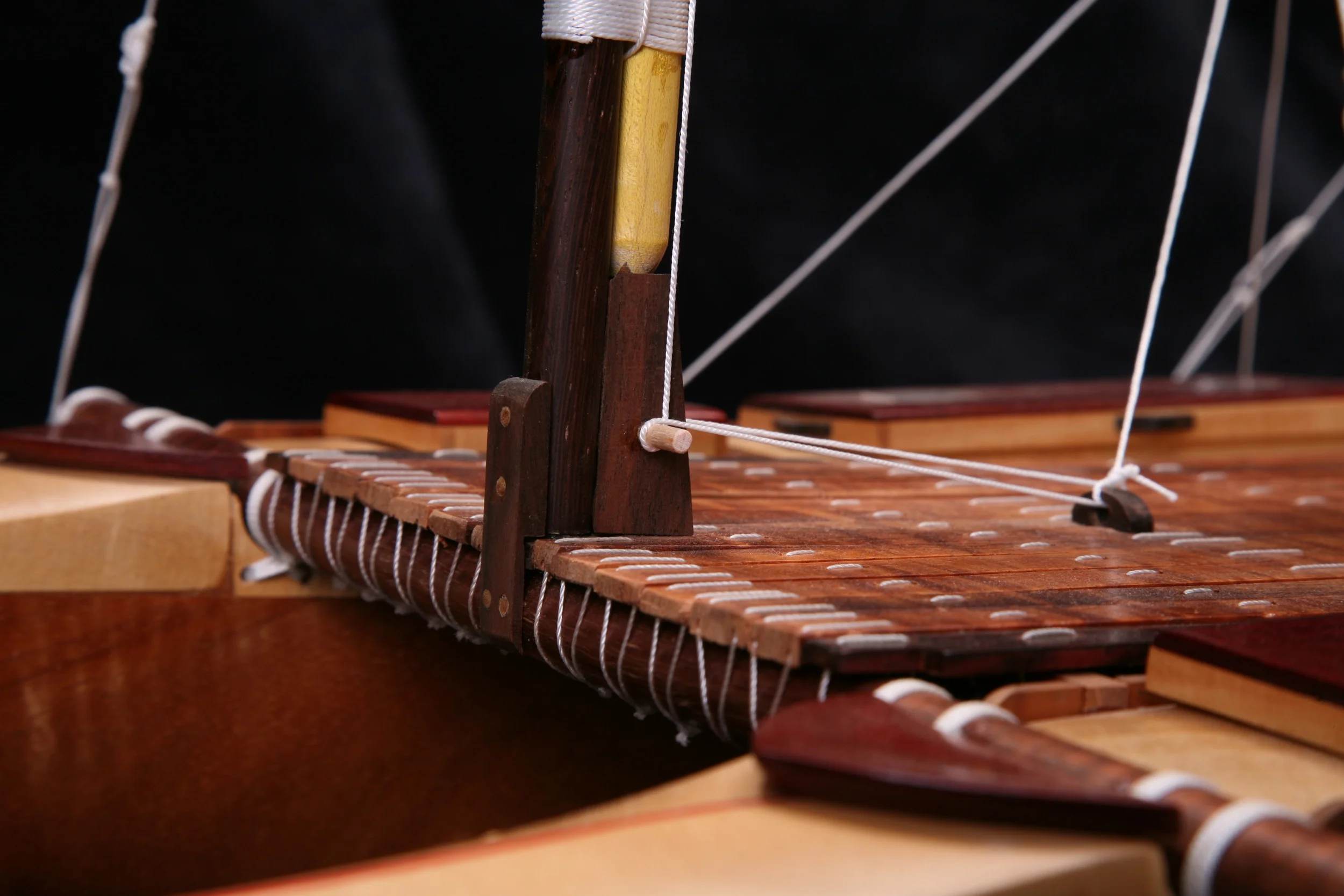
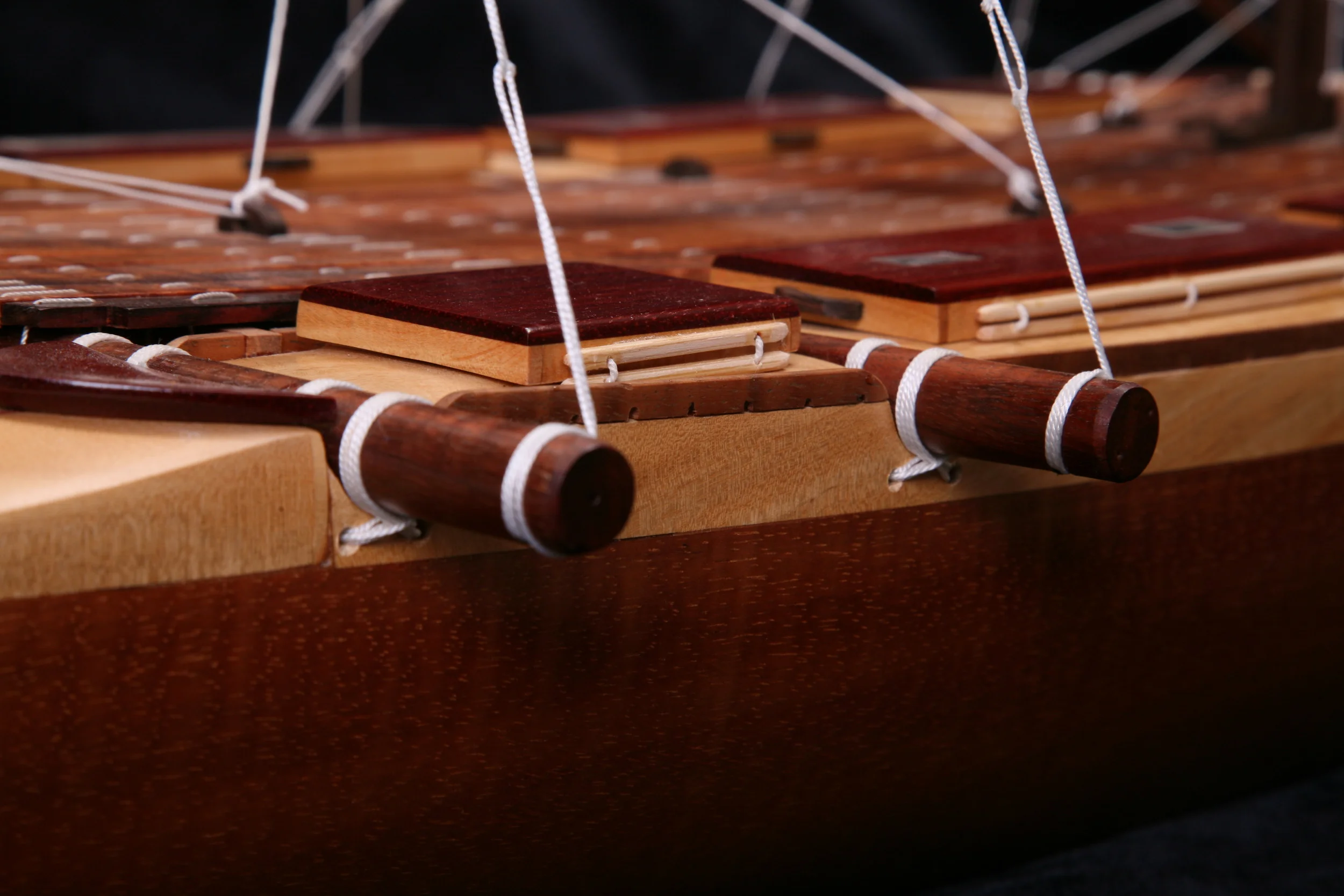
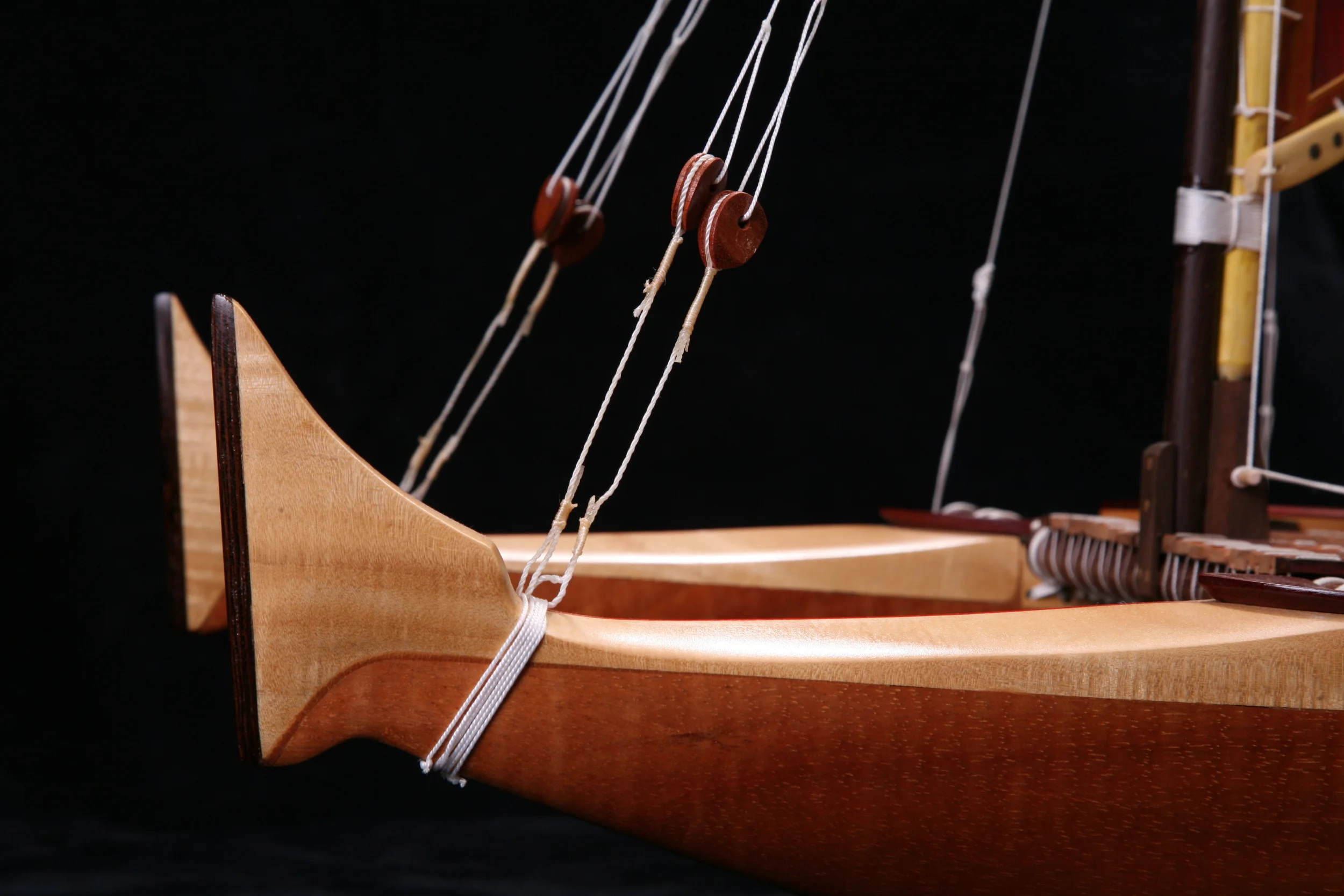
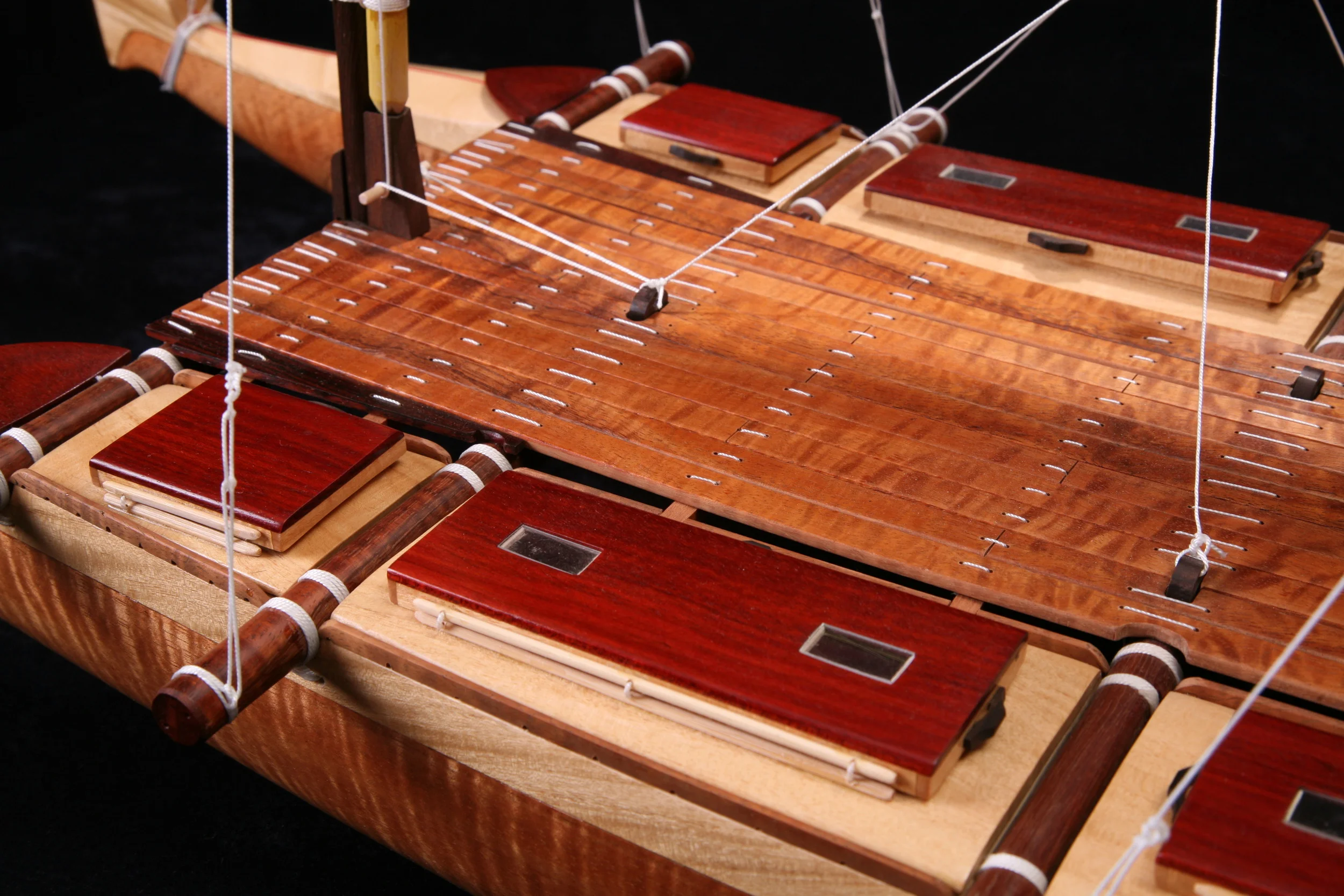
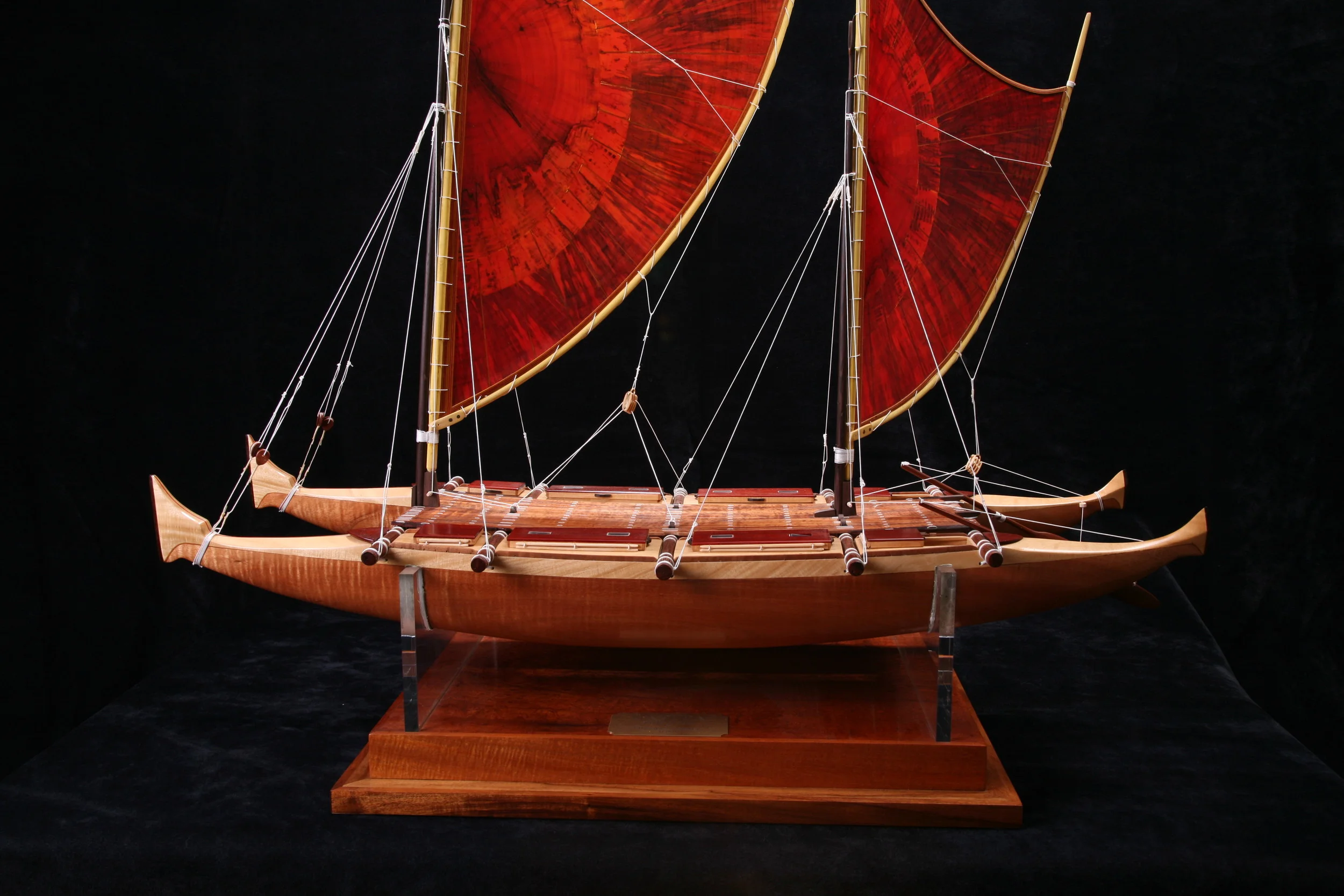
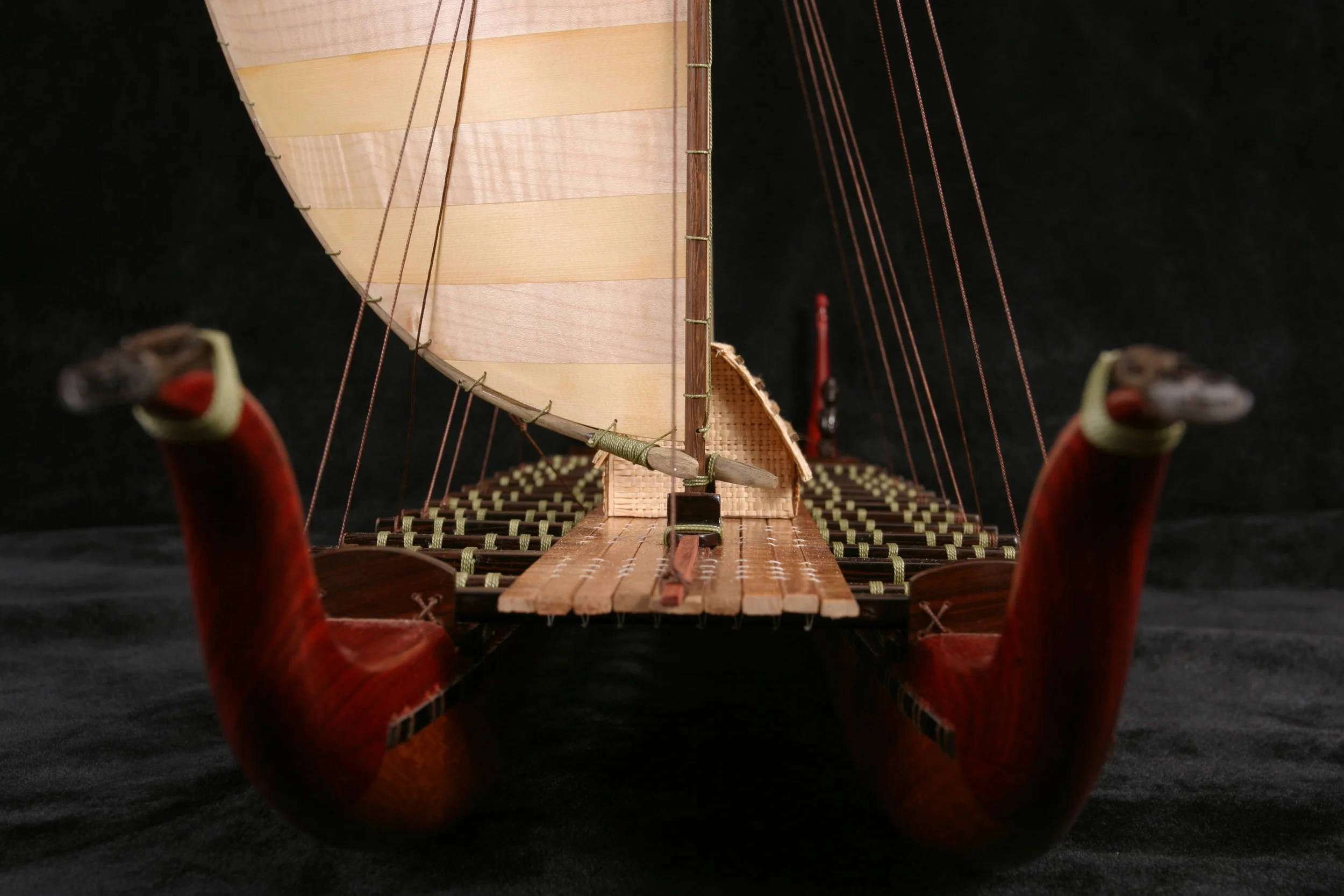
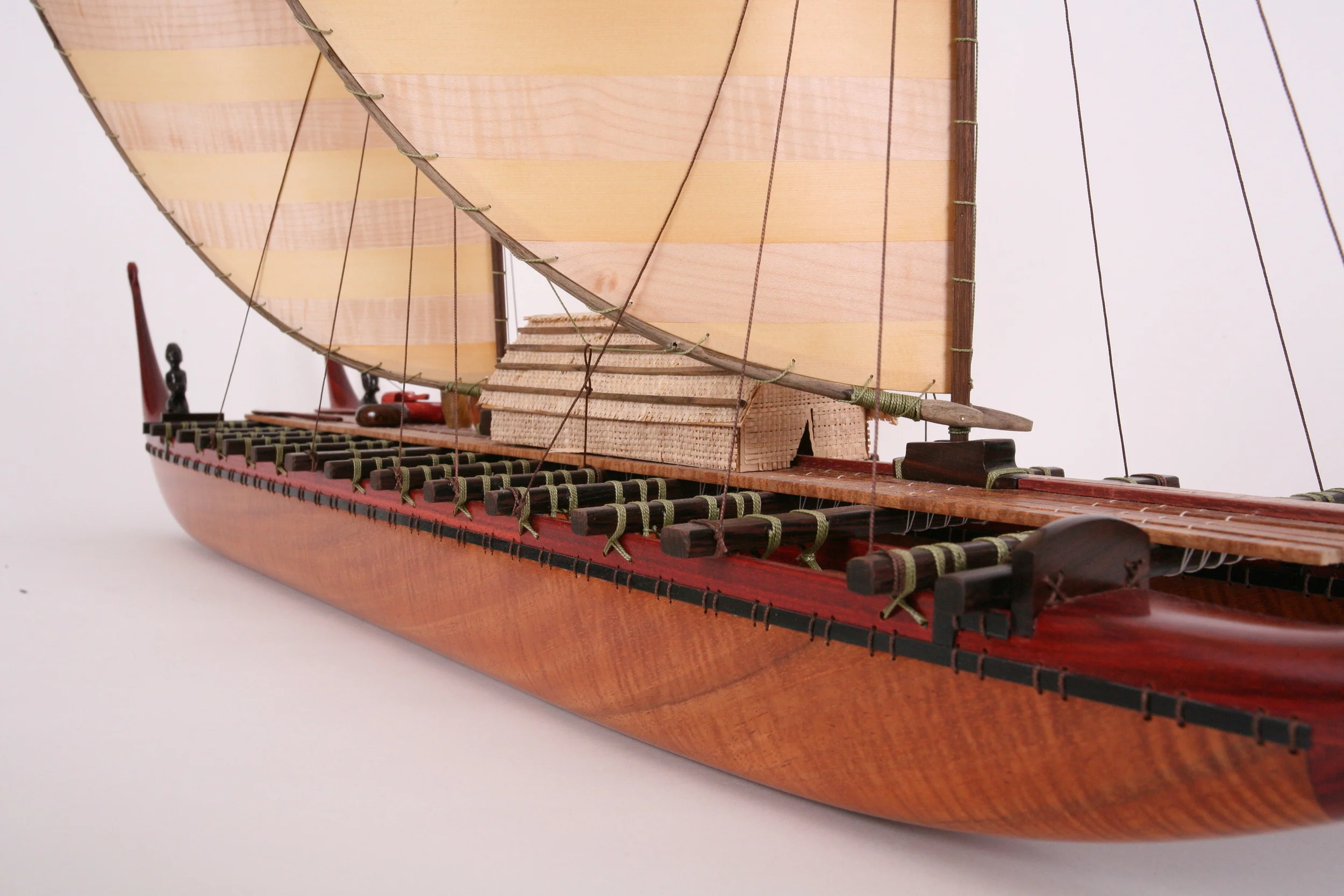
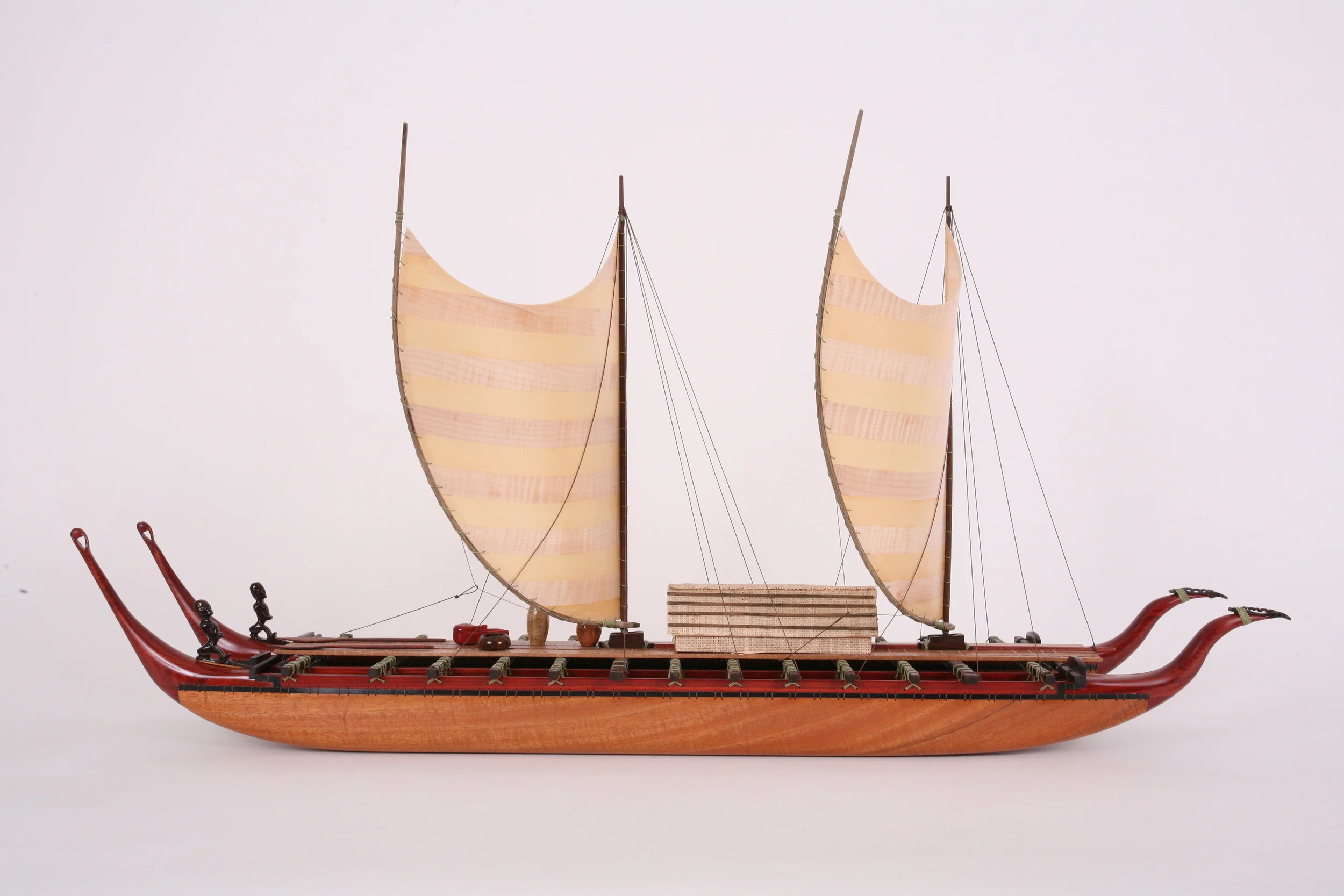
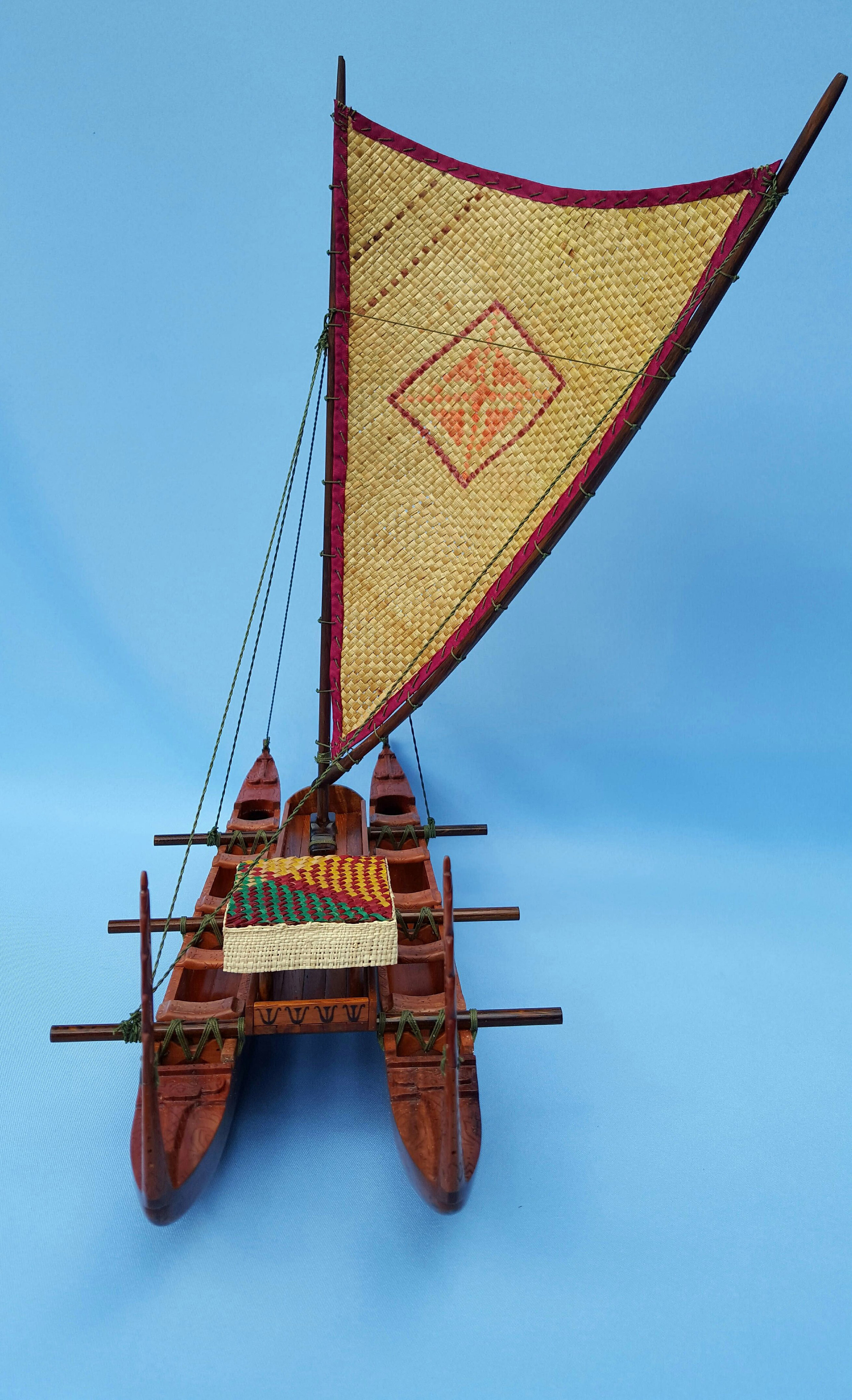
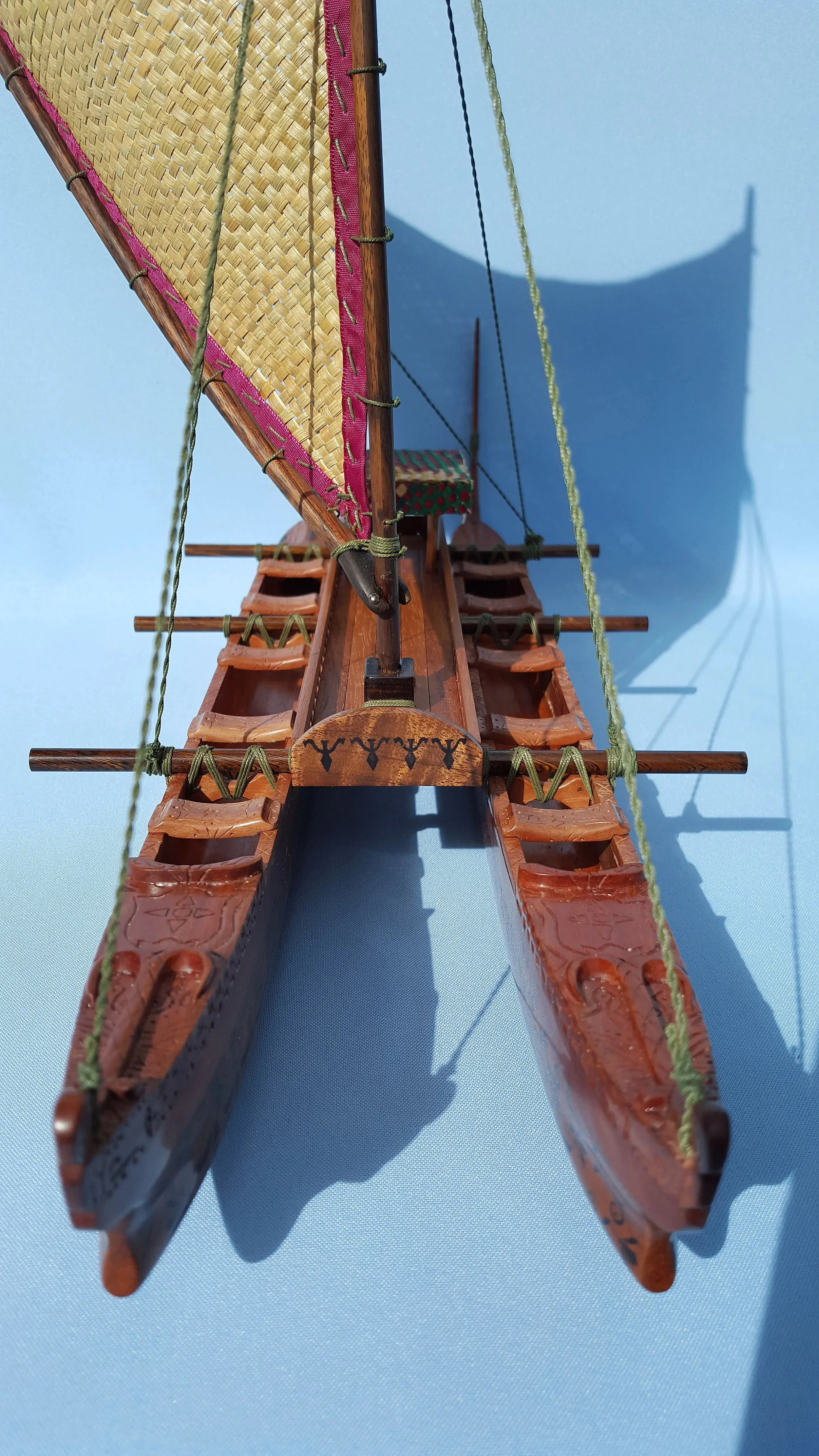
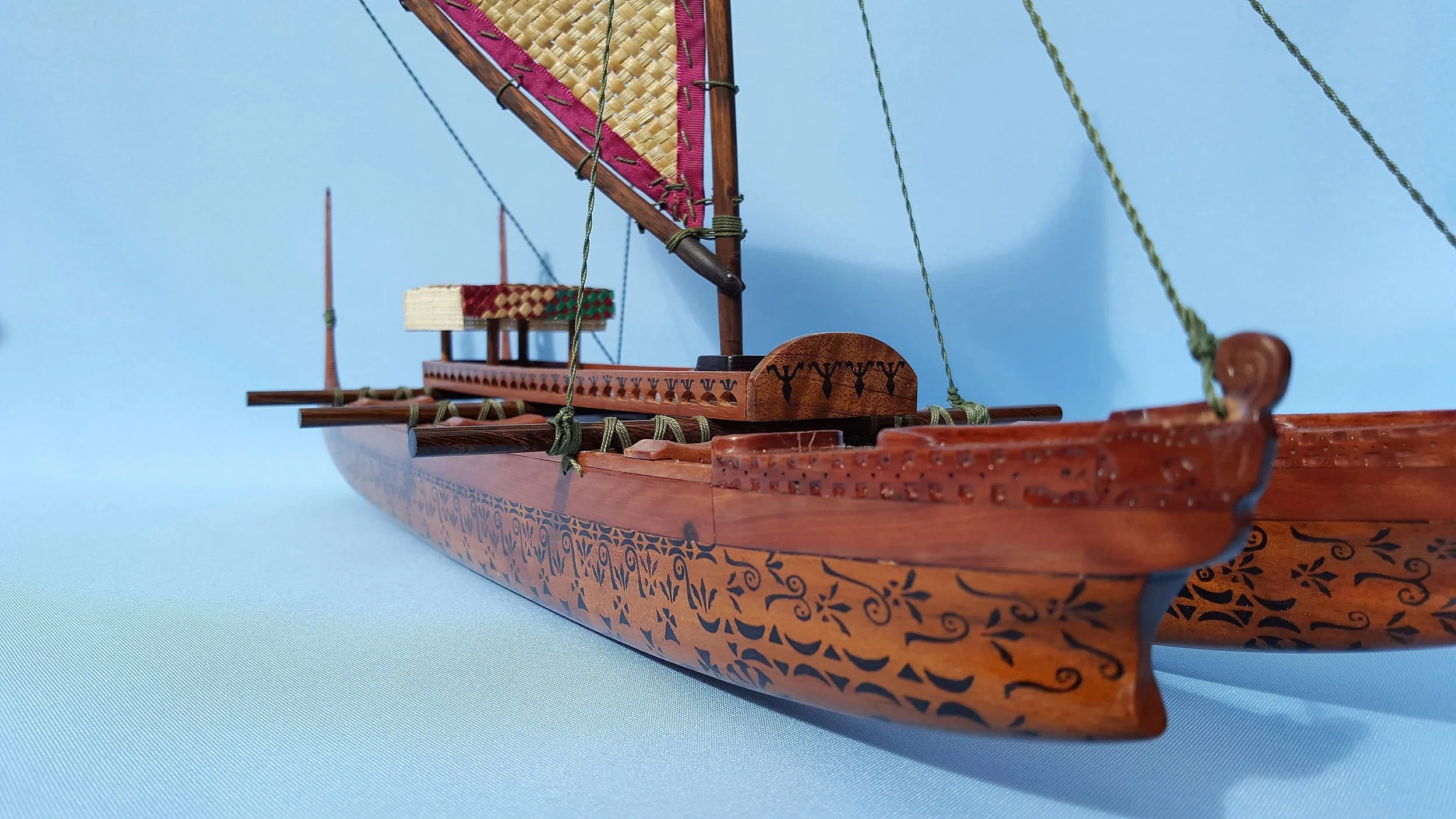
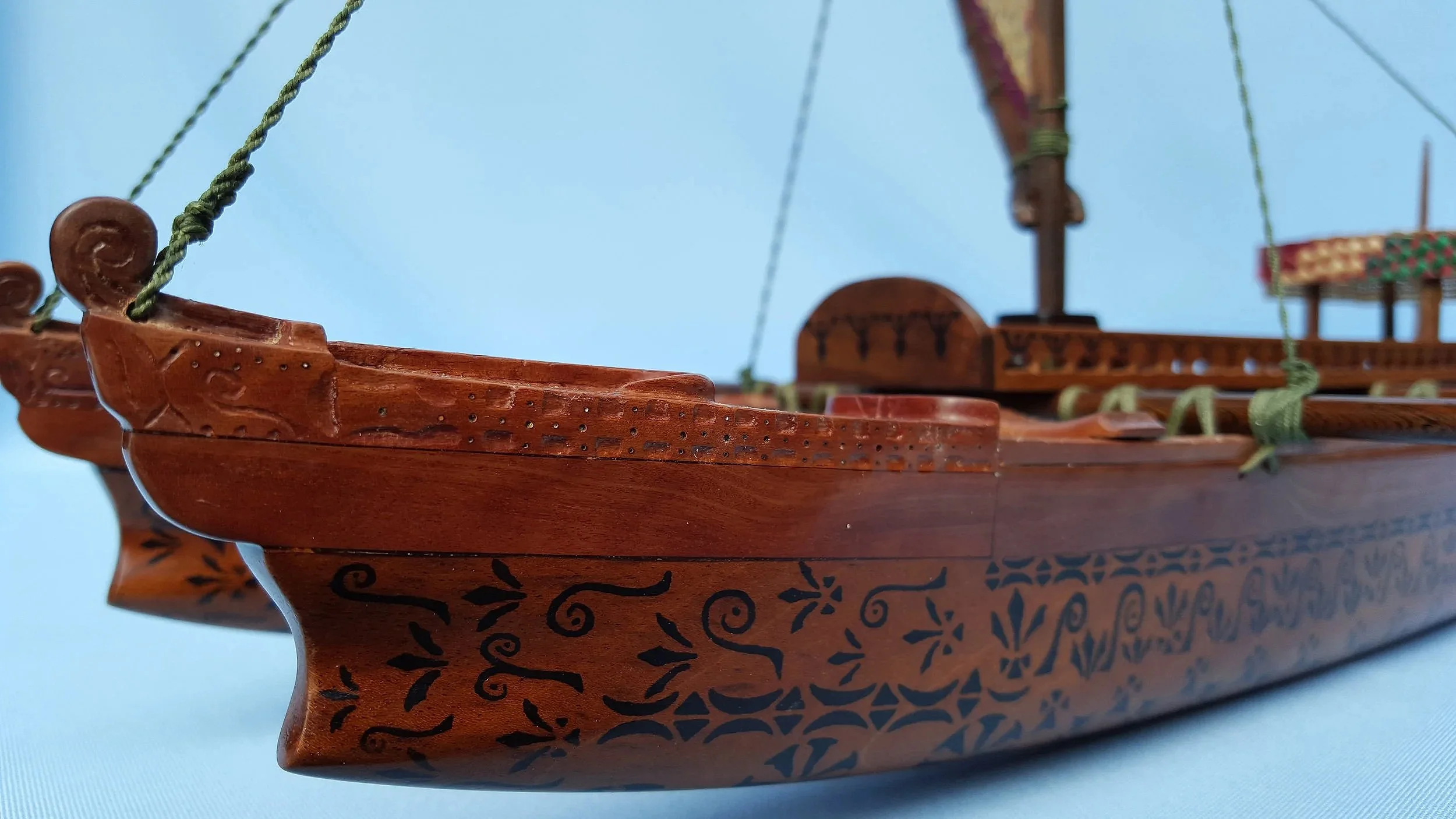
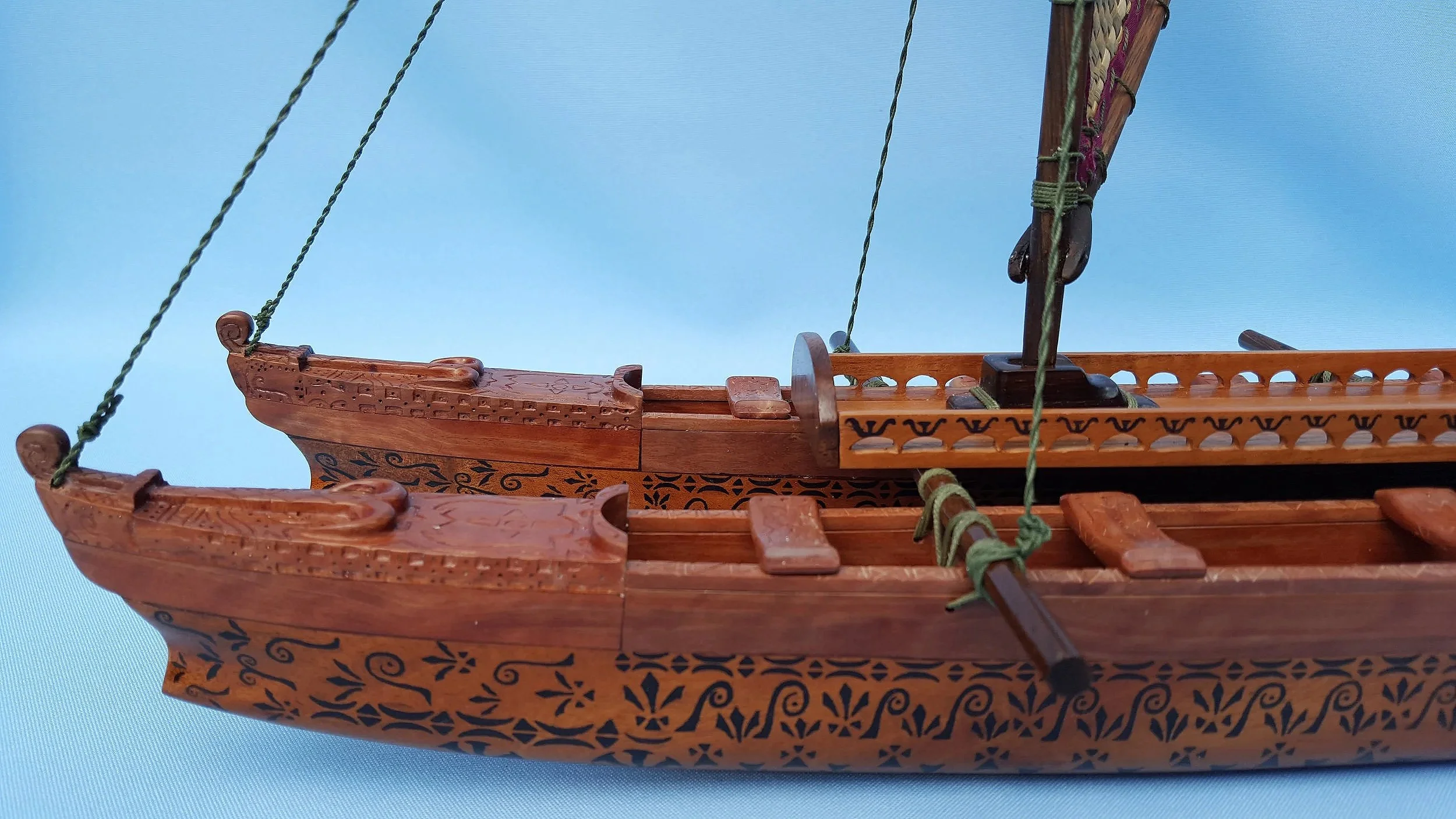
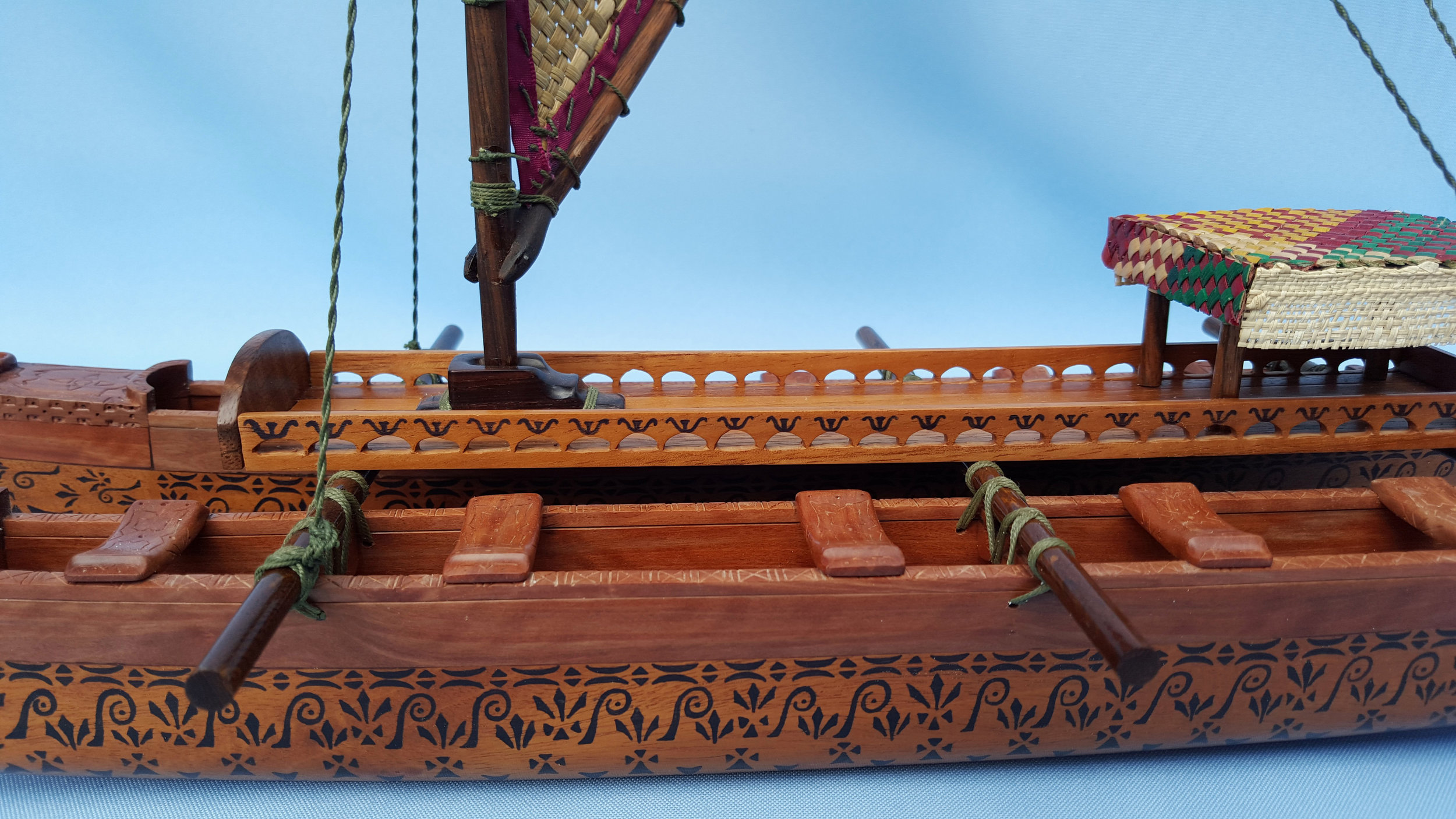
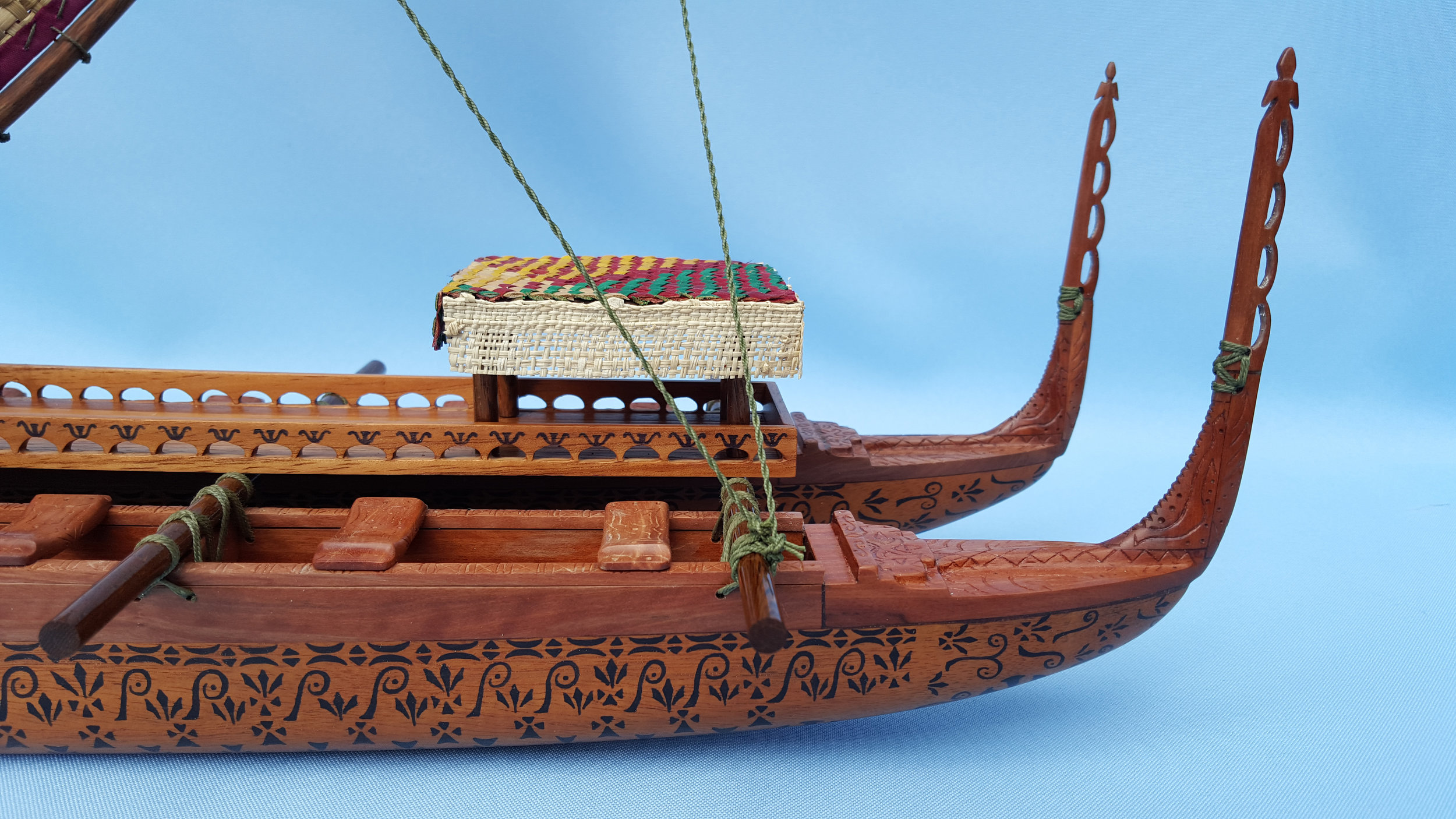
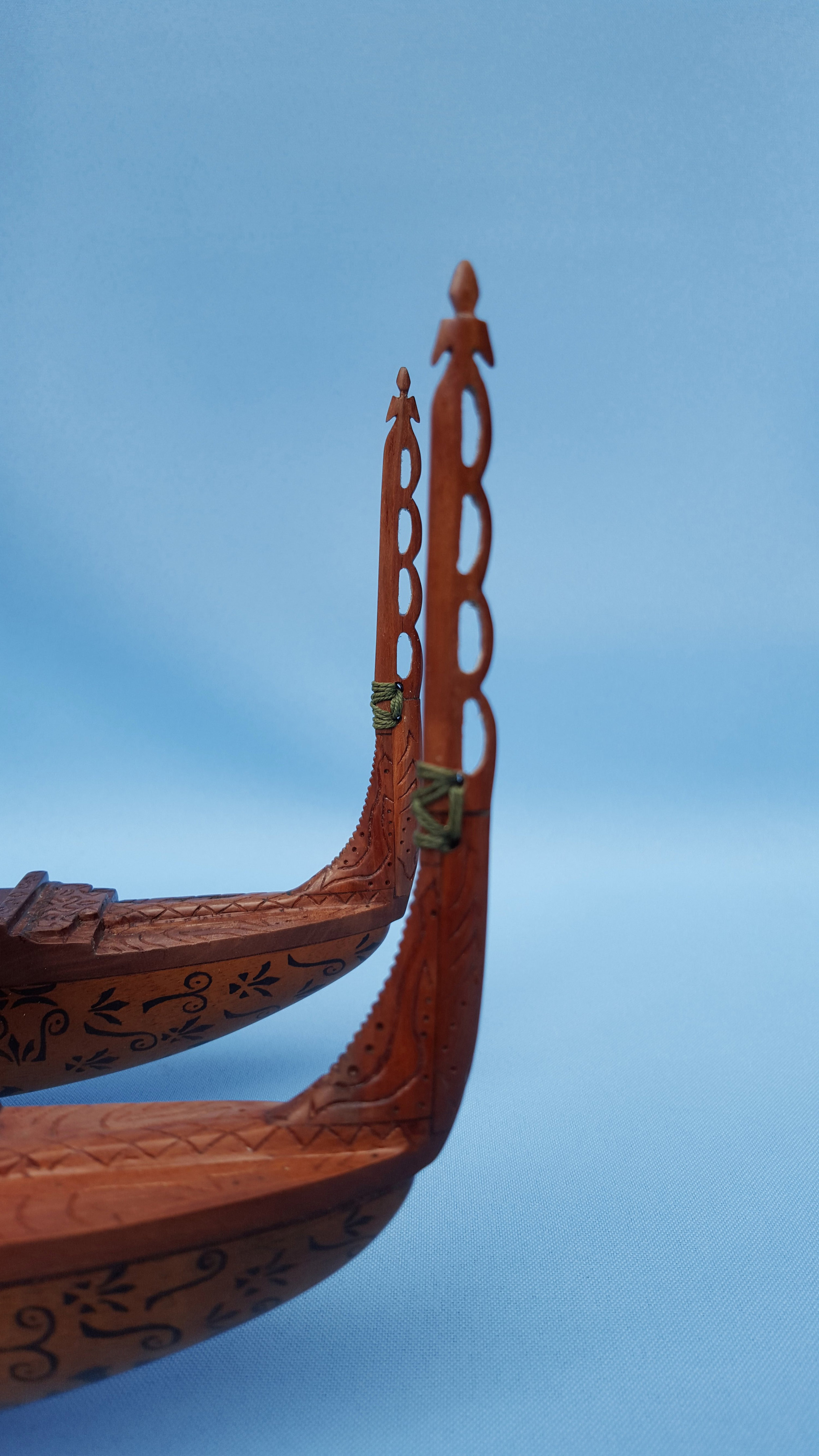
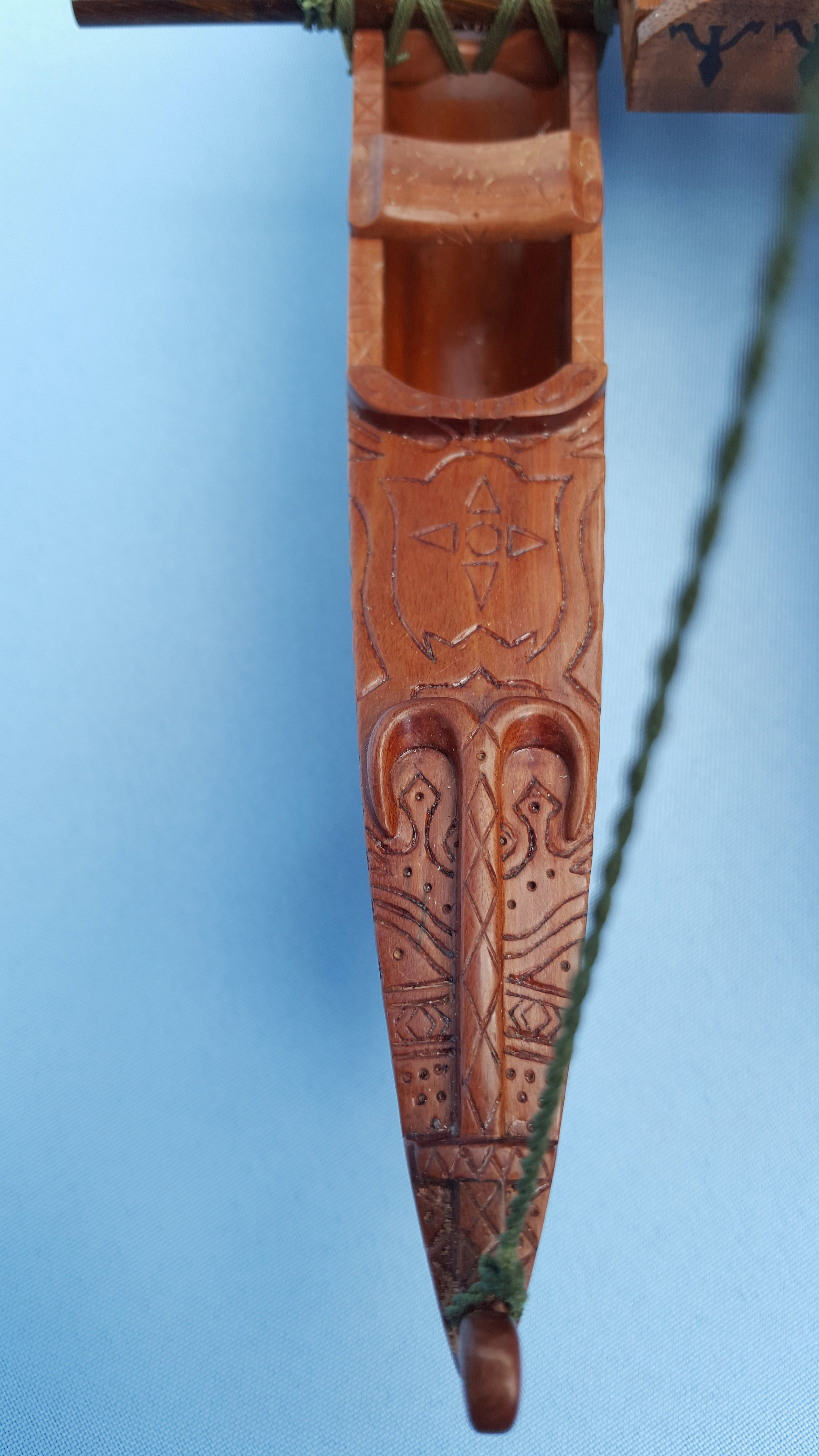
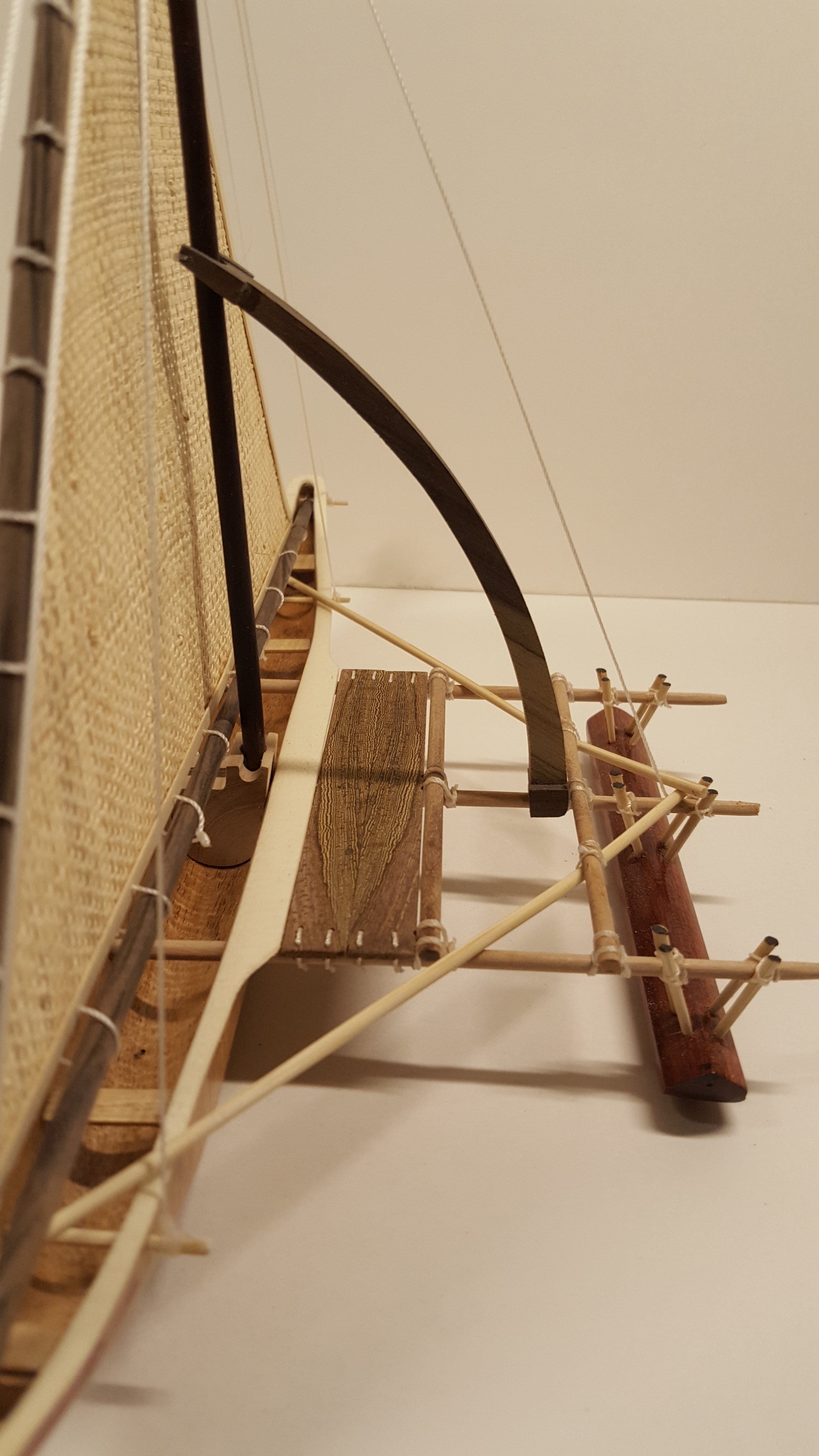
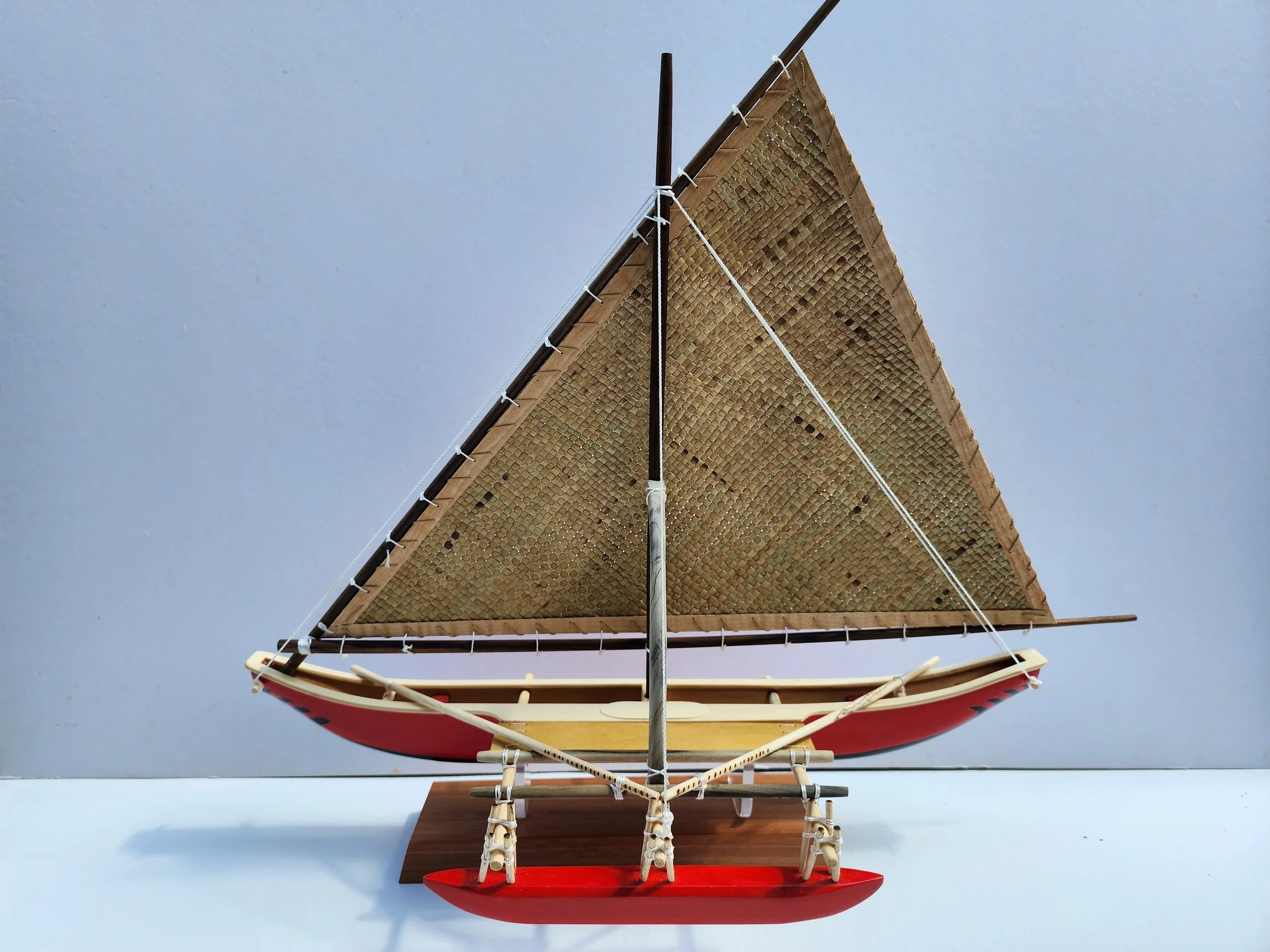
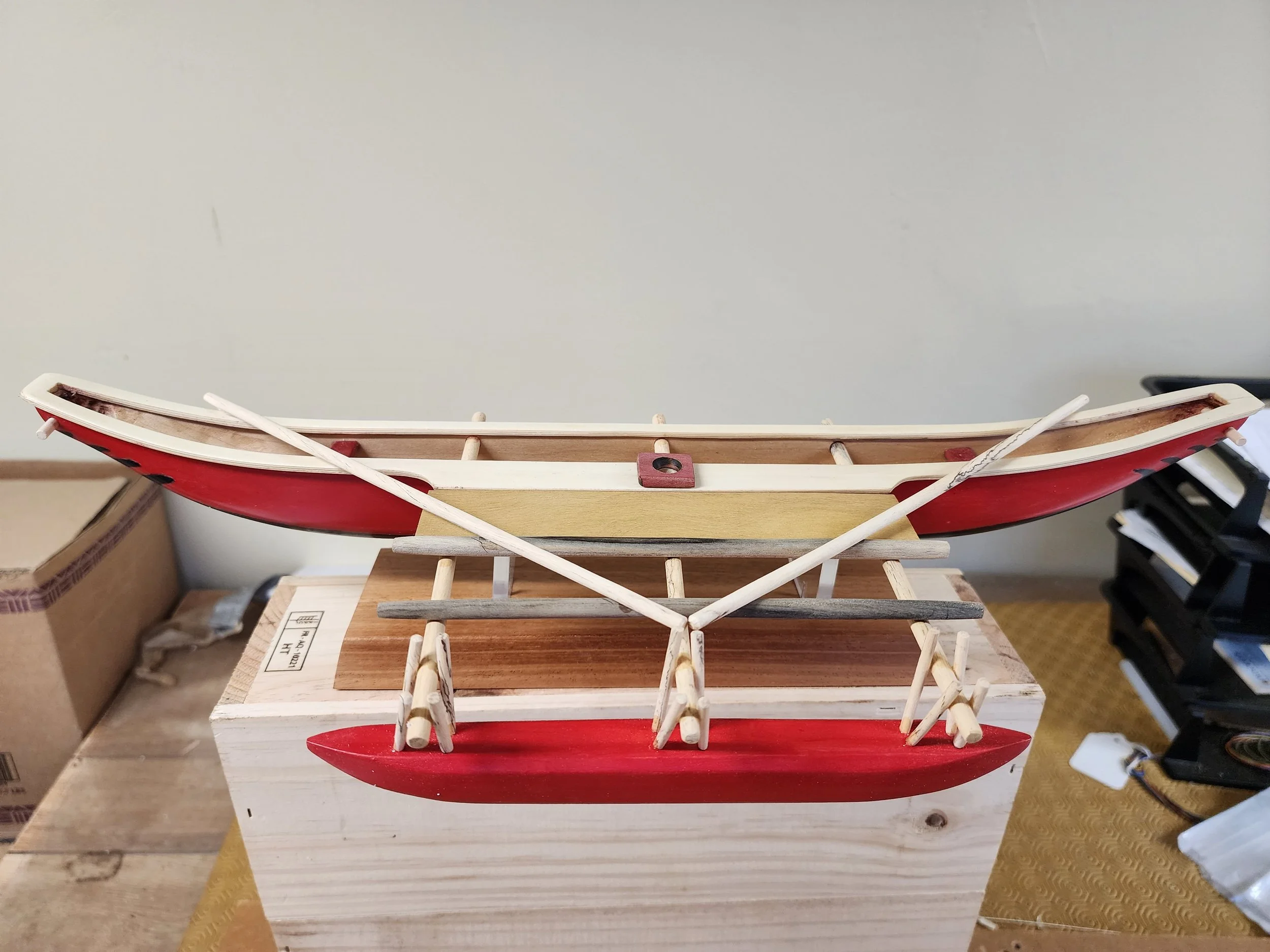
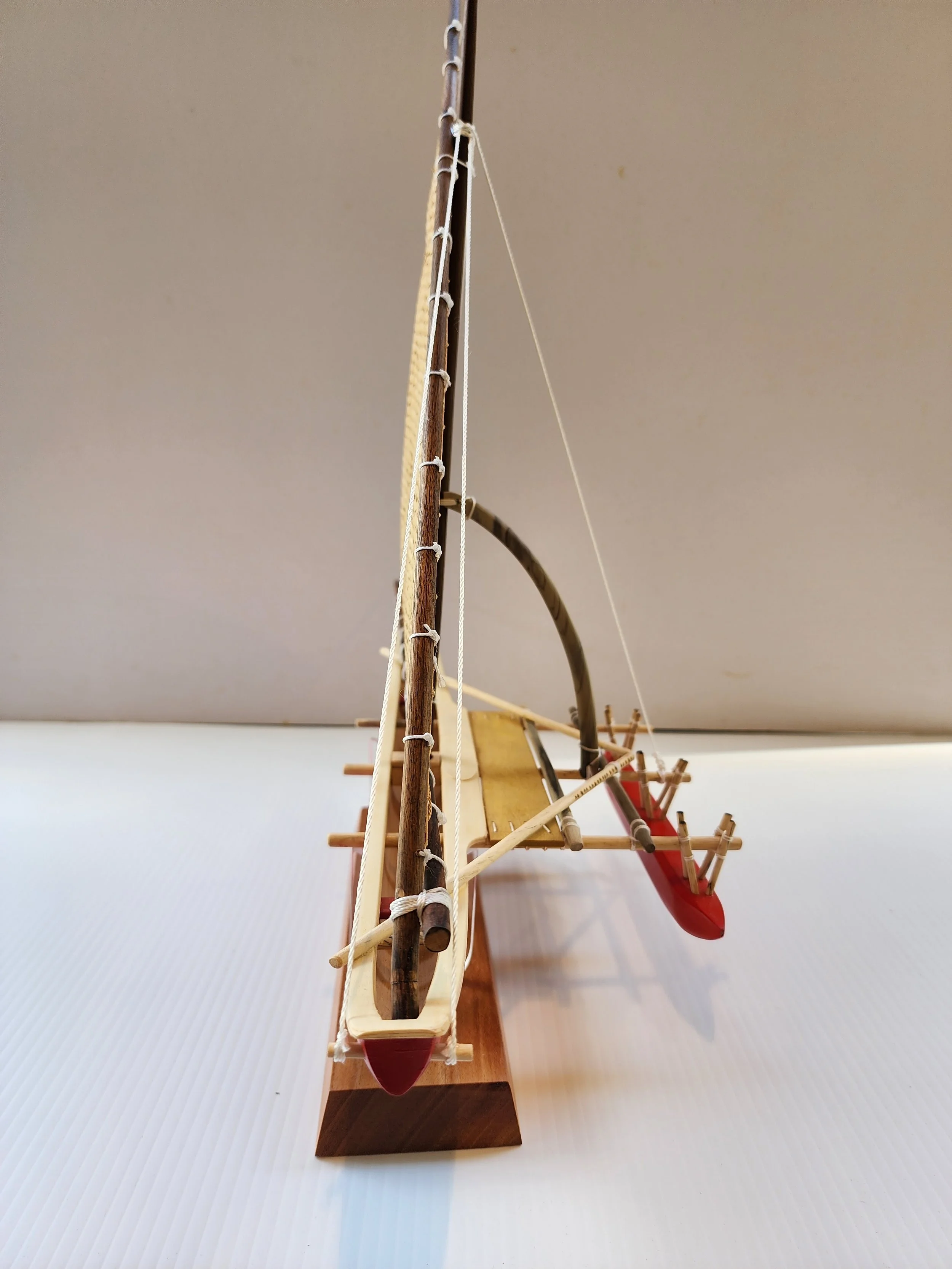
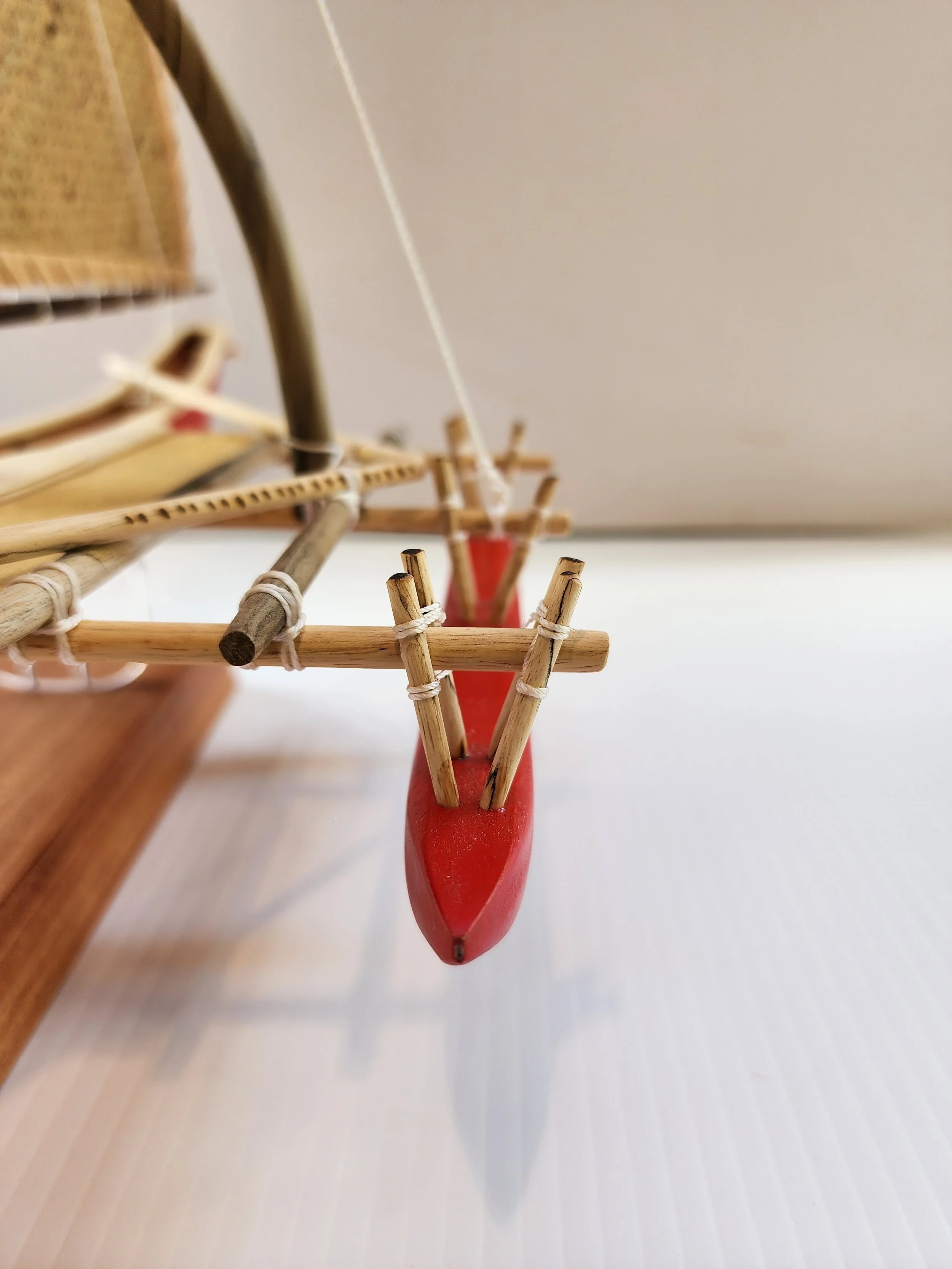
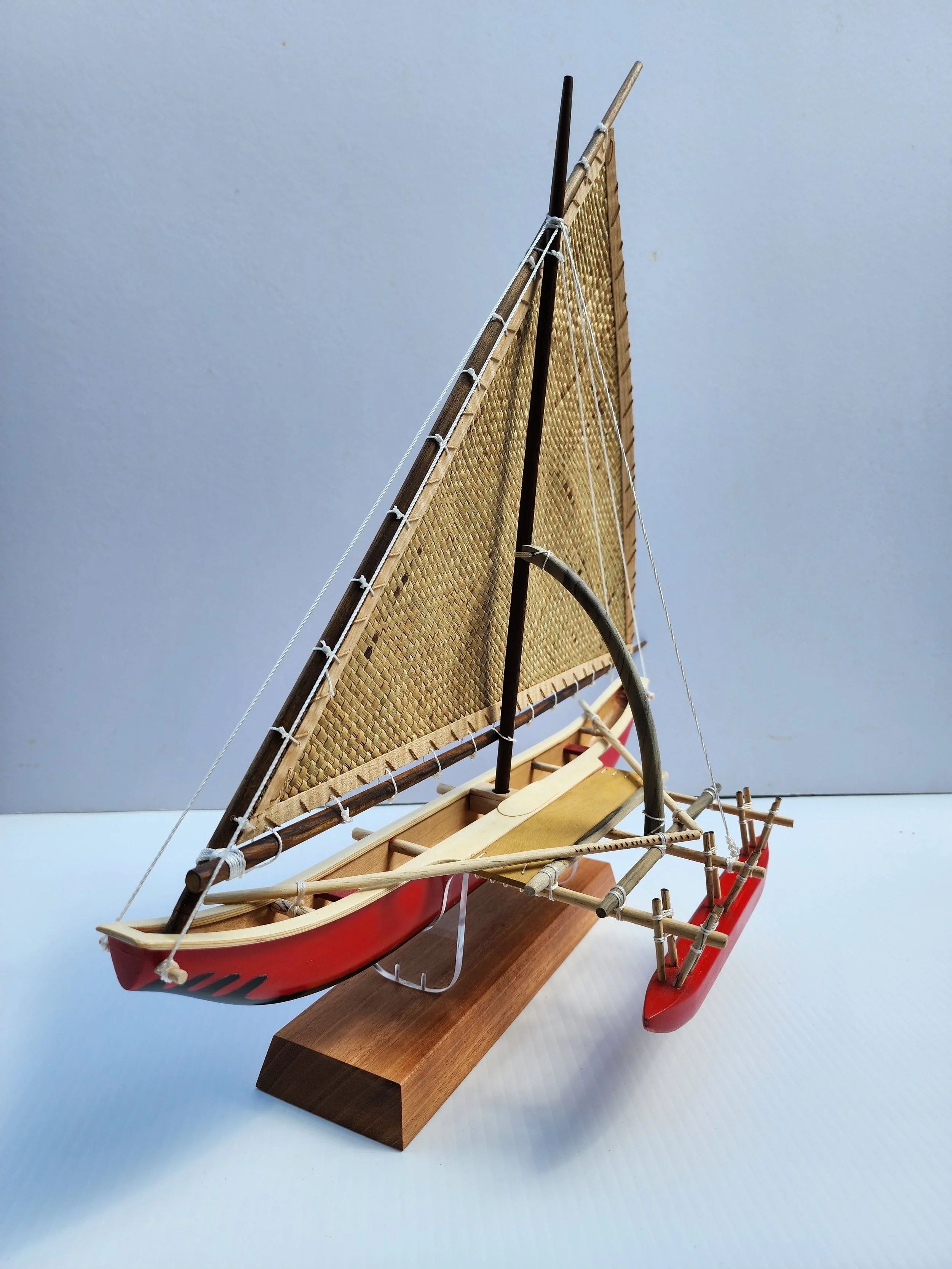
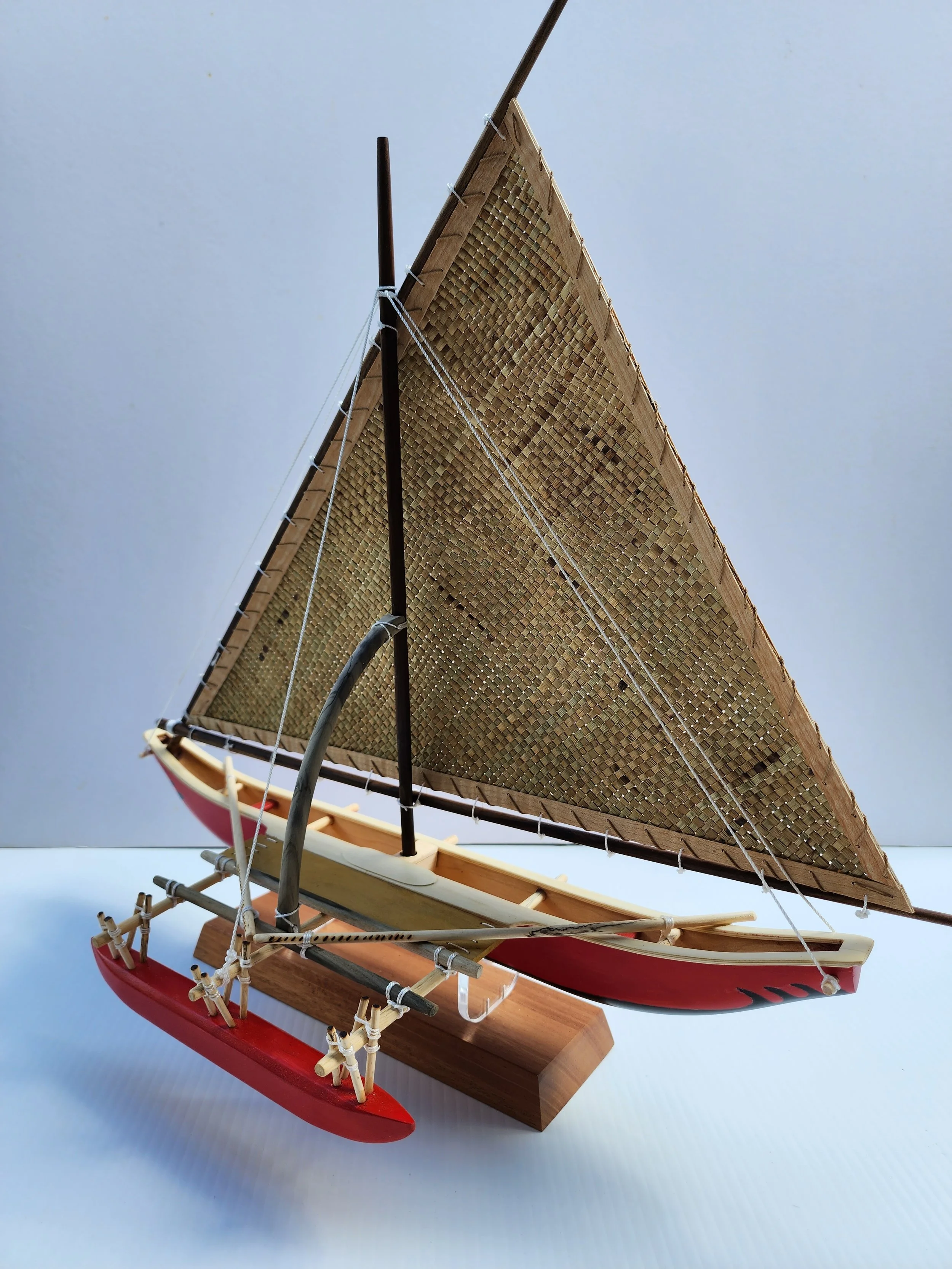
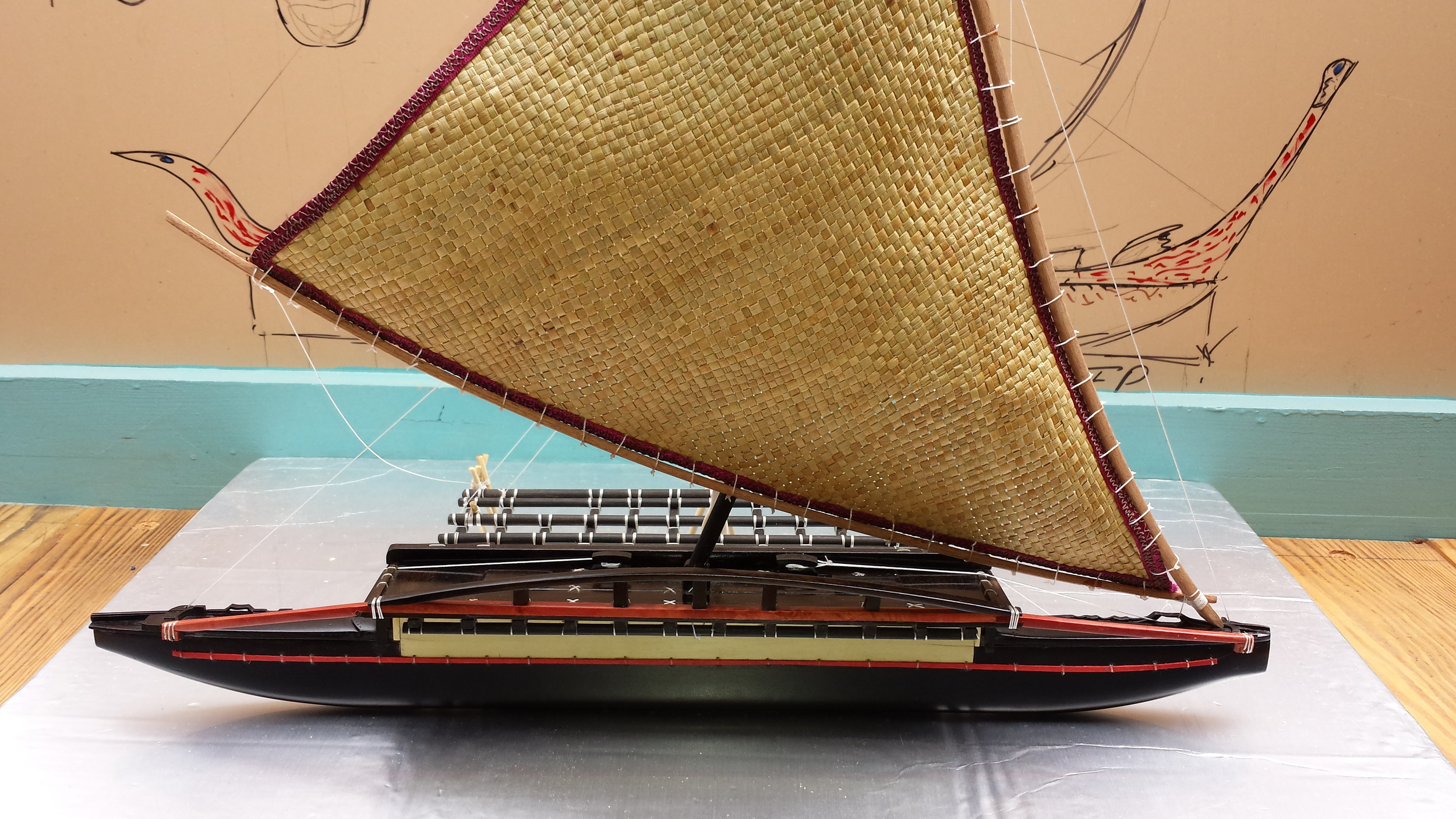
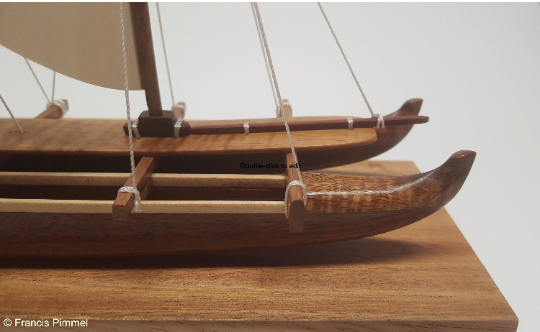
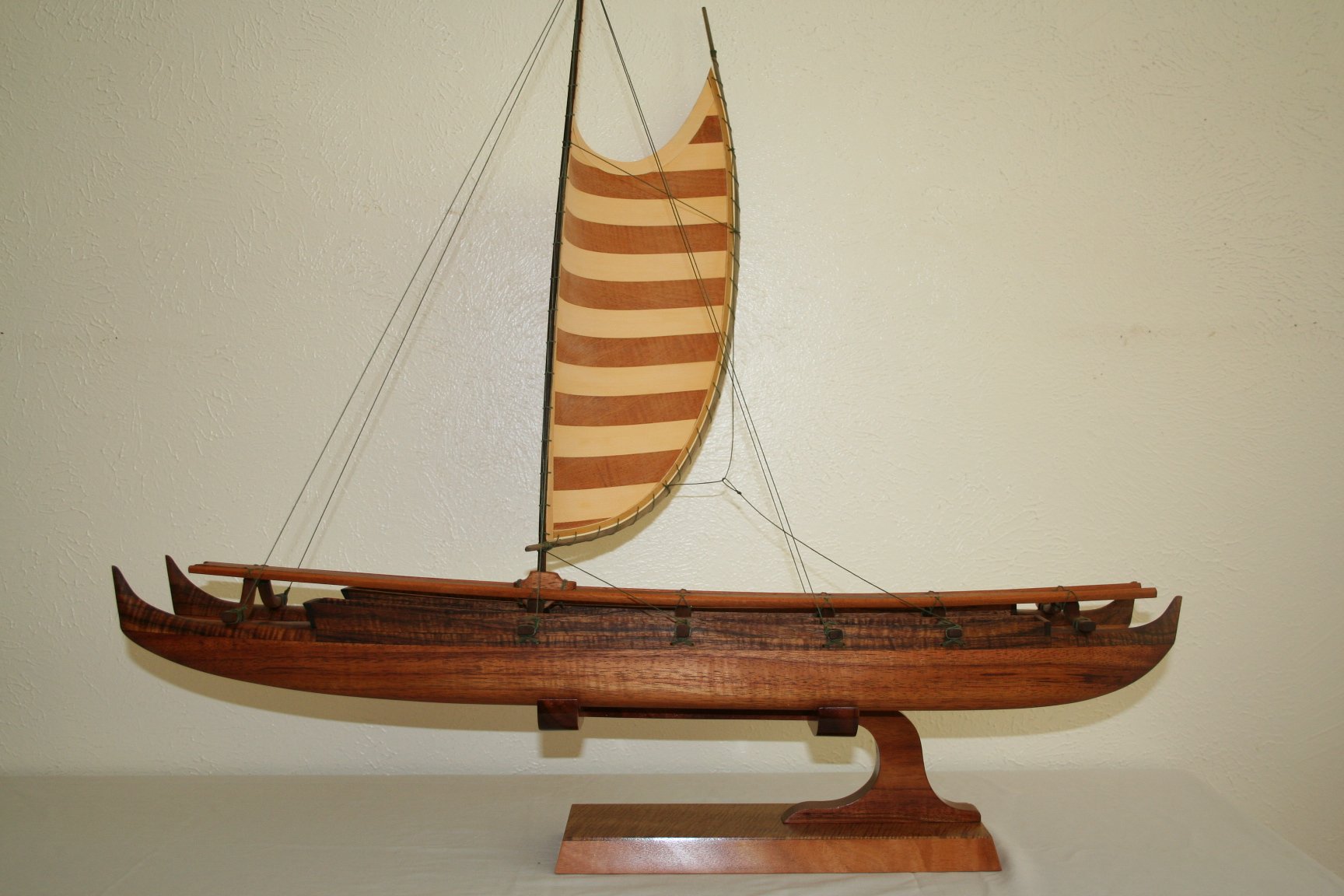
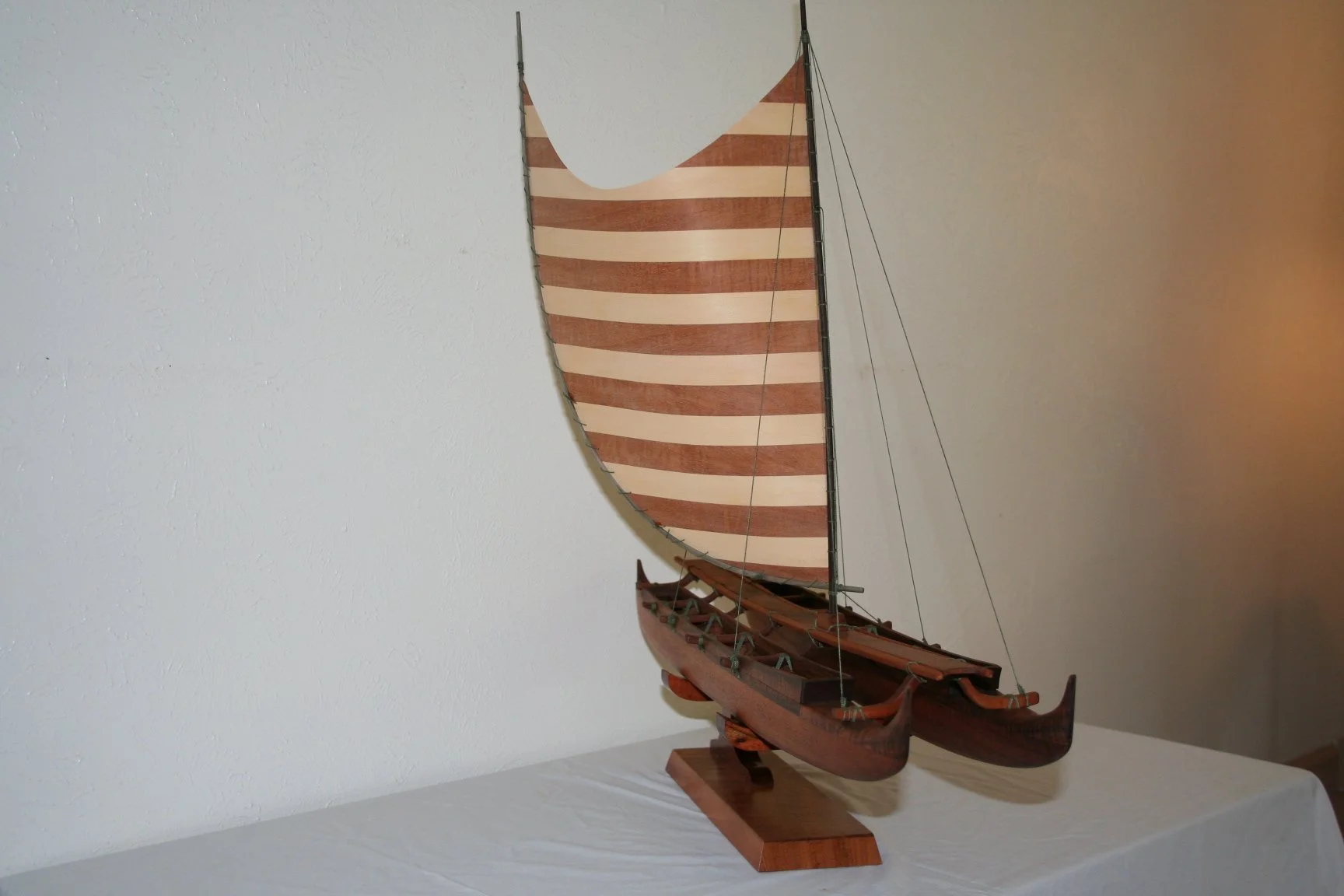
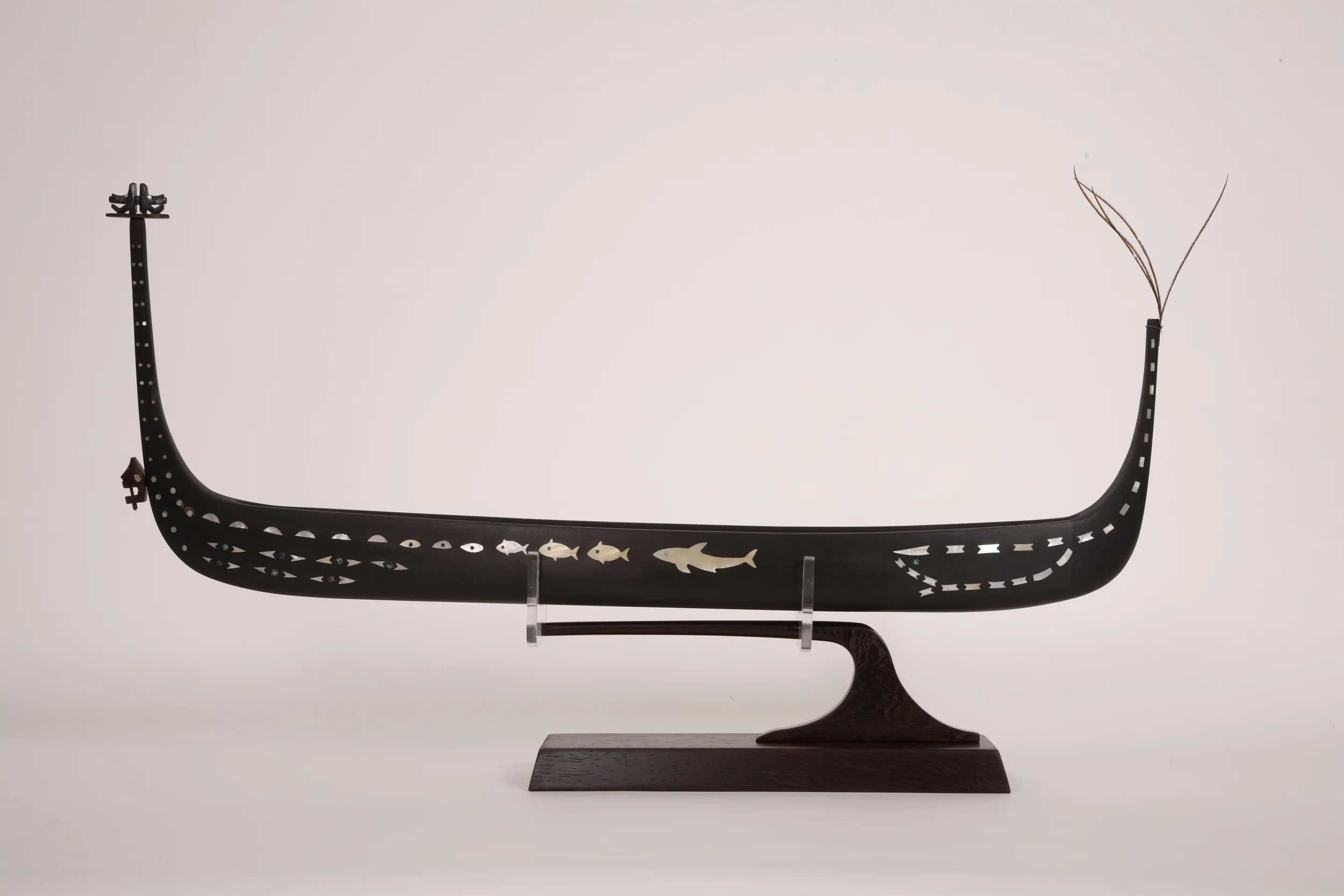
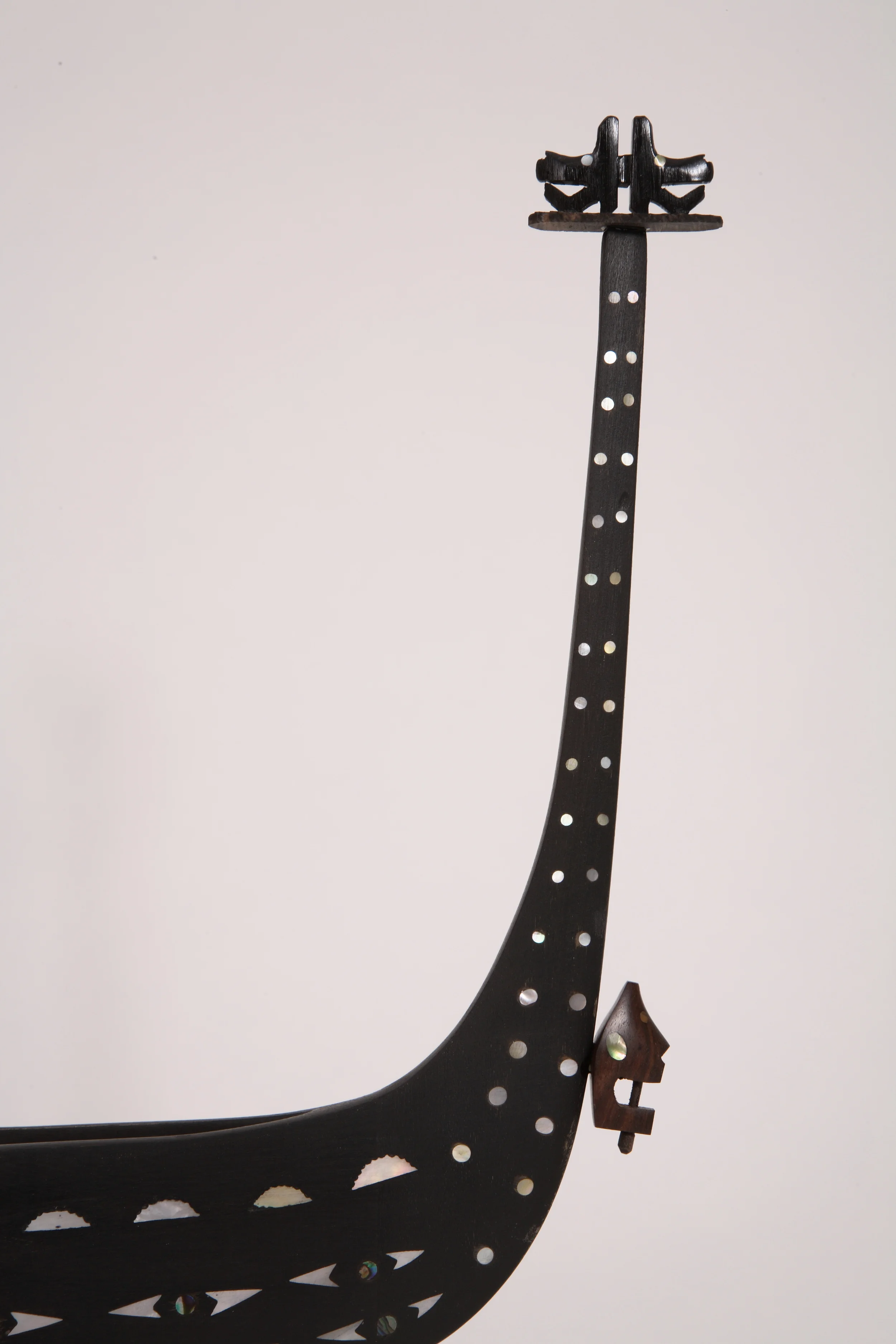
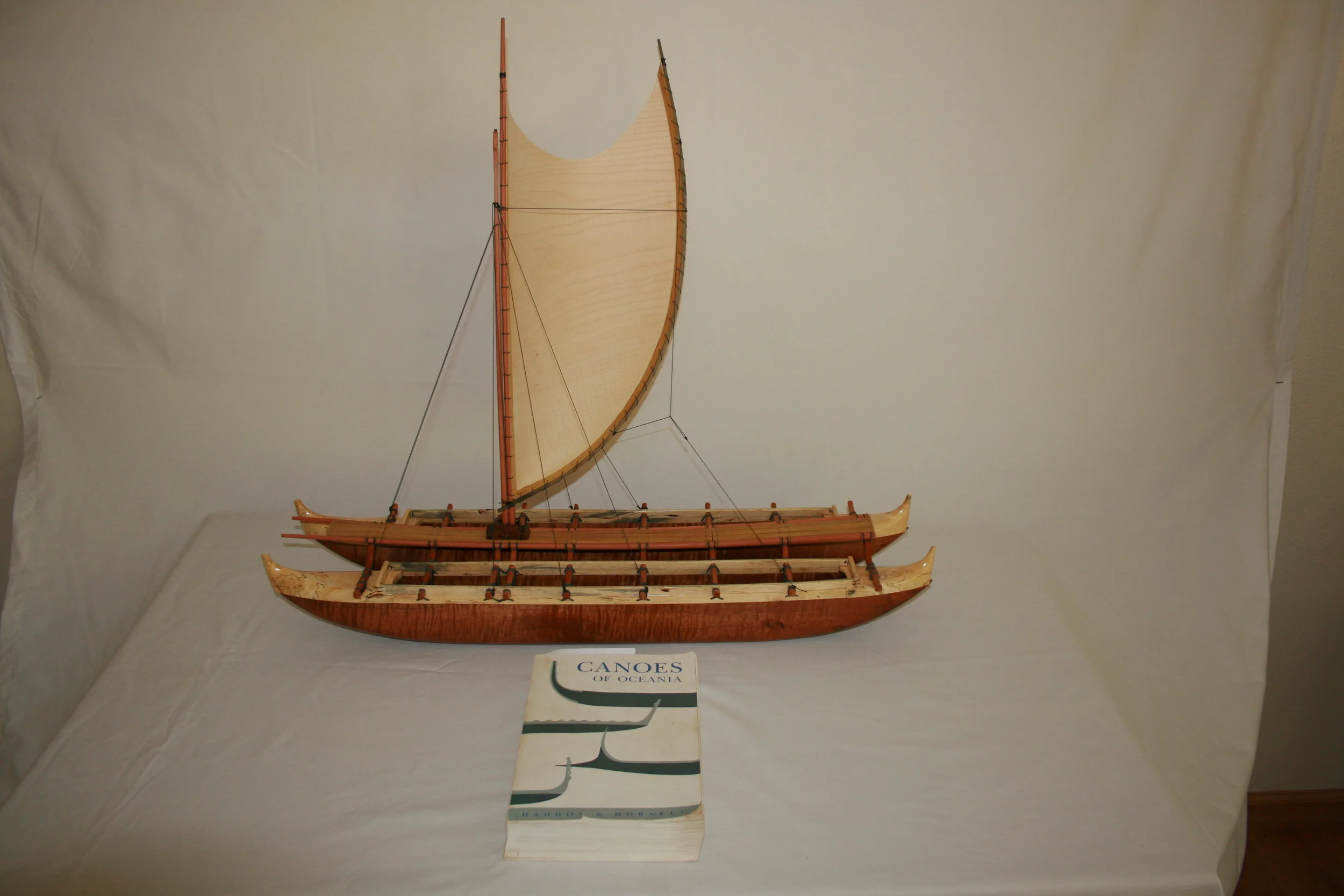
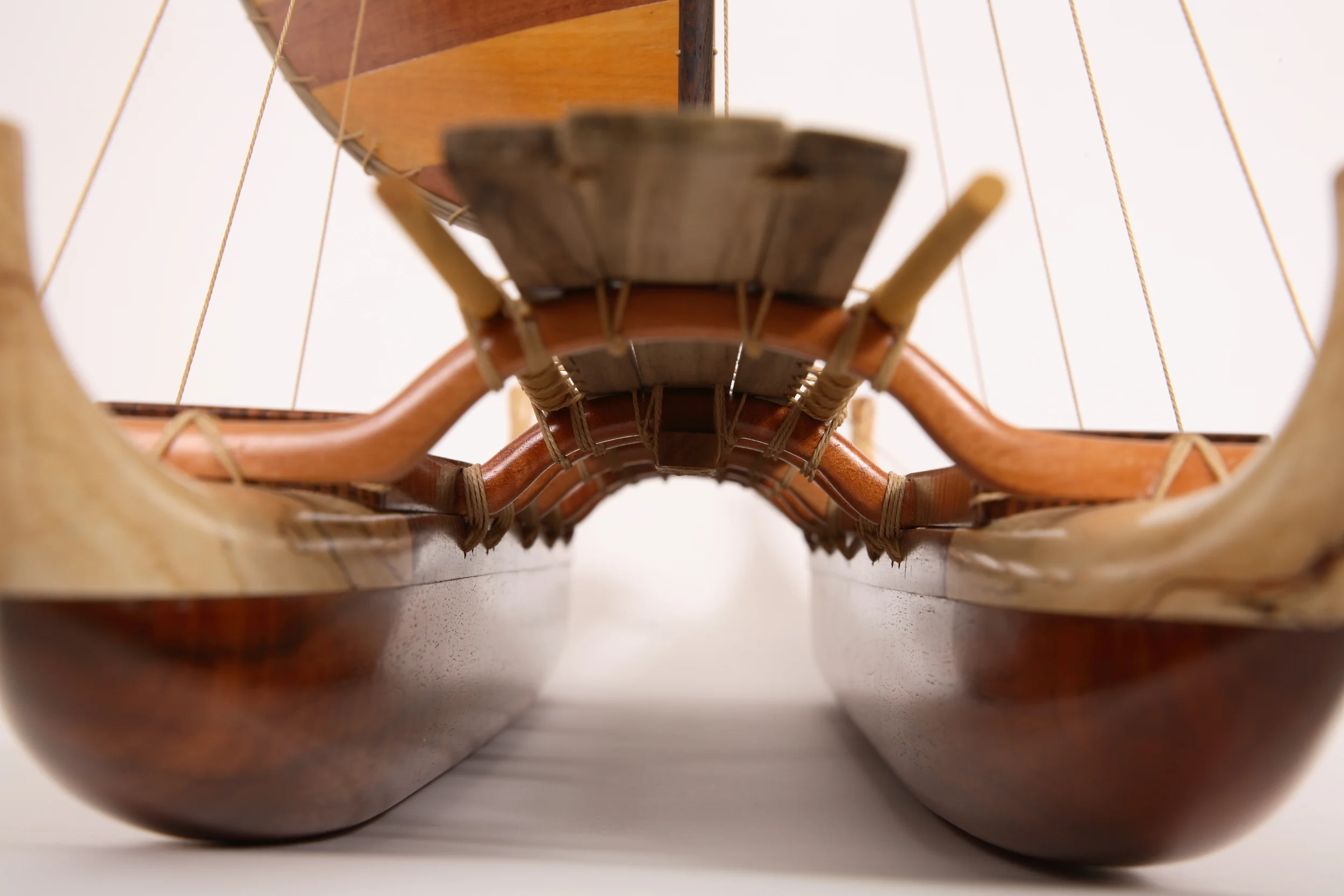
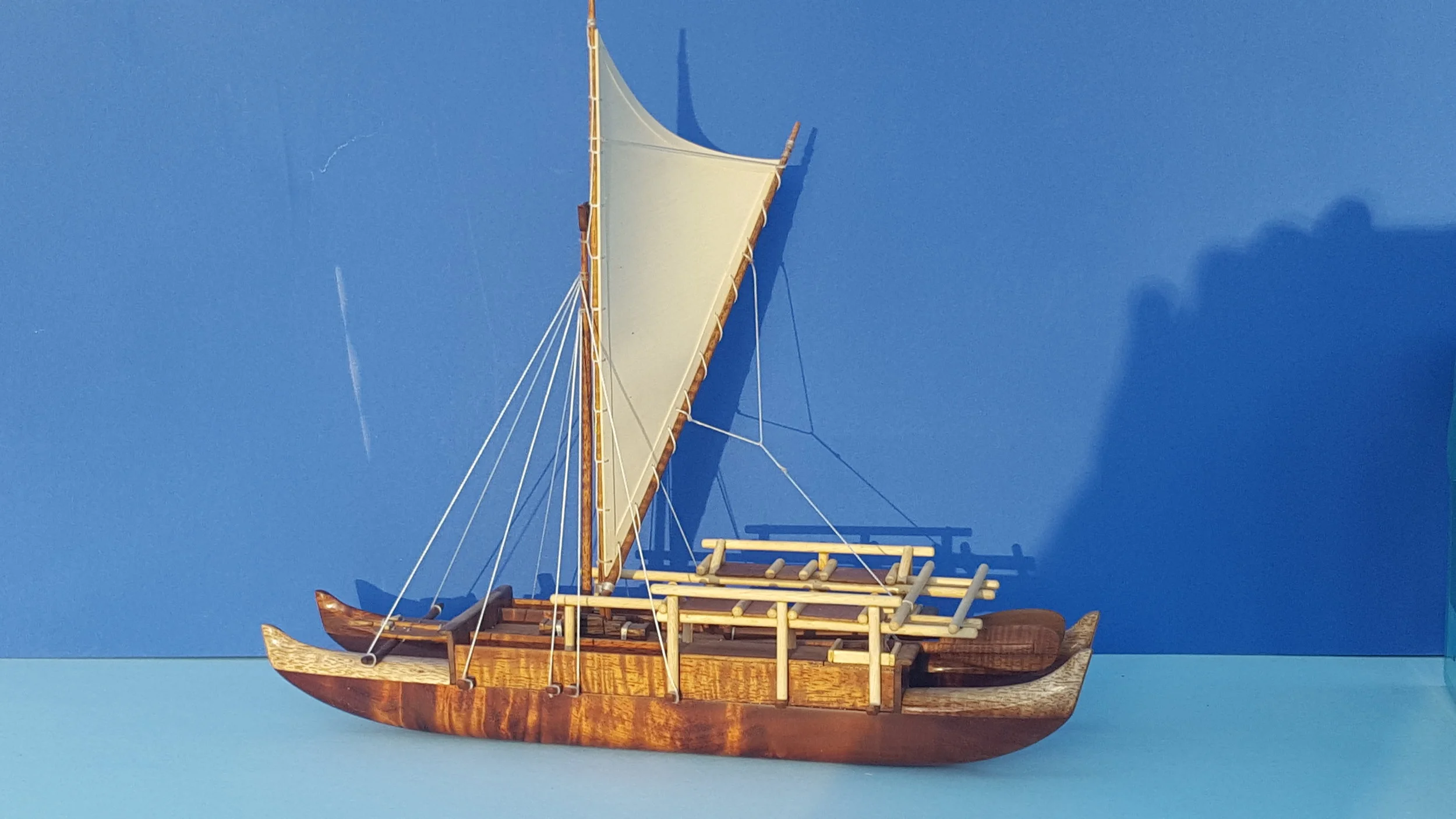
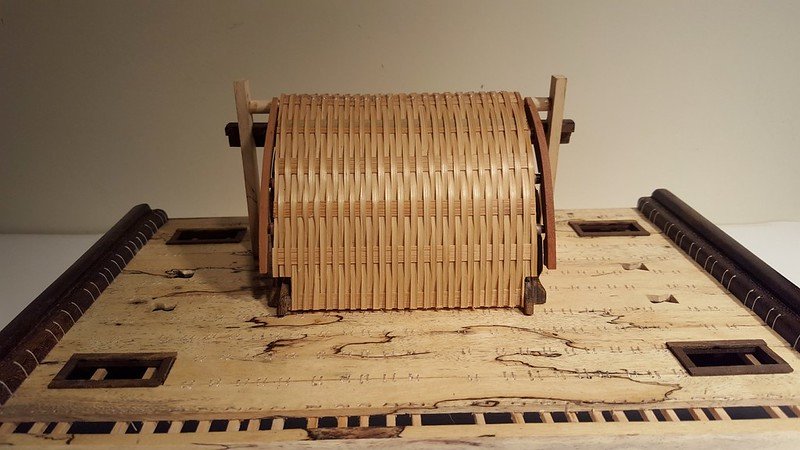
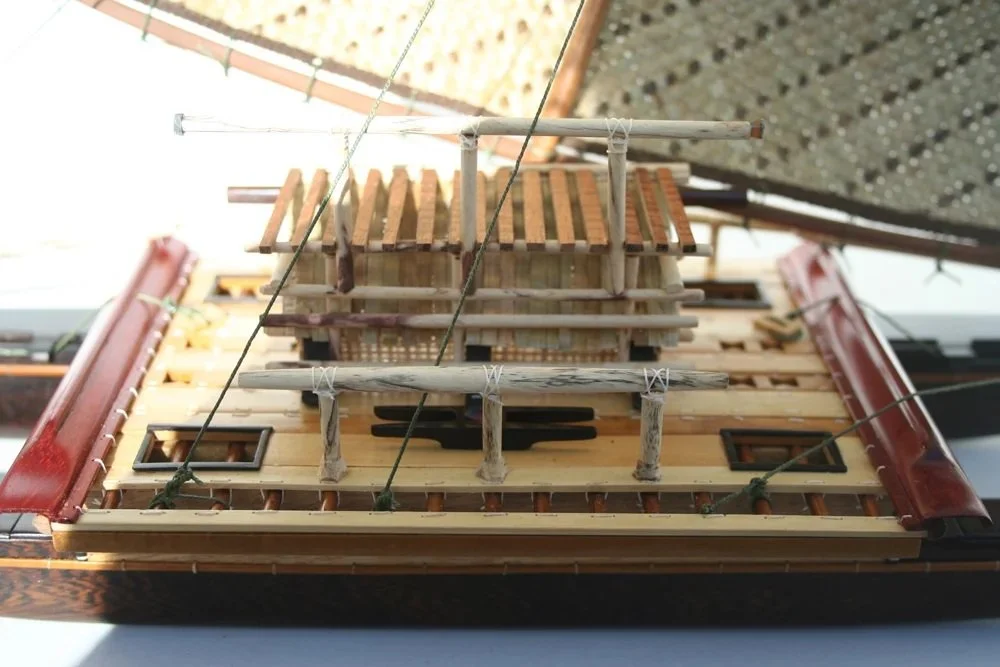
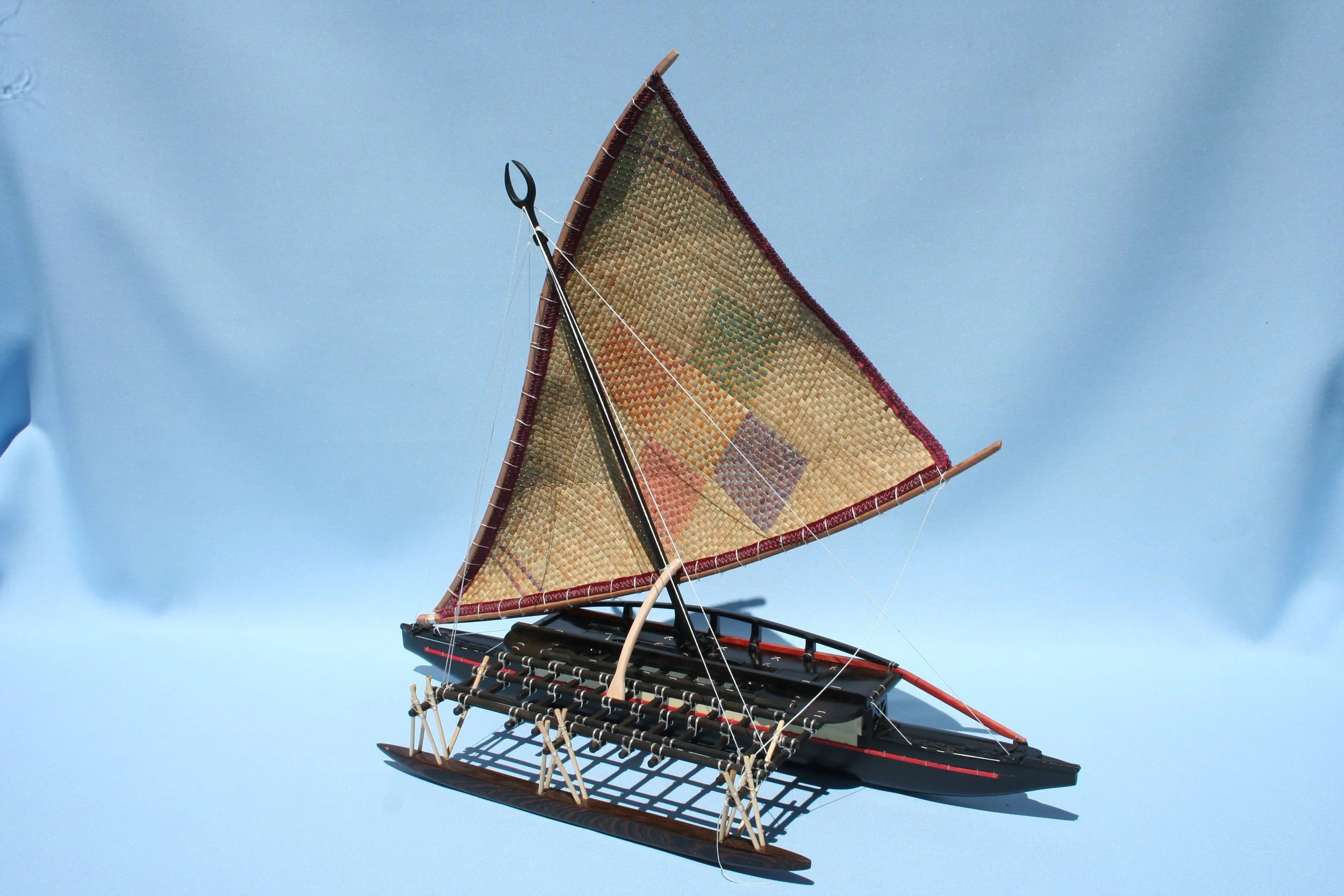
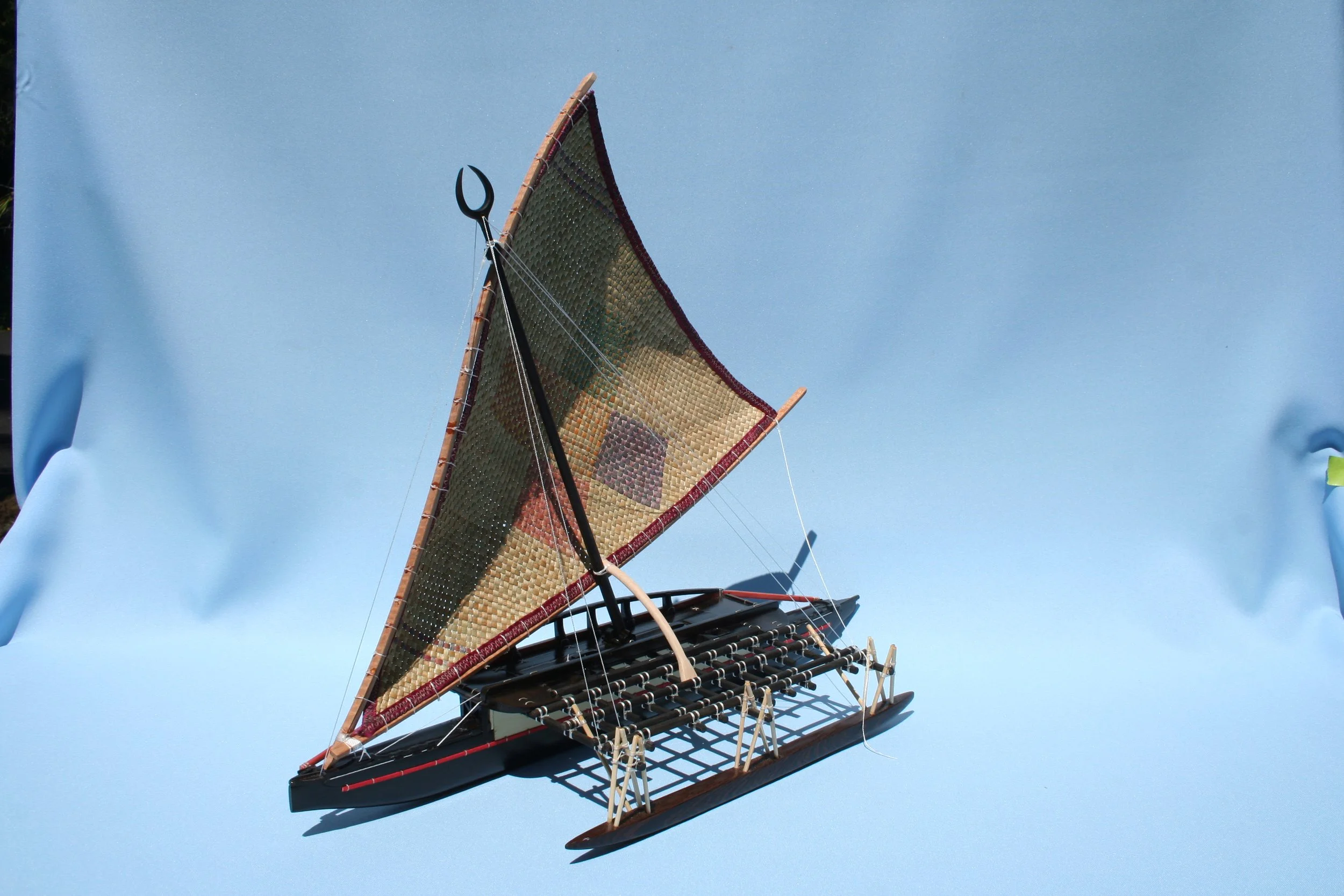
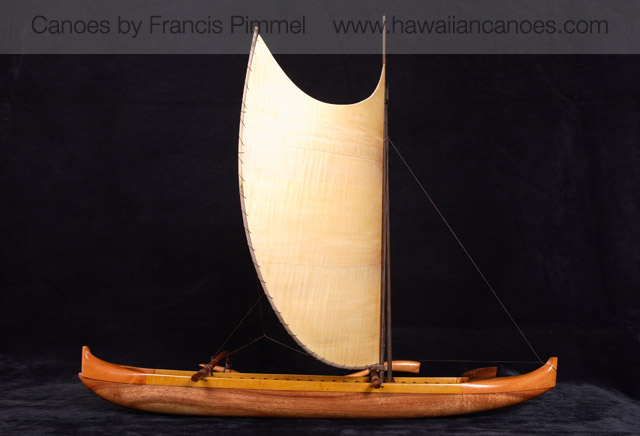
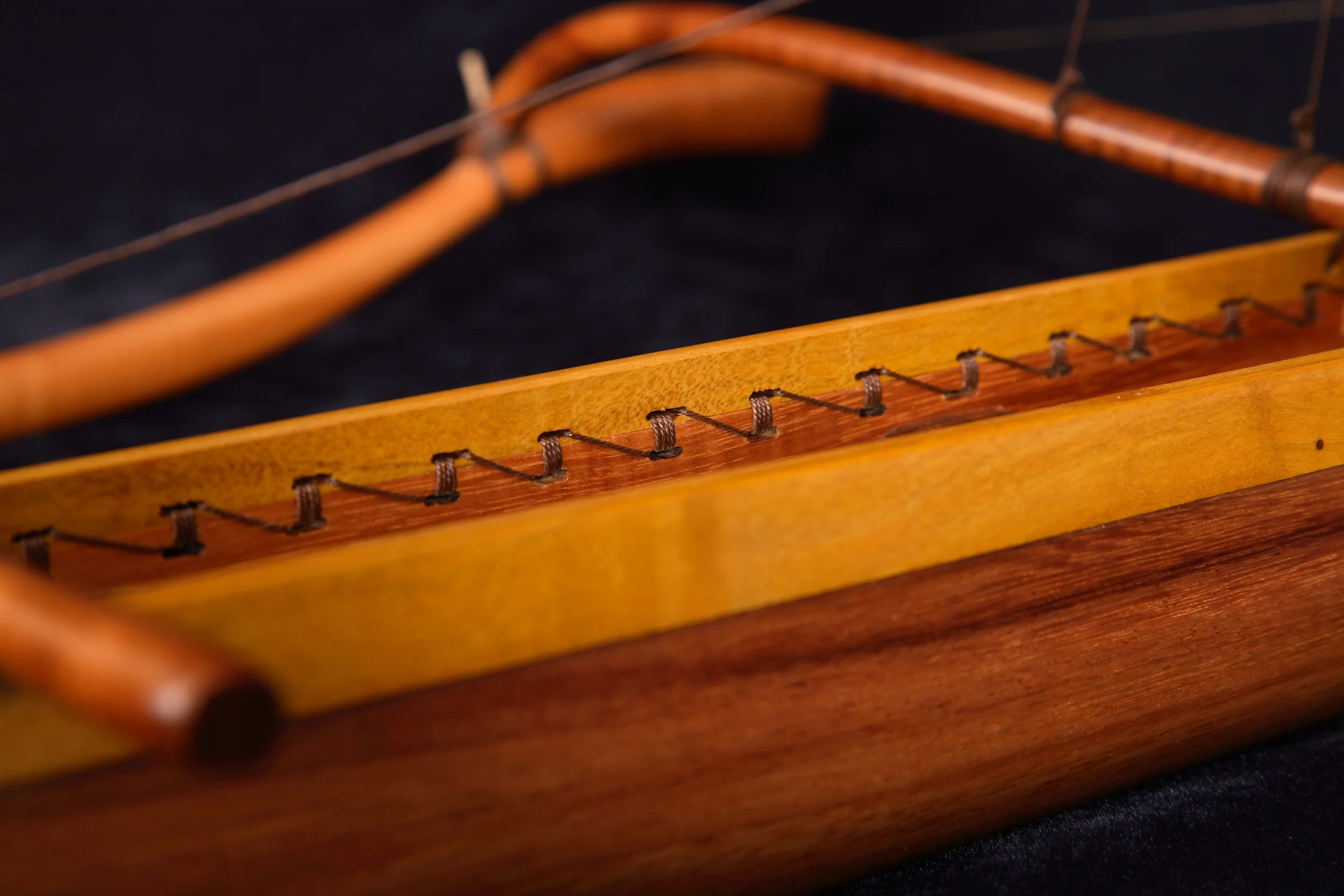
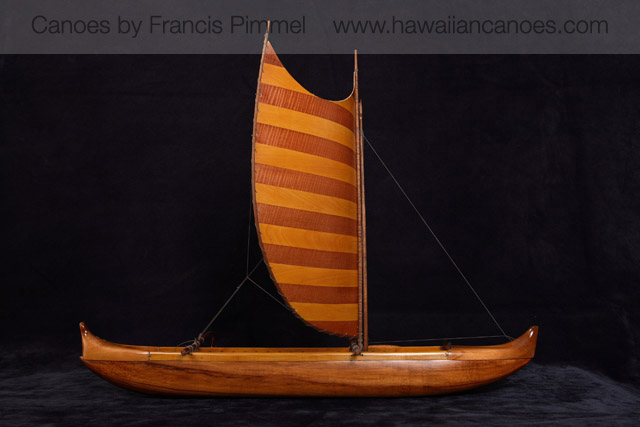
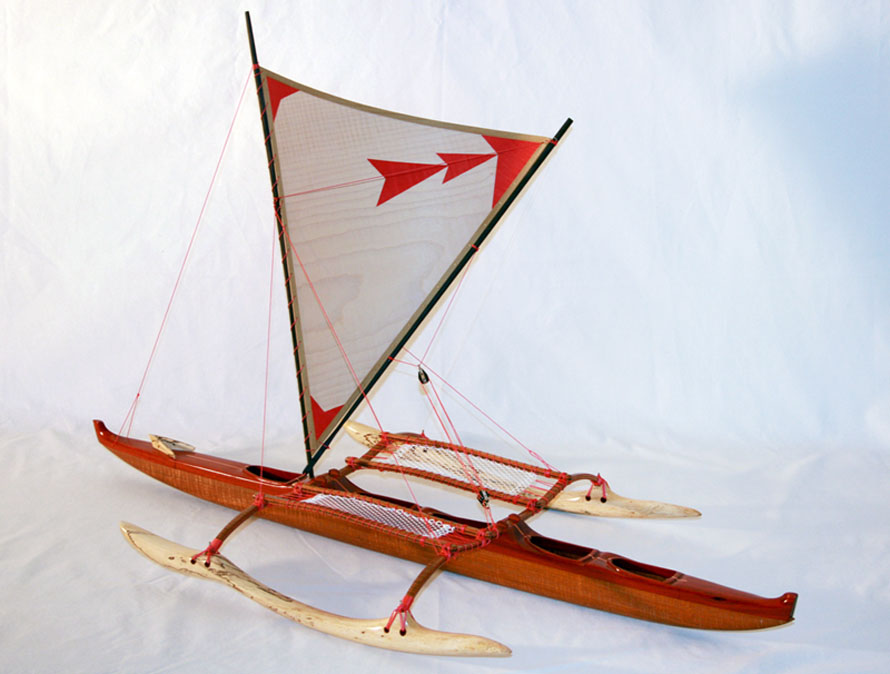
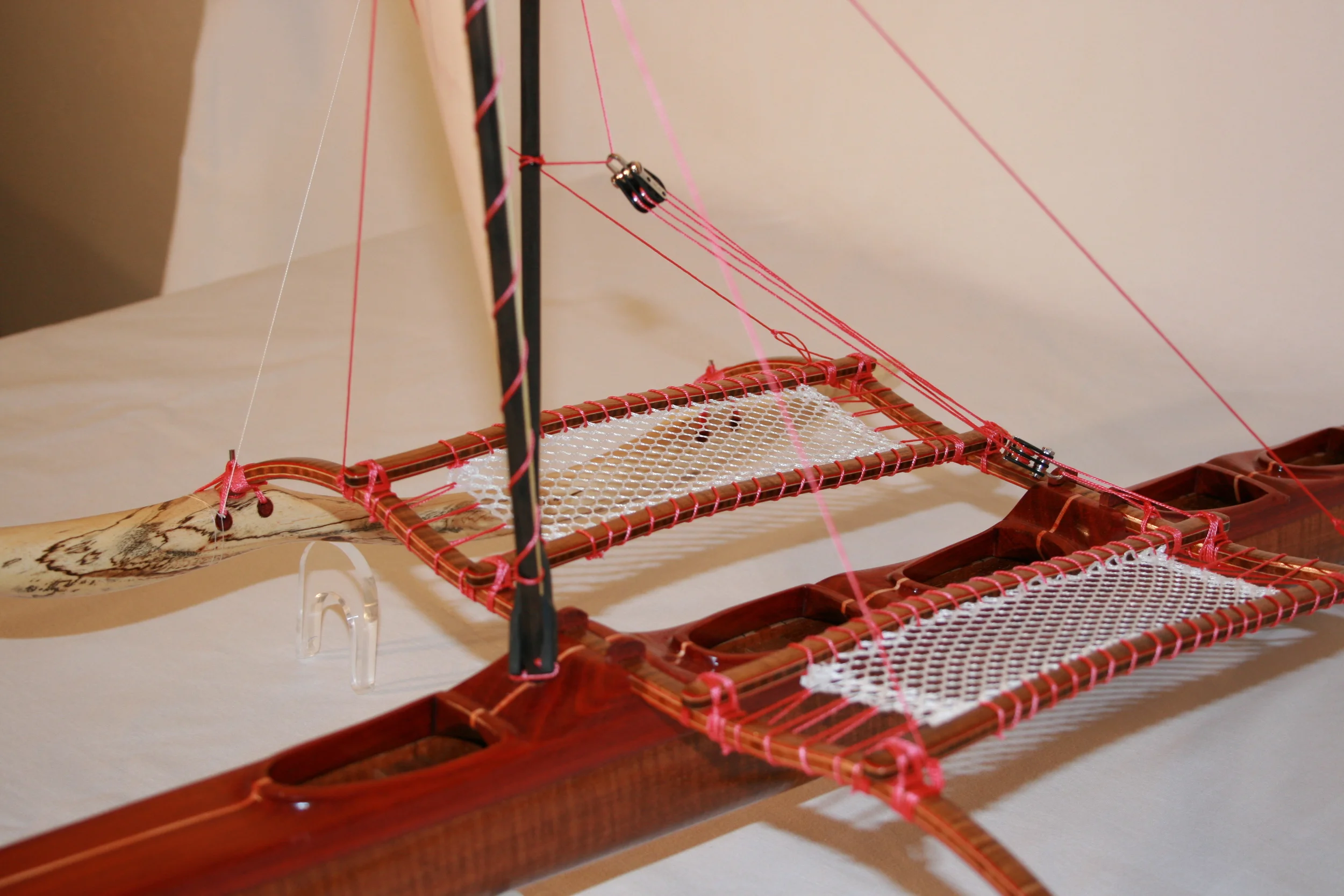
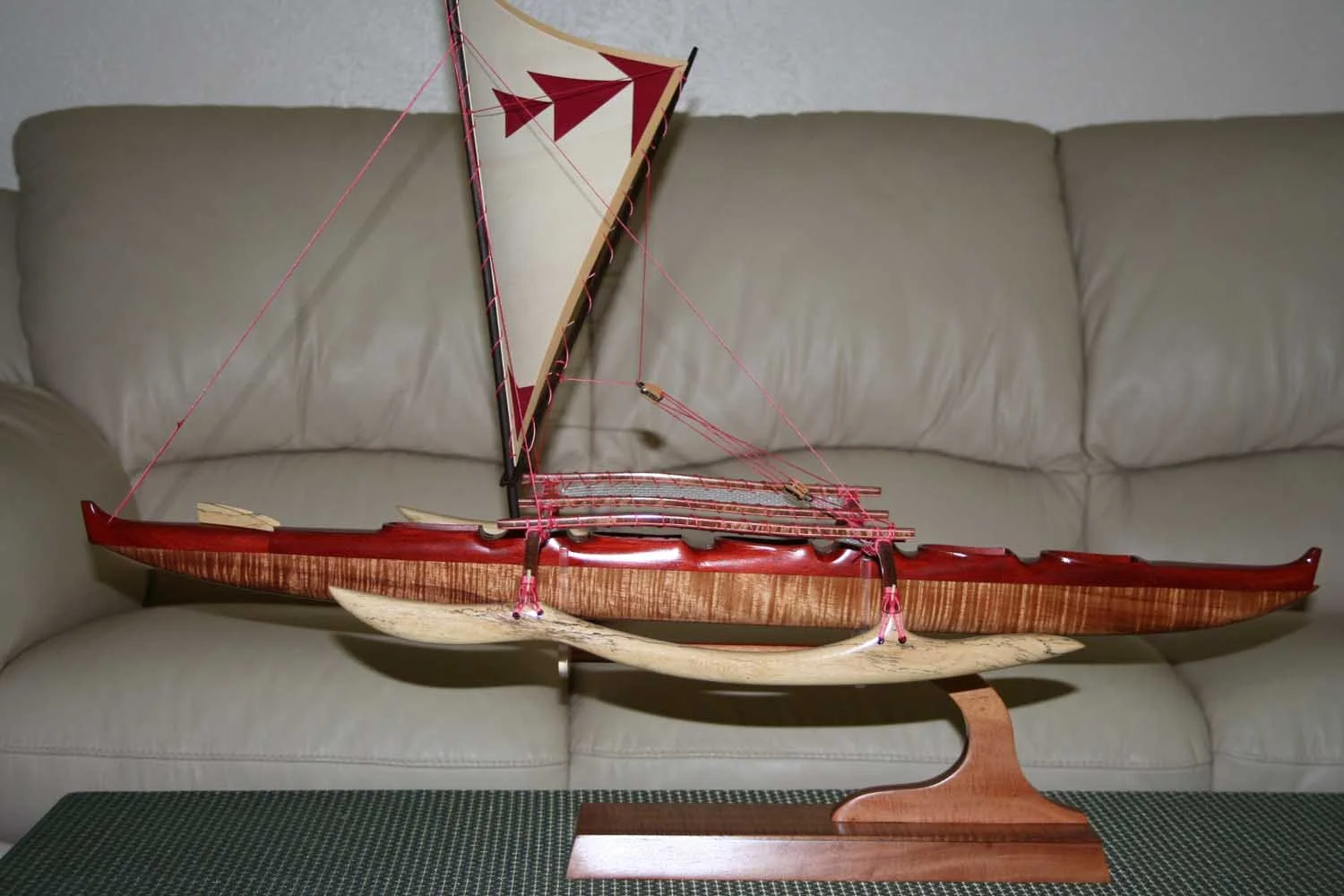
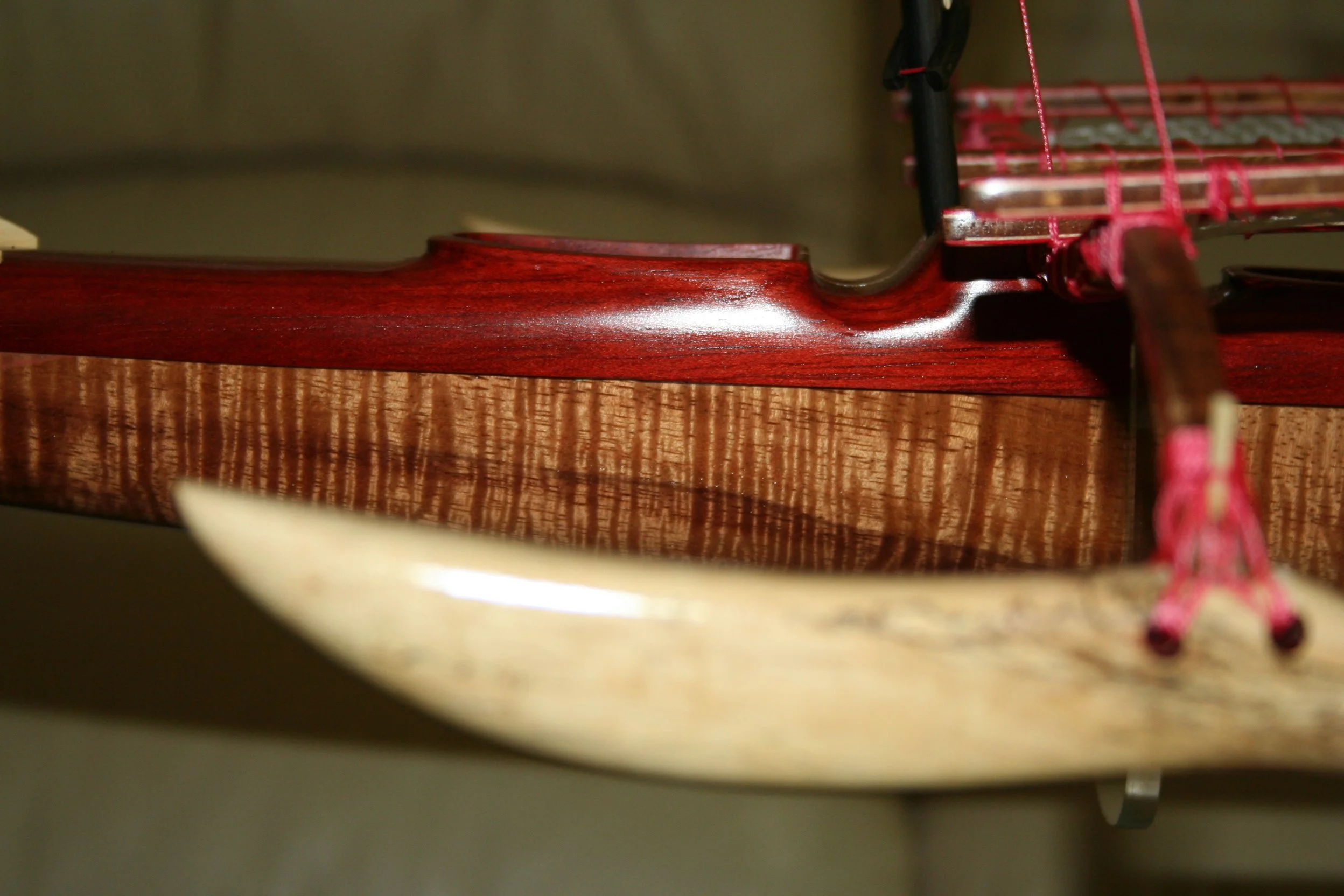
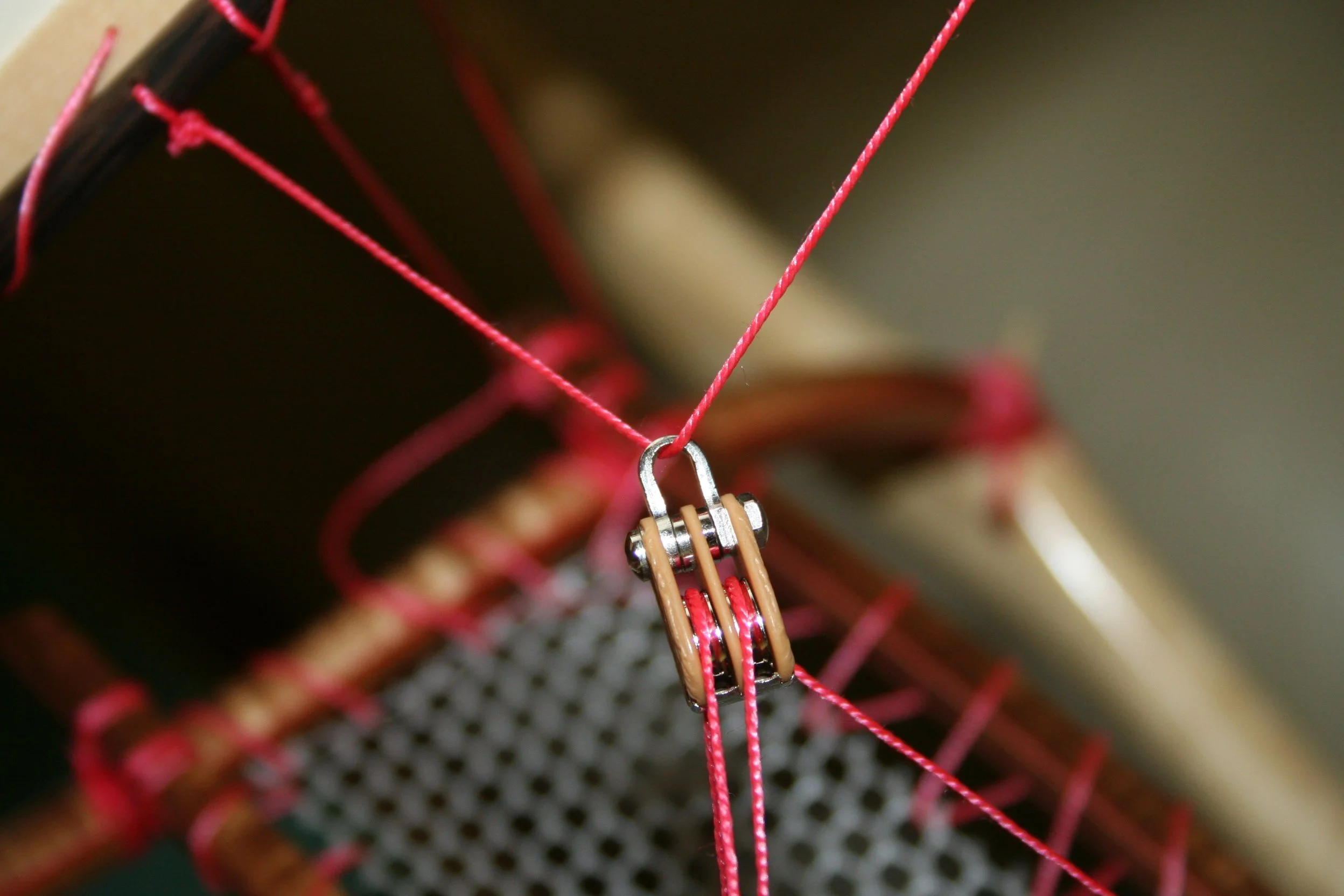
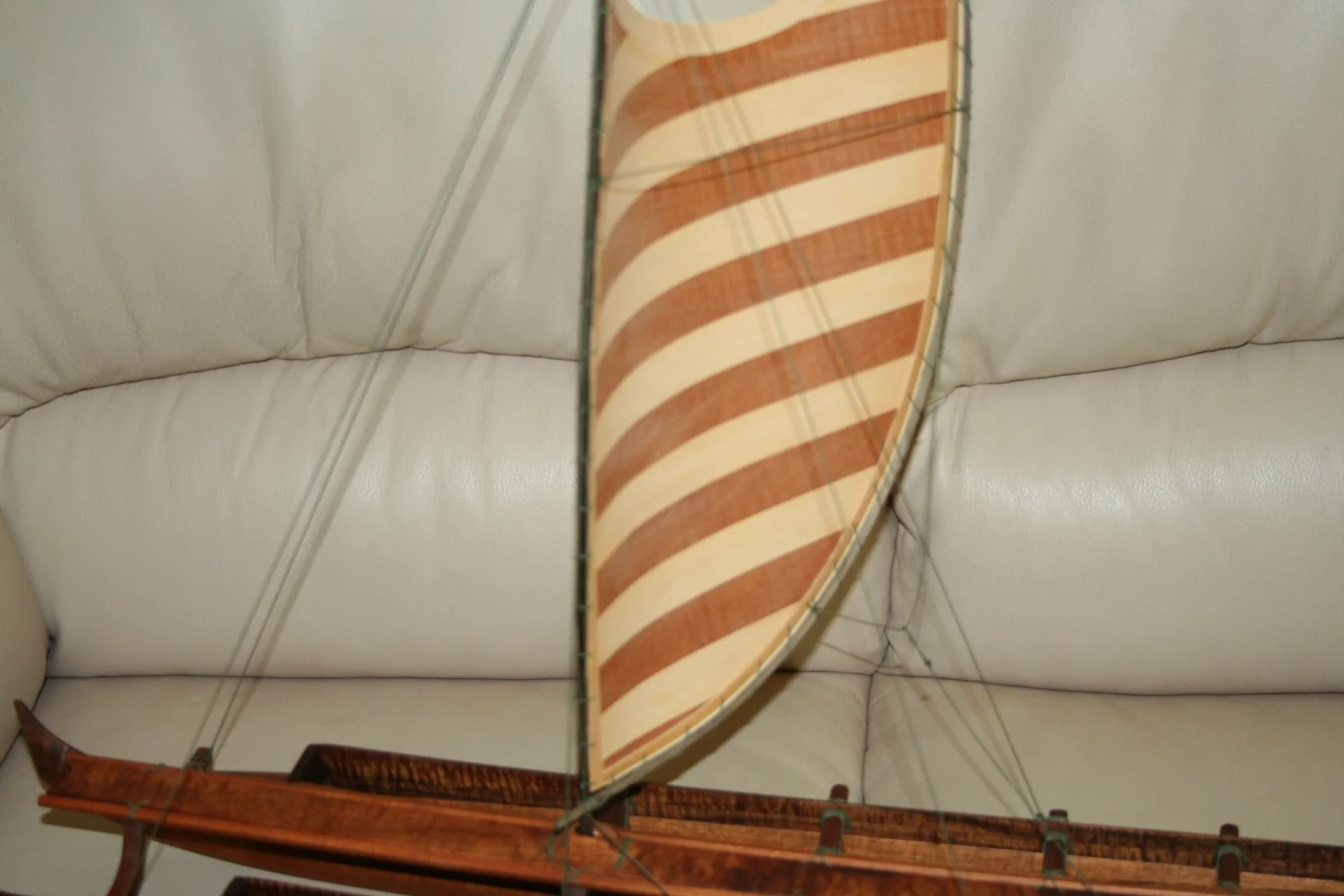
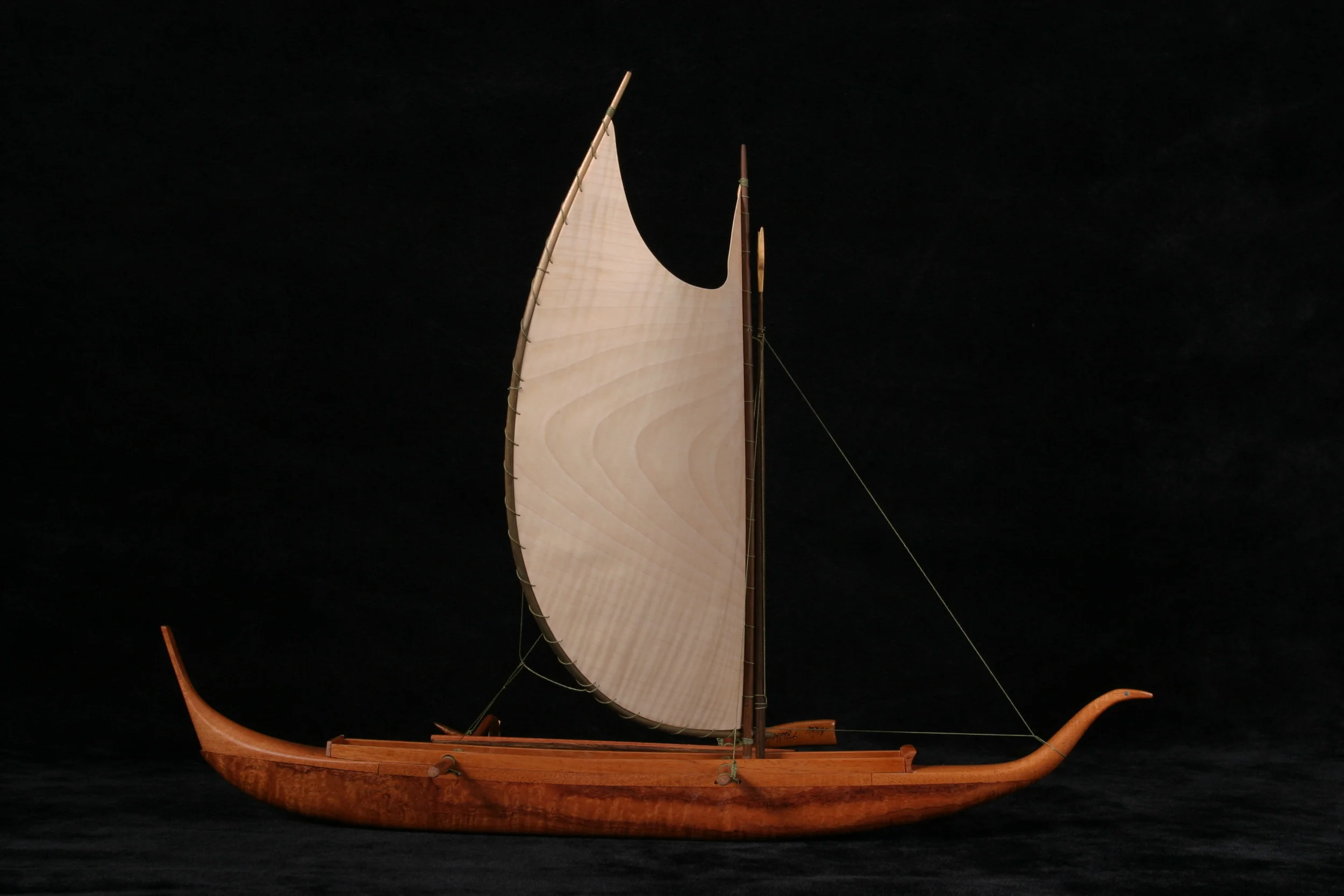
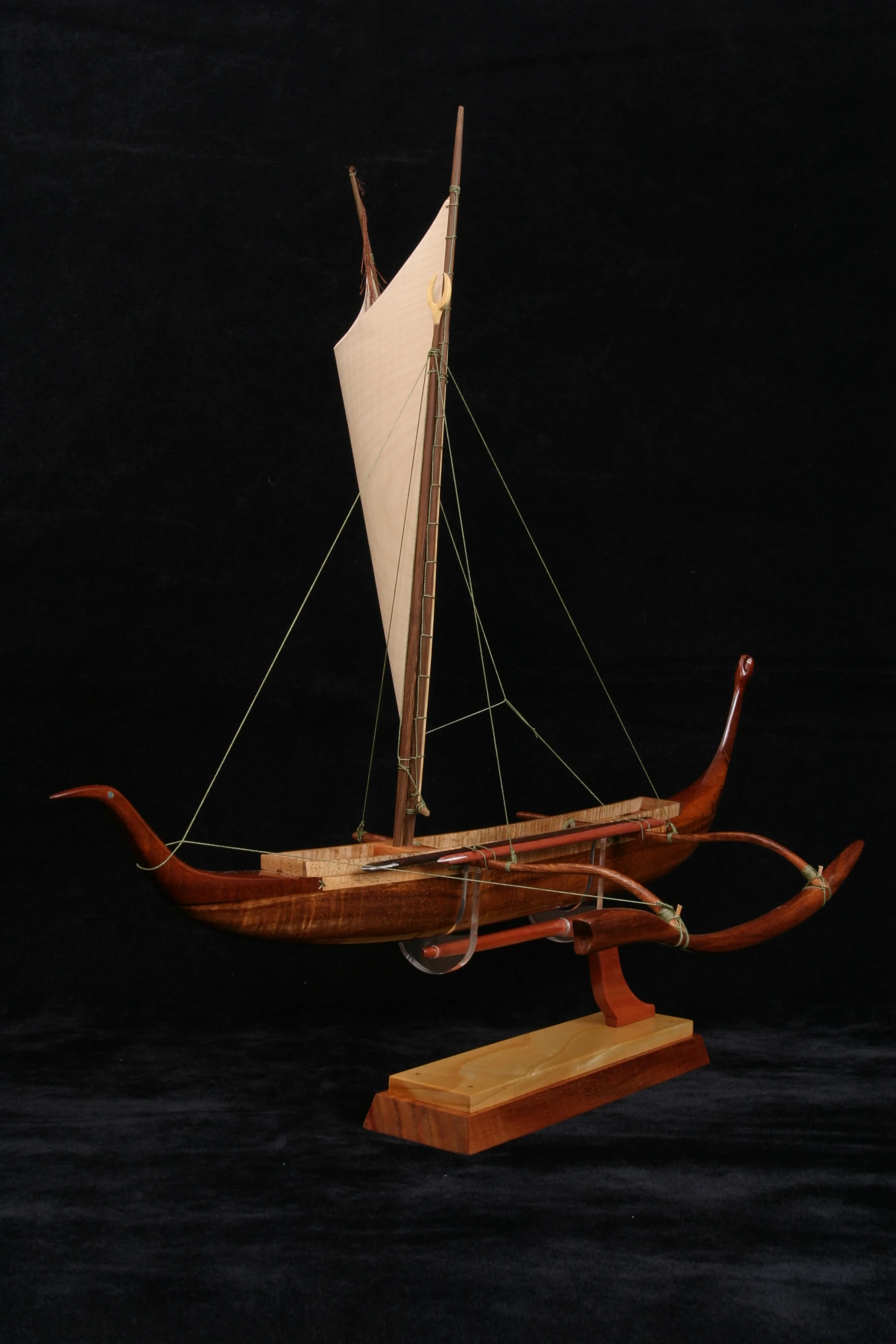
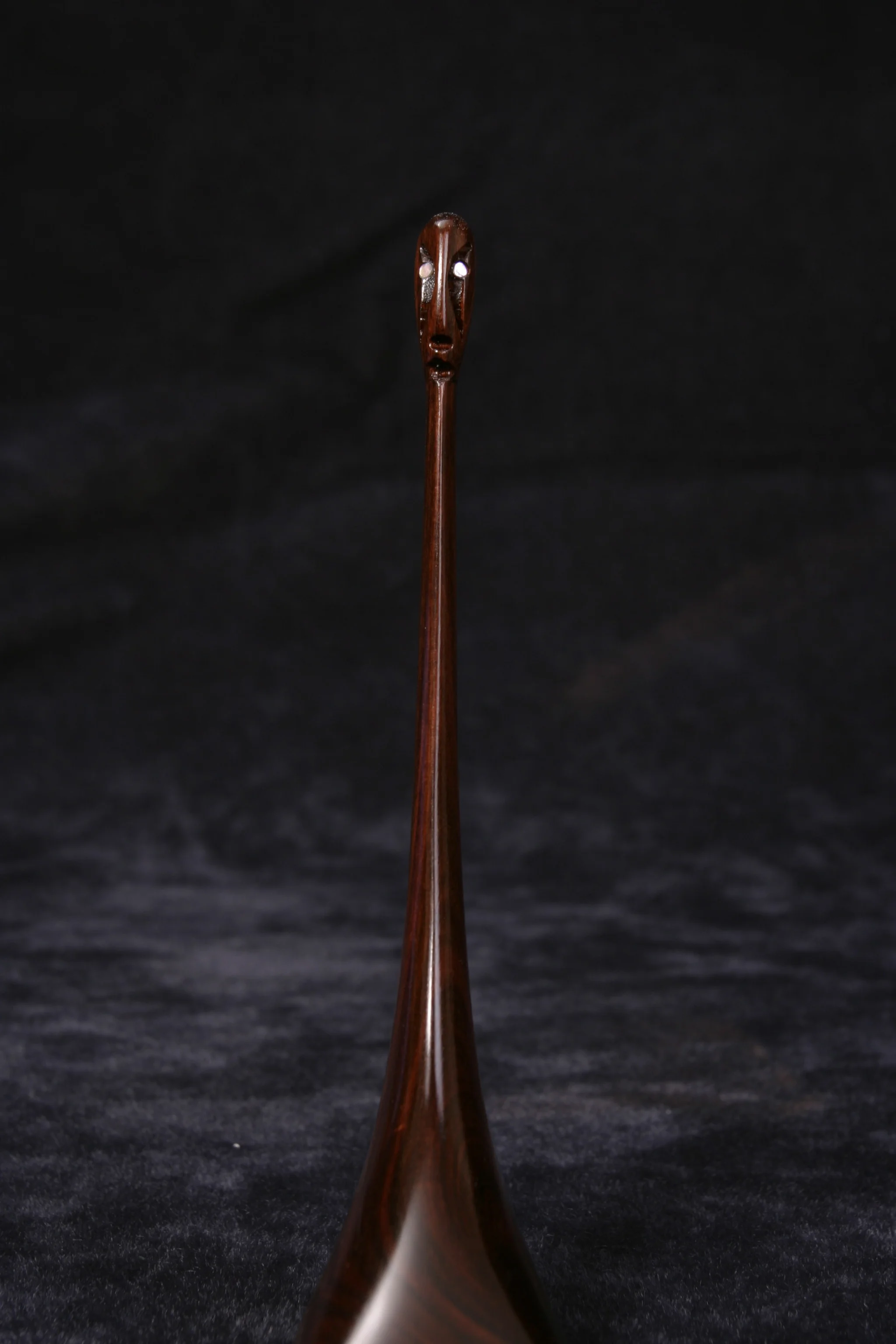
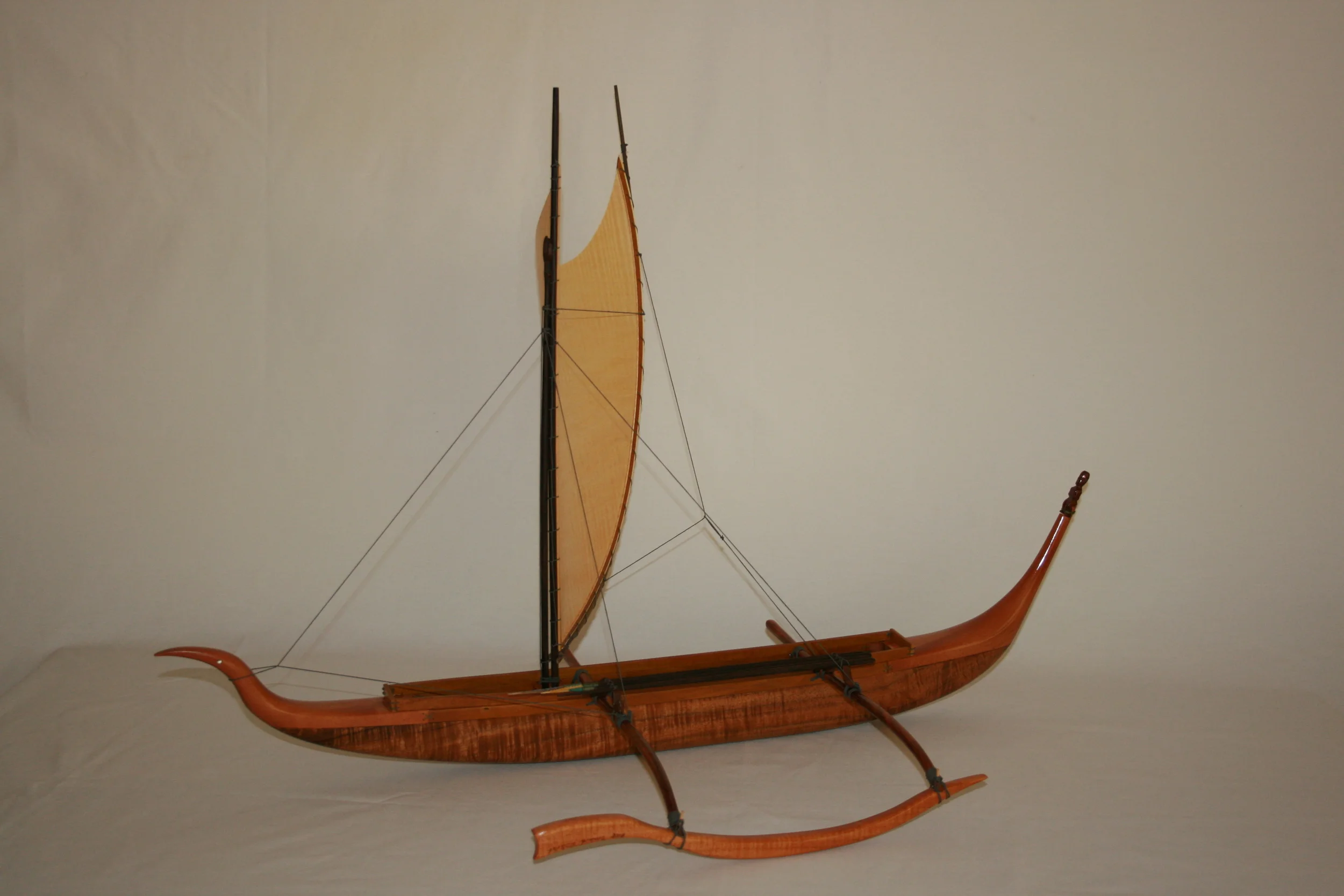
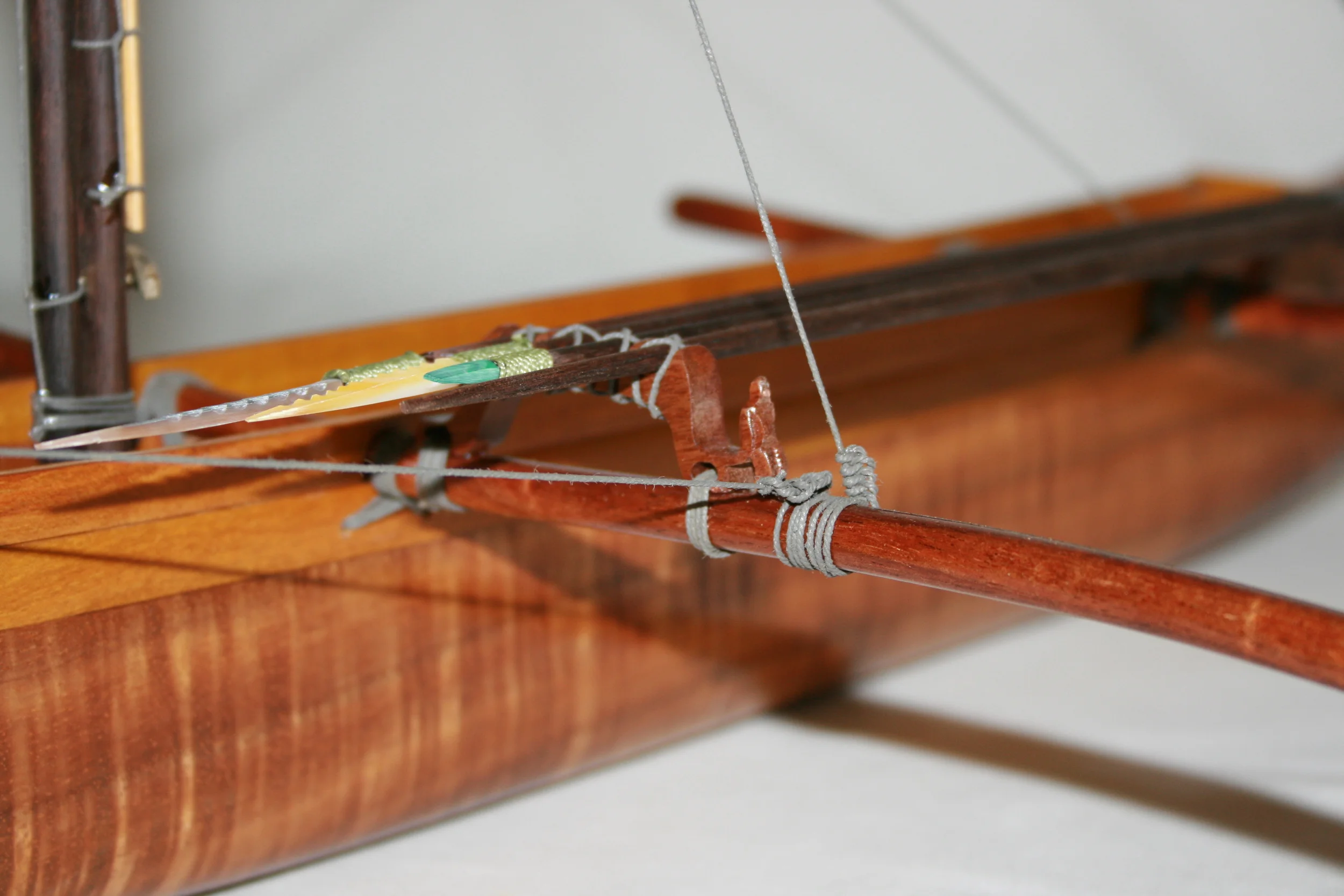
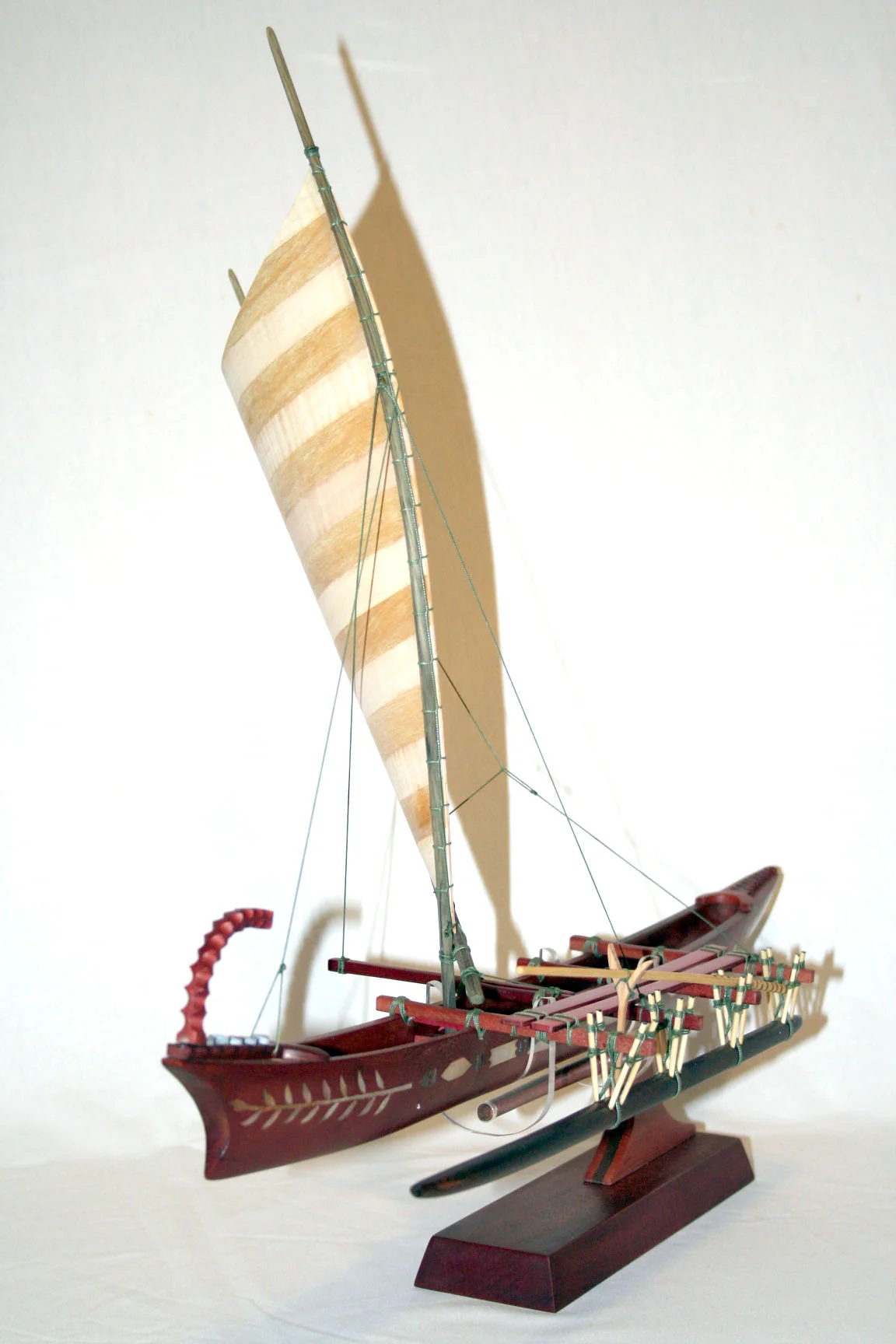
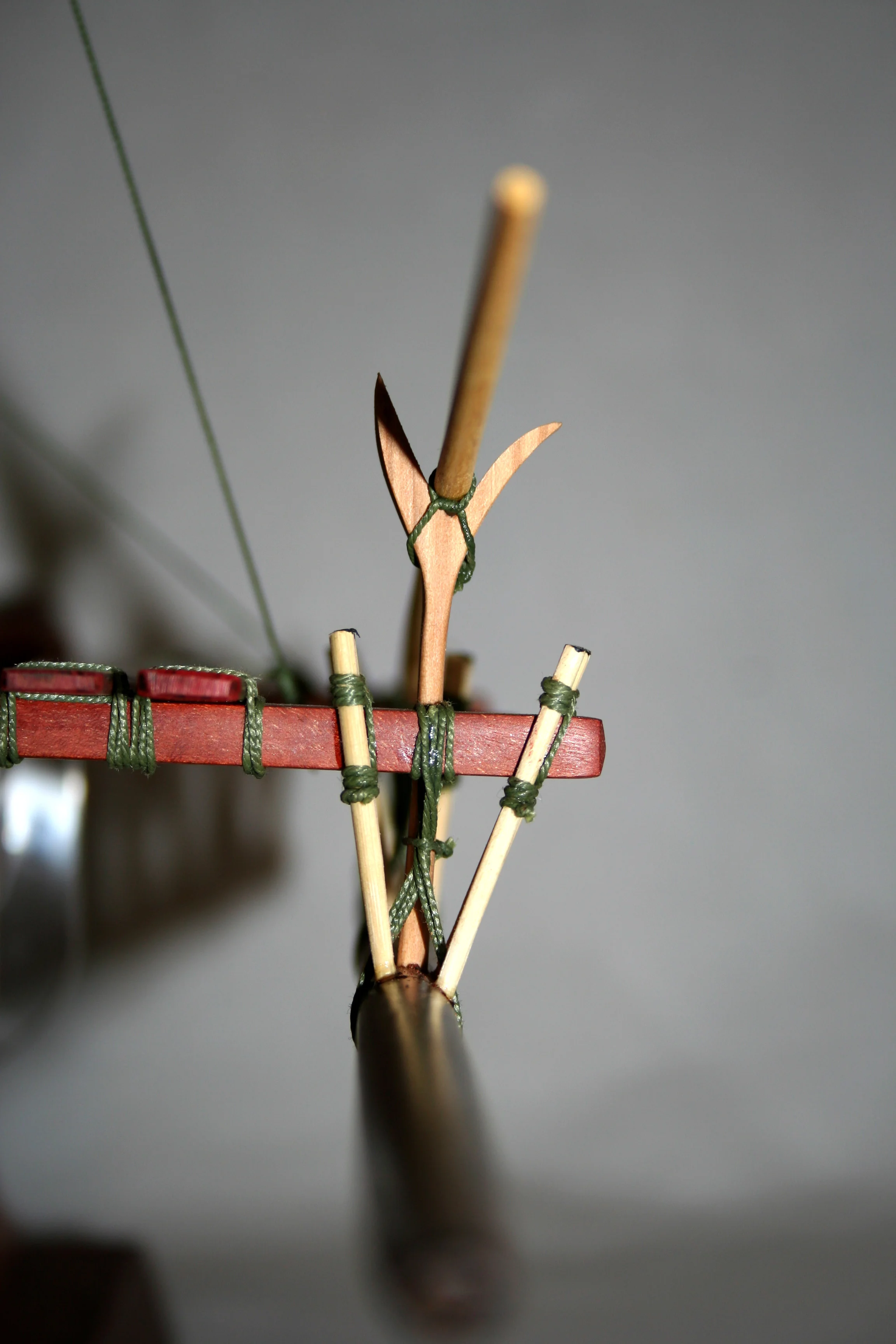
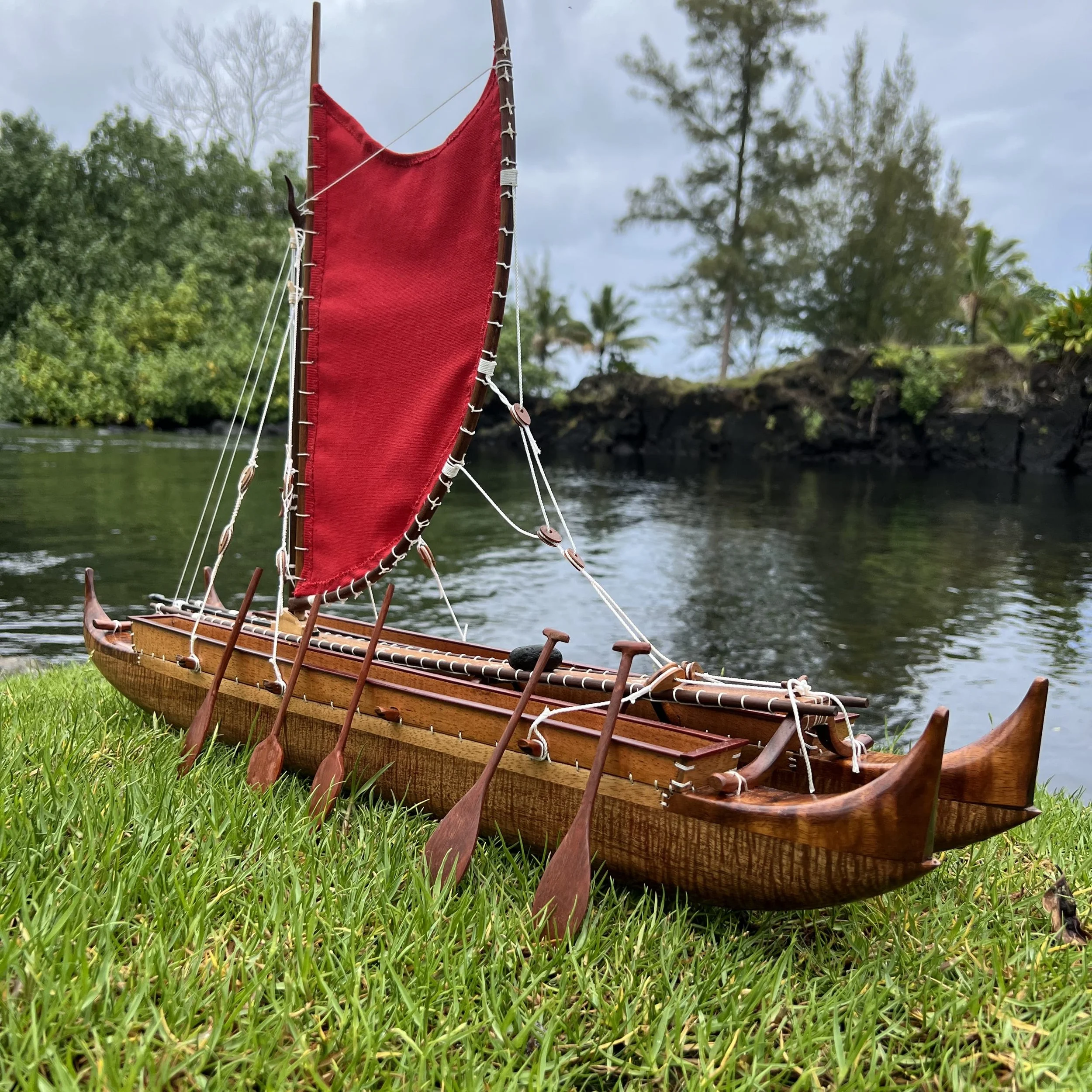


THE GALLERY displays some of the larger-scale model canoes I have built over the years. Many of these models now belong to private collections, institutions, decorating the conference rooms of corporations, or the lobbies of hotel resorts.
I am often asked whether building canoes is a hobby of mine. The answer is no; I have been doing this professionally since 1995. Have I ever sailed on the Hokule'a or any other voyaging canoe? My main interest lies in studying the various types of canoes that have sailed, or are currently sailing, across Oceania. My aim is to replicate some of these canoes on a smaller scale while adhering to traditional building methods.
As for my favorite canoes, there’s no doubt that the Hokule'a stands out for its elegance, navigational performance, and sturdiness. In second place, I really admire the lines and speed of the Samoan Va’aalo. The Va’aalo is akin to a speedboat, while the Fijian Drua is like a jumbo jet of the sea.
How long does it take for me to build a larger model? The large Fiji Drua I constructed a few years ago for the Polynesian Cultural Center took three months.
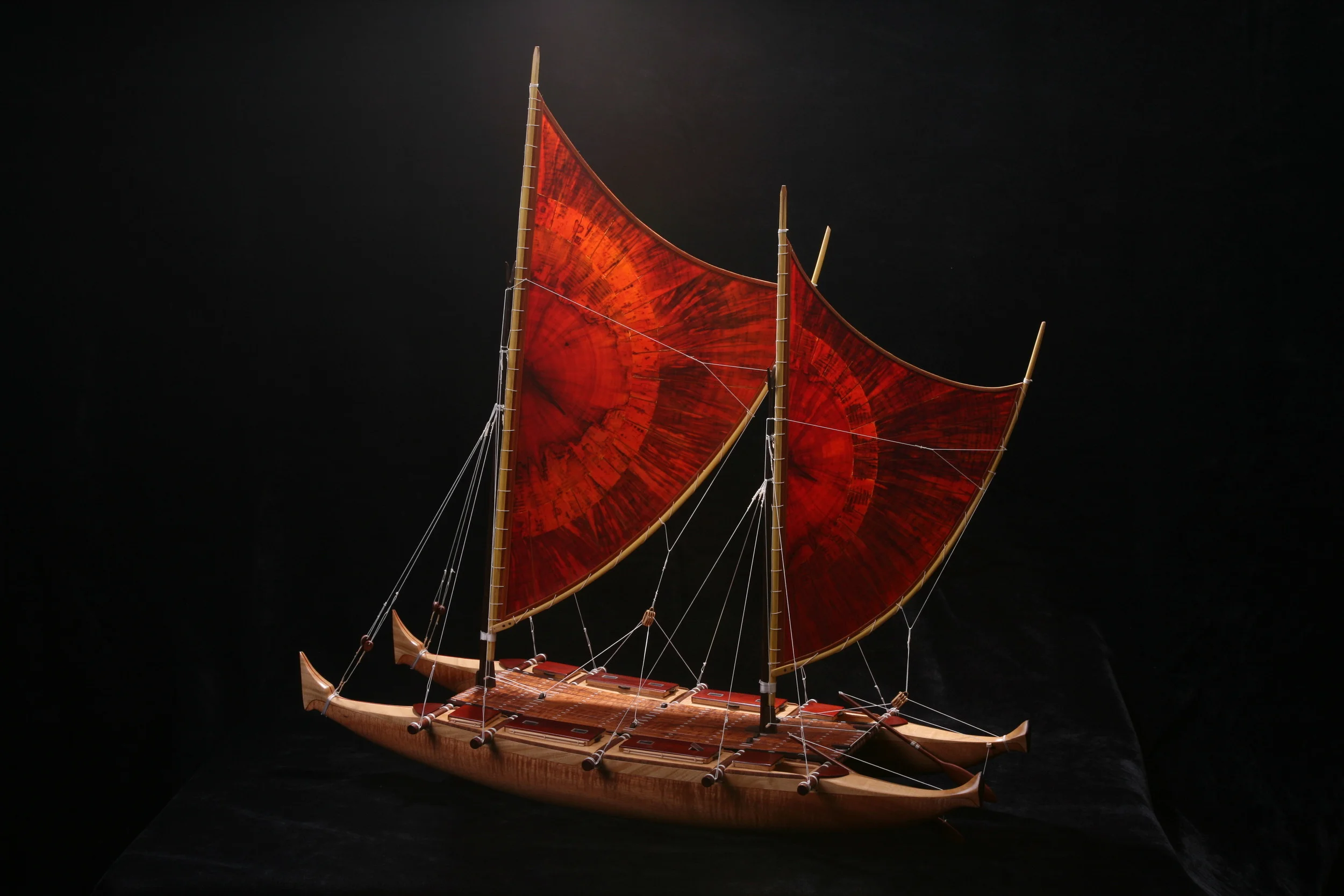
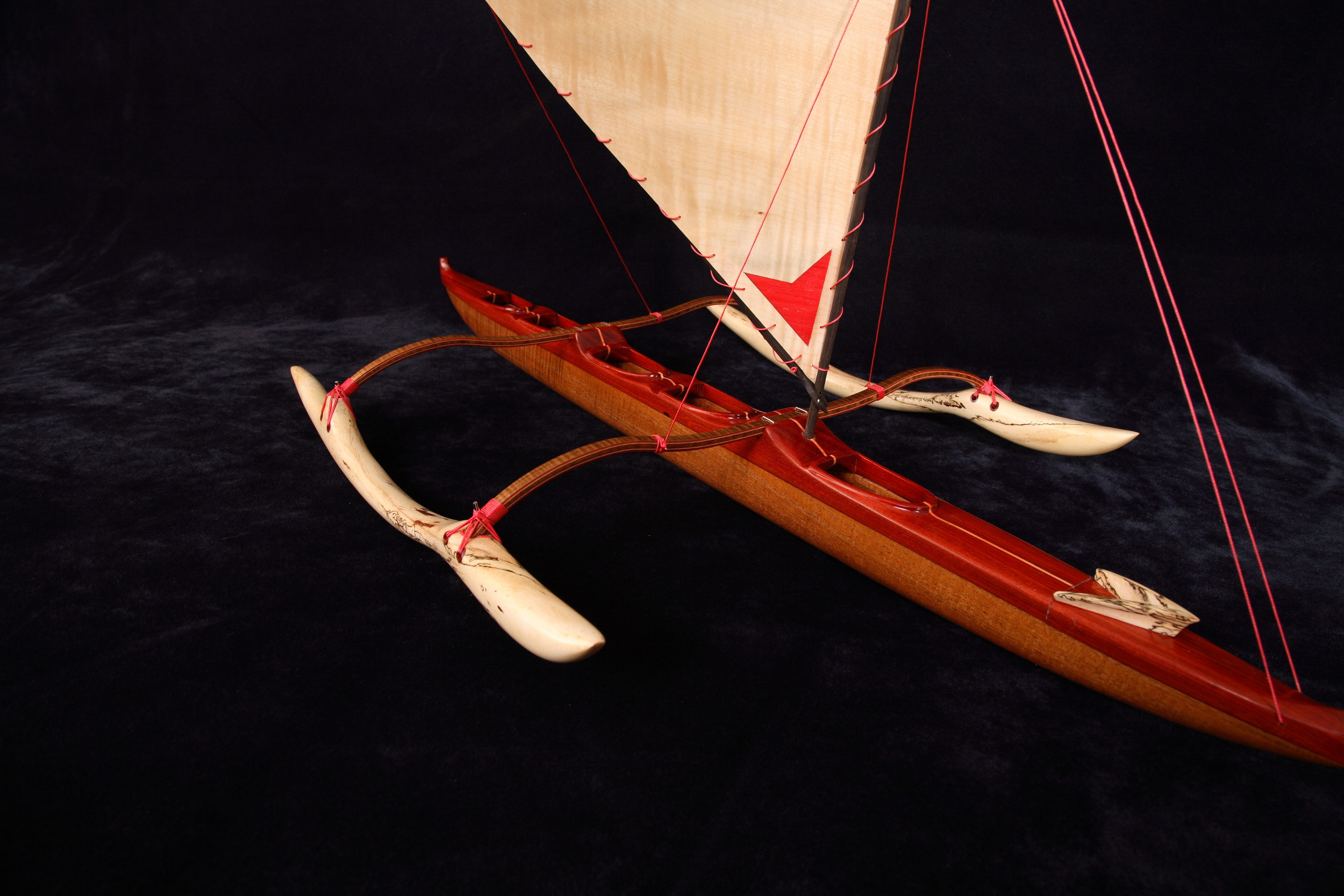
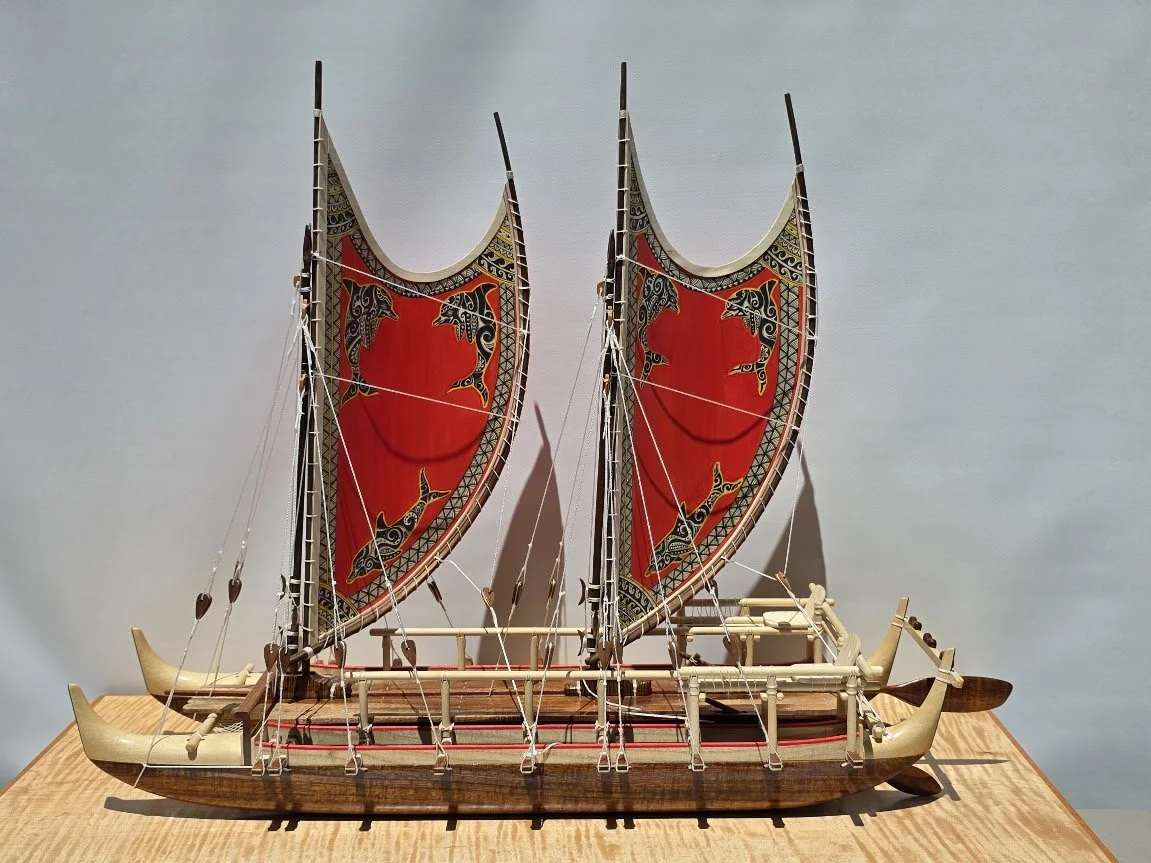
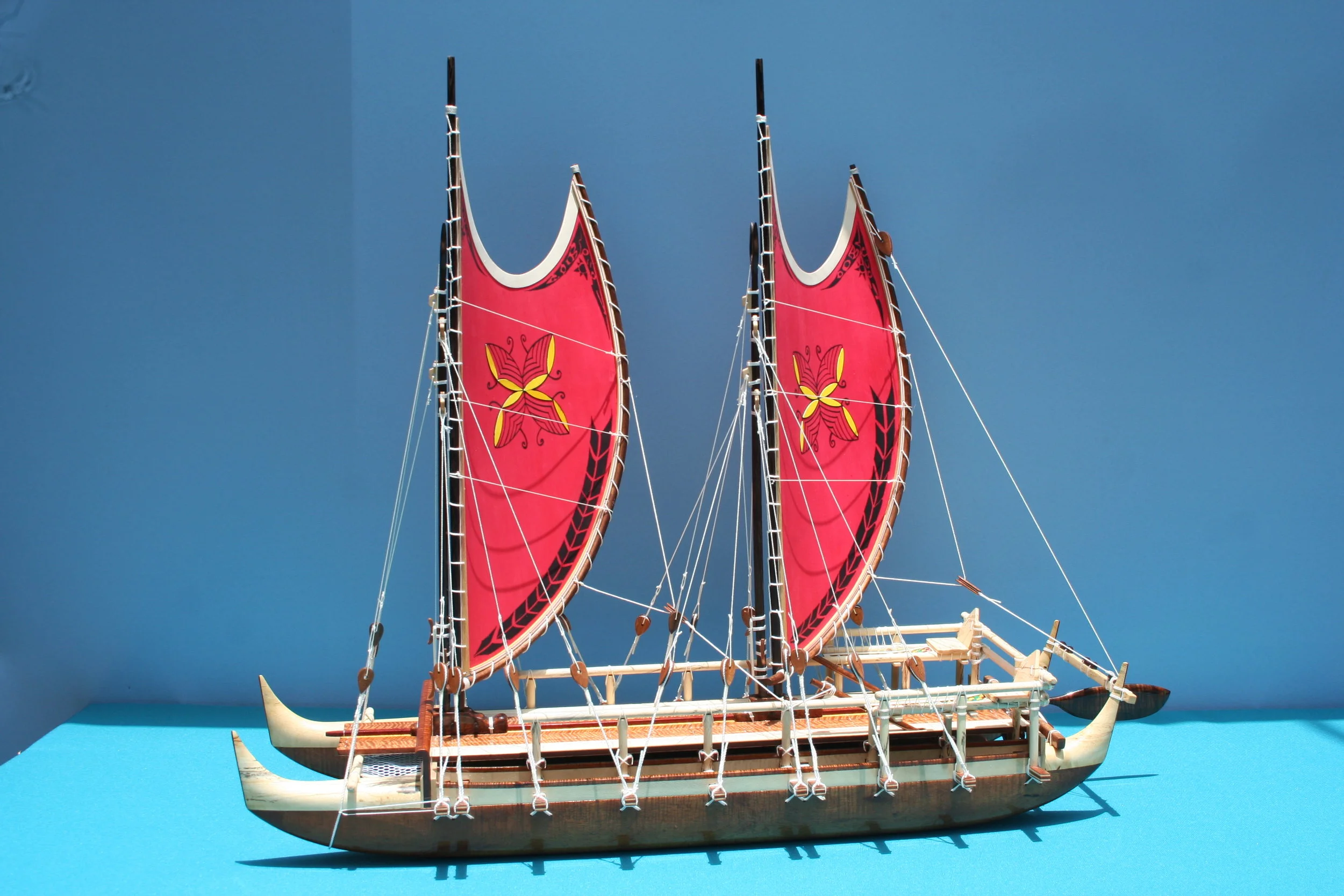
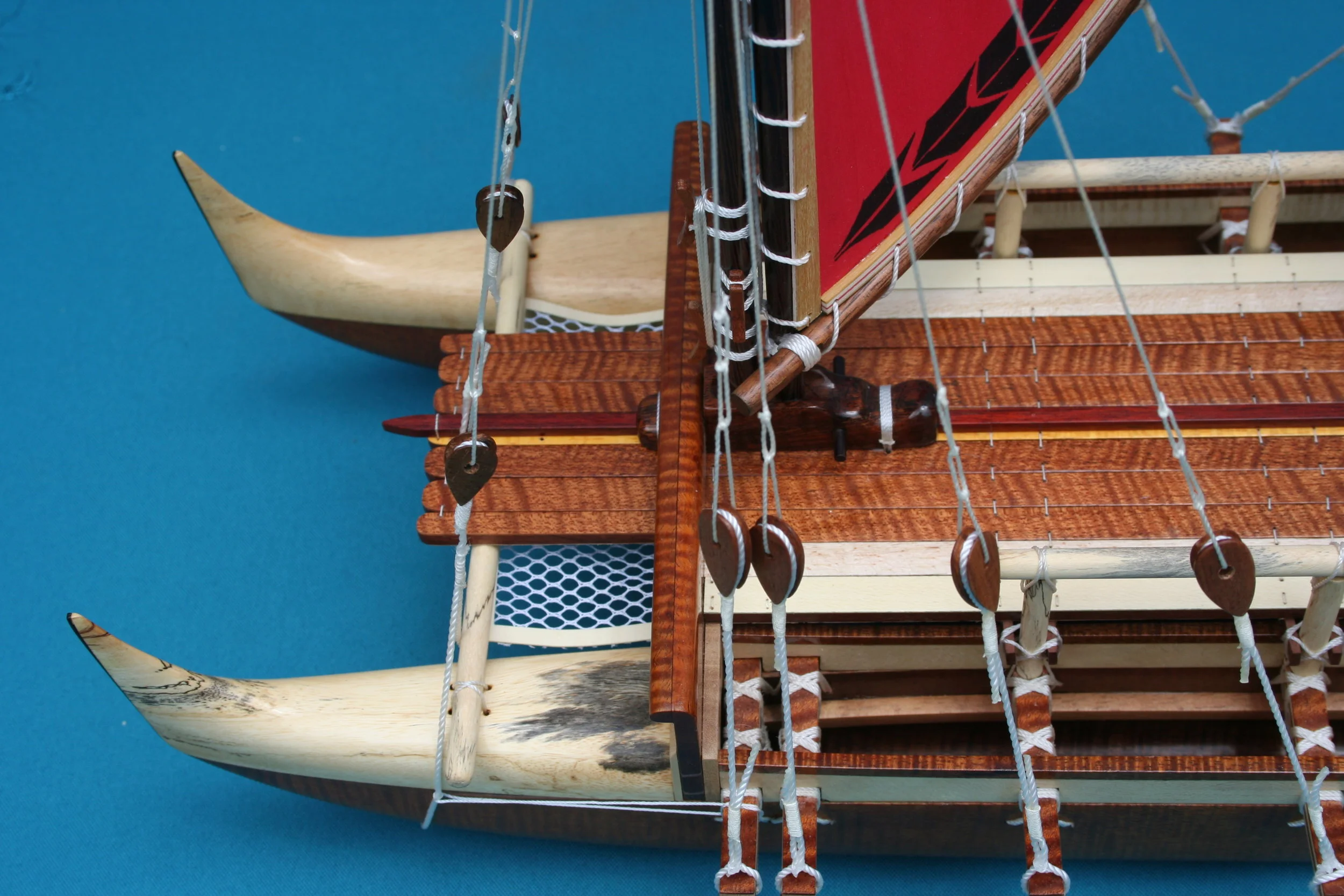
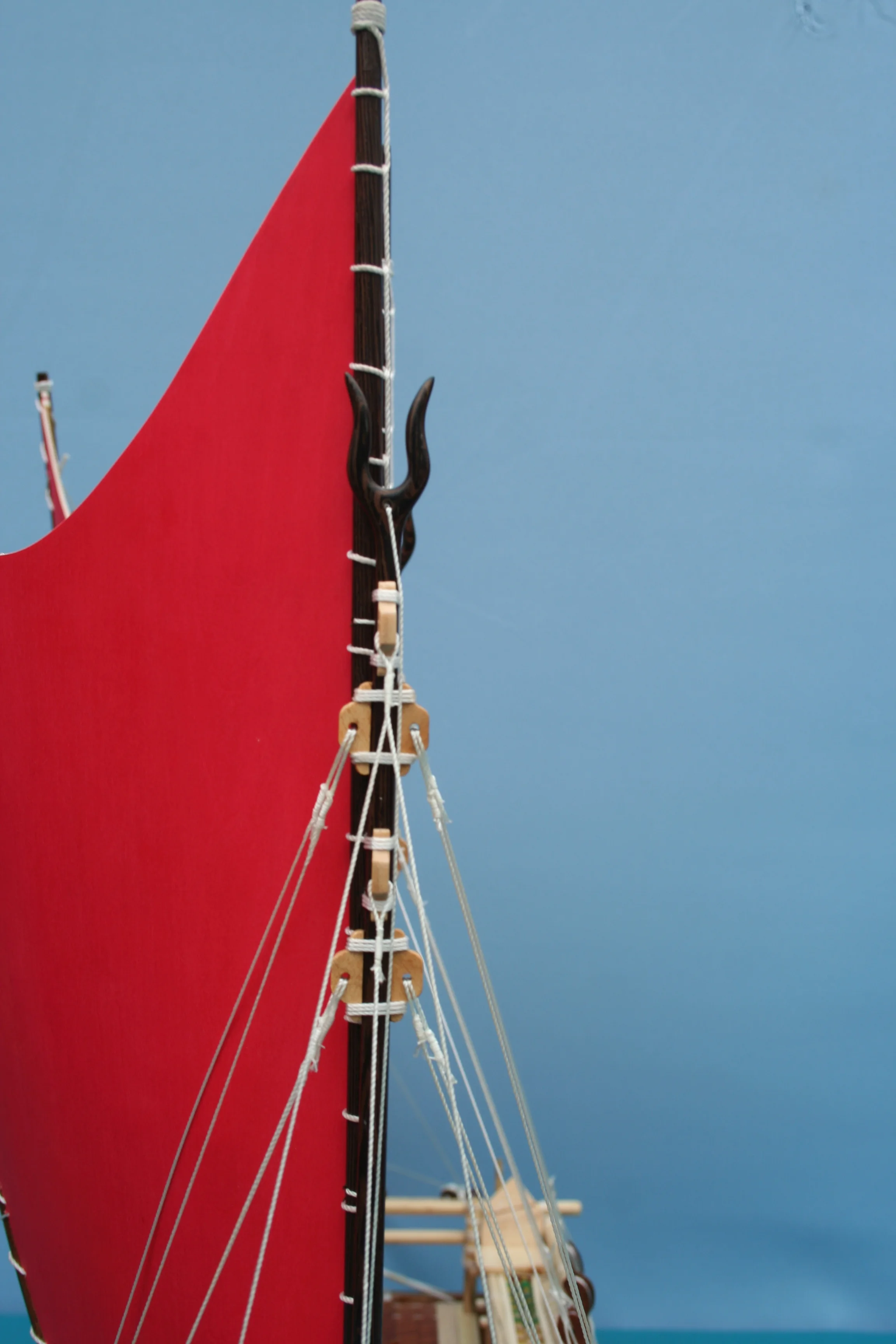
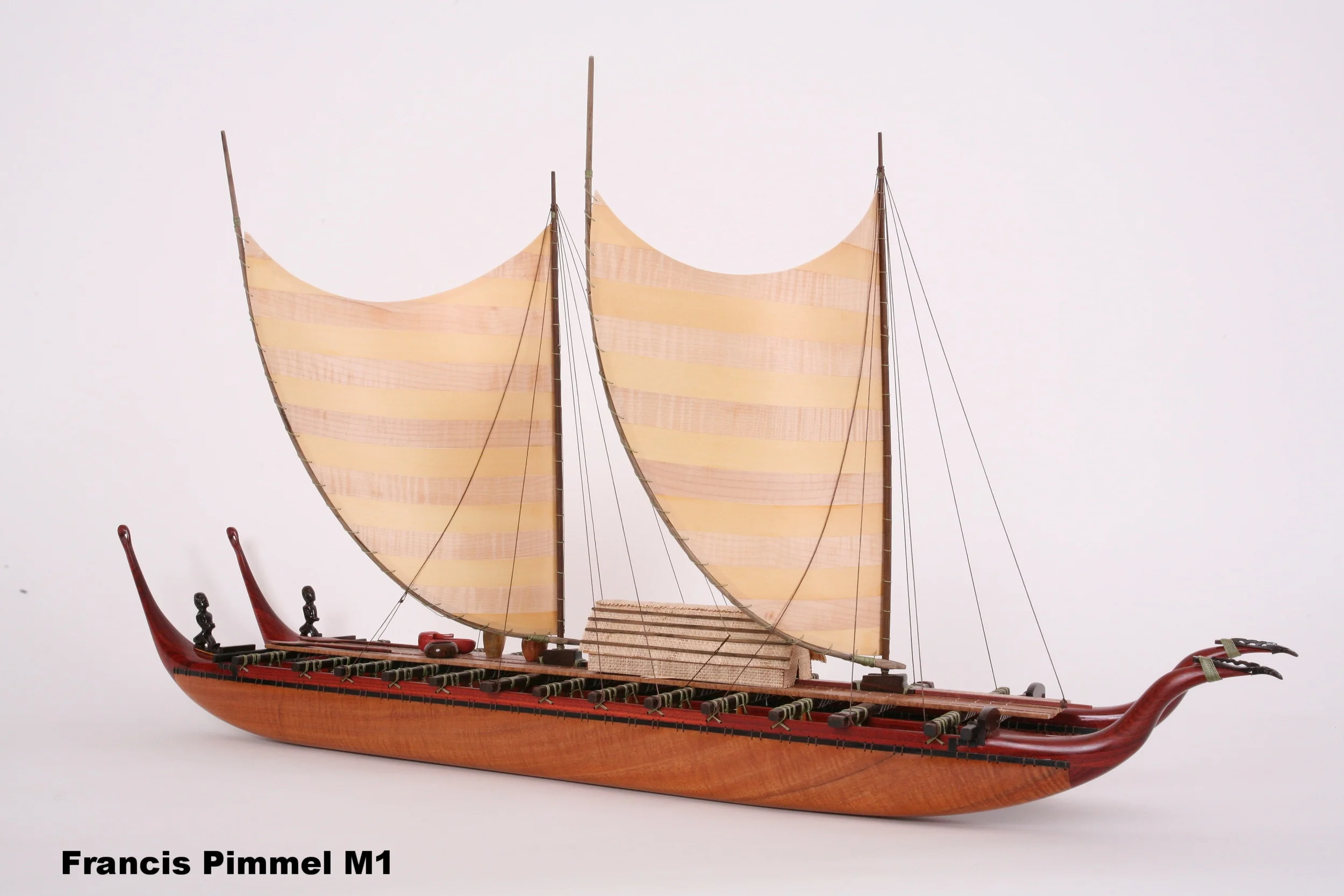
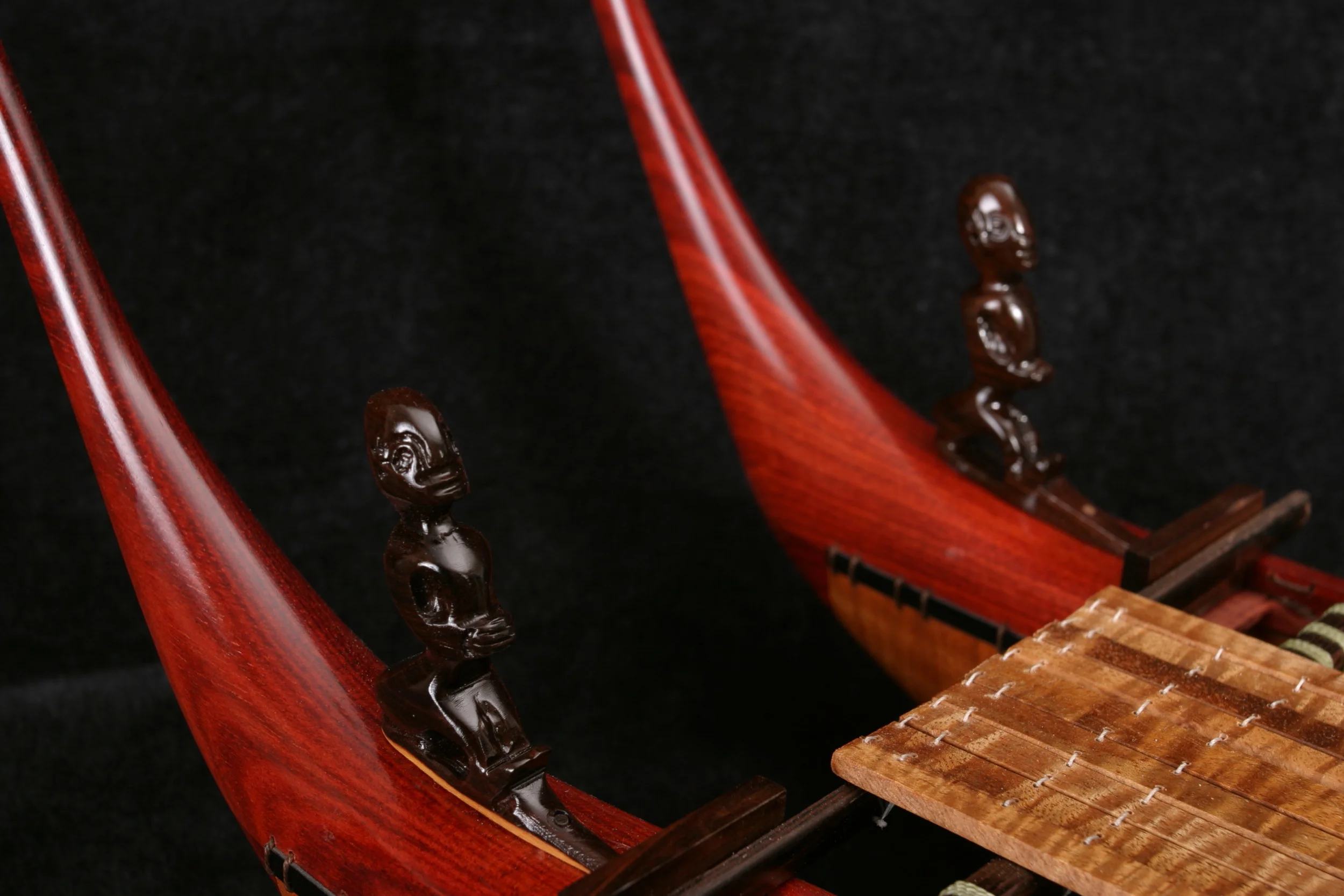
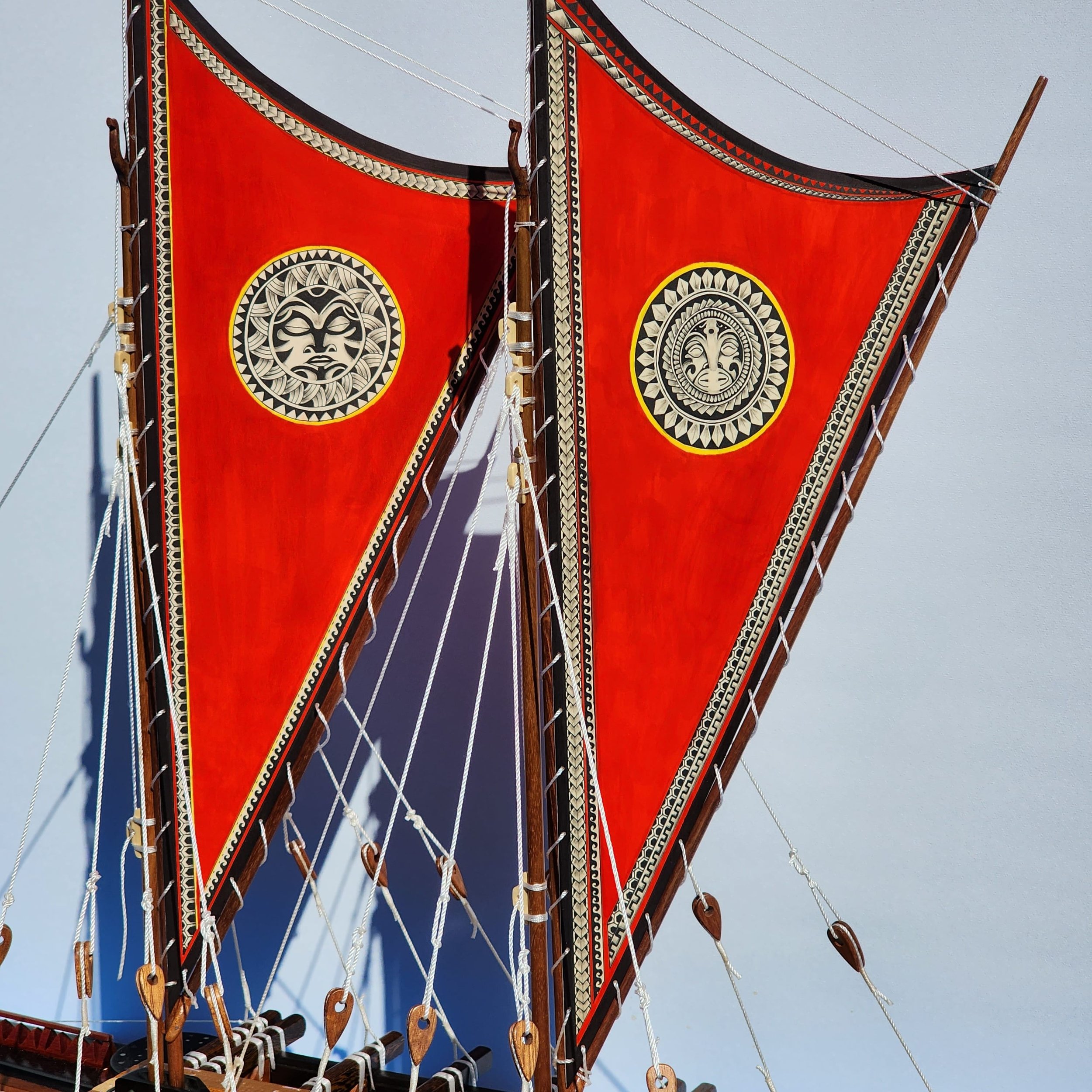
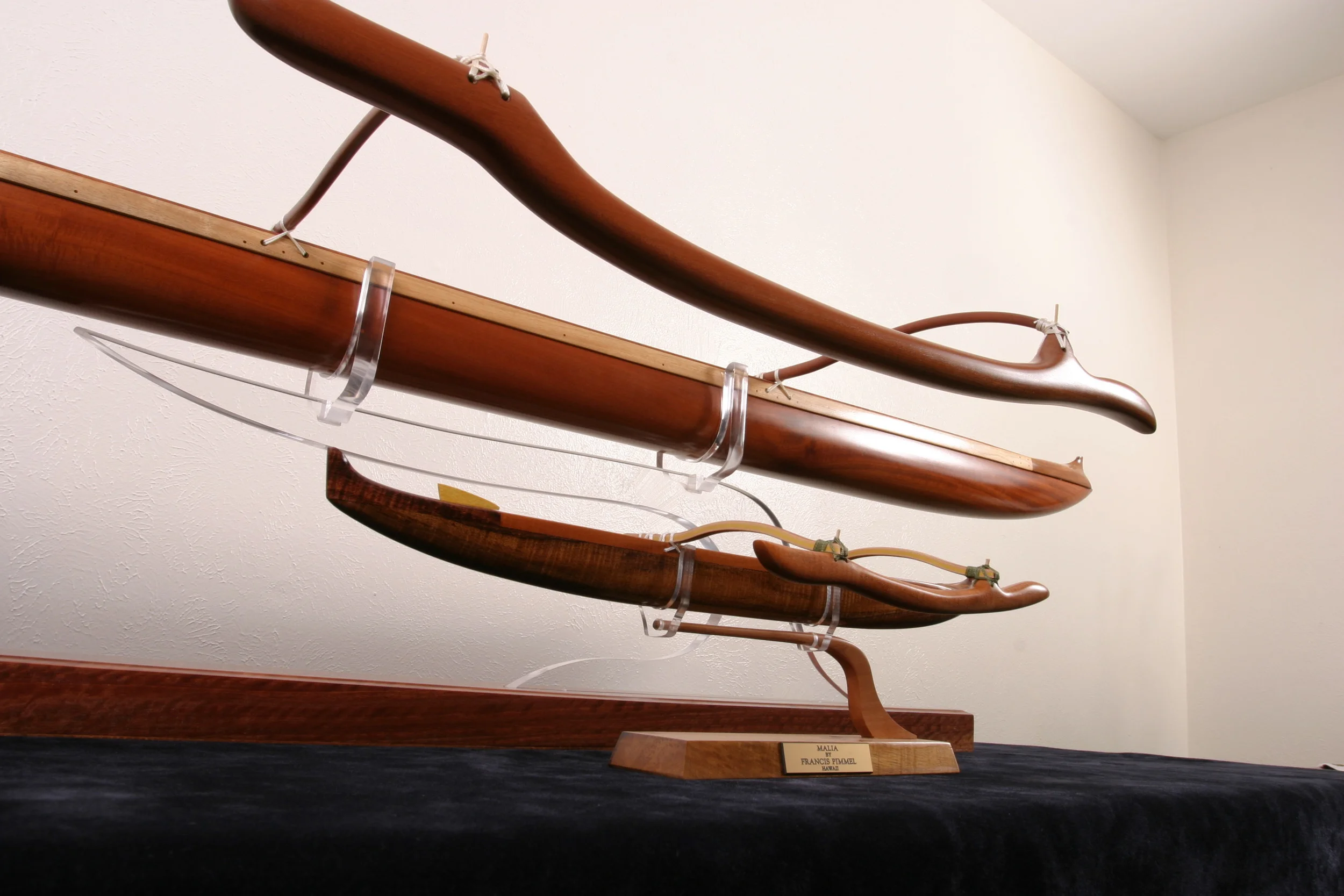
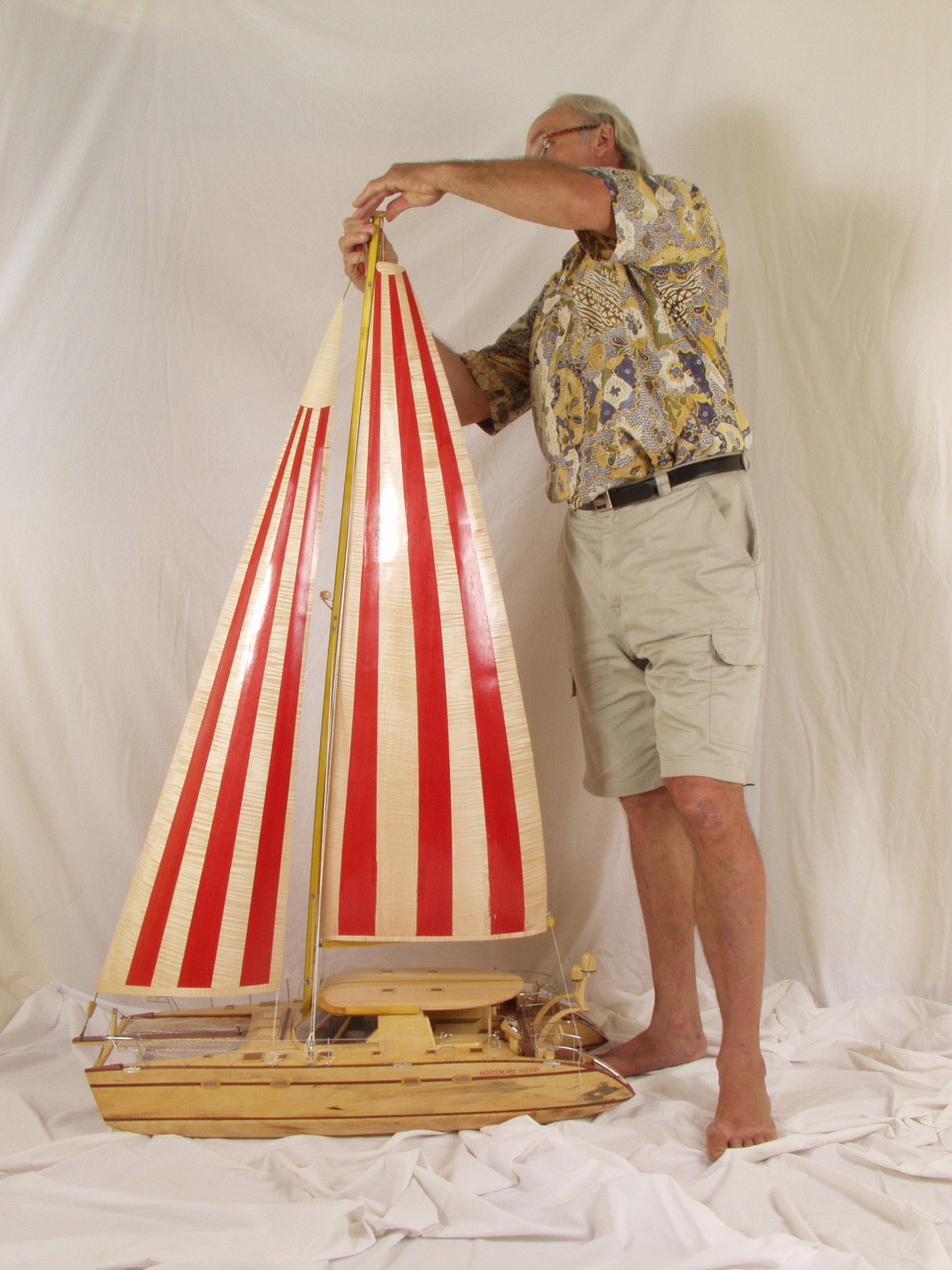
The illustration shows two larger models at various stages of completion. One is a double-hull Marquesan canoe, and the model with the red designer sails is a Hokule'a. Building a canoe involves sawing, cutting, and carving pieces from Koa or other types of wood, which creates dust. I perform this task in another workshop equipped with the necessary machinery.
More pictures of my models can be found on Instagram.com/Francispimmel
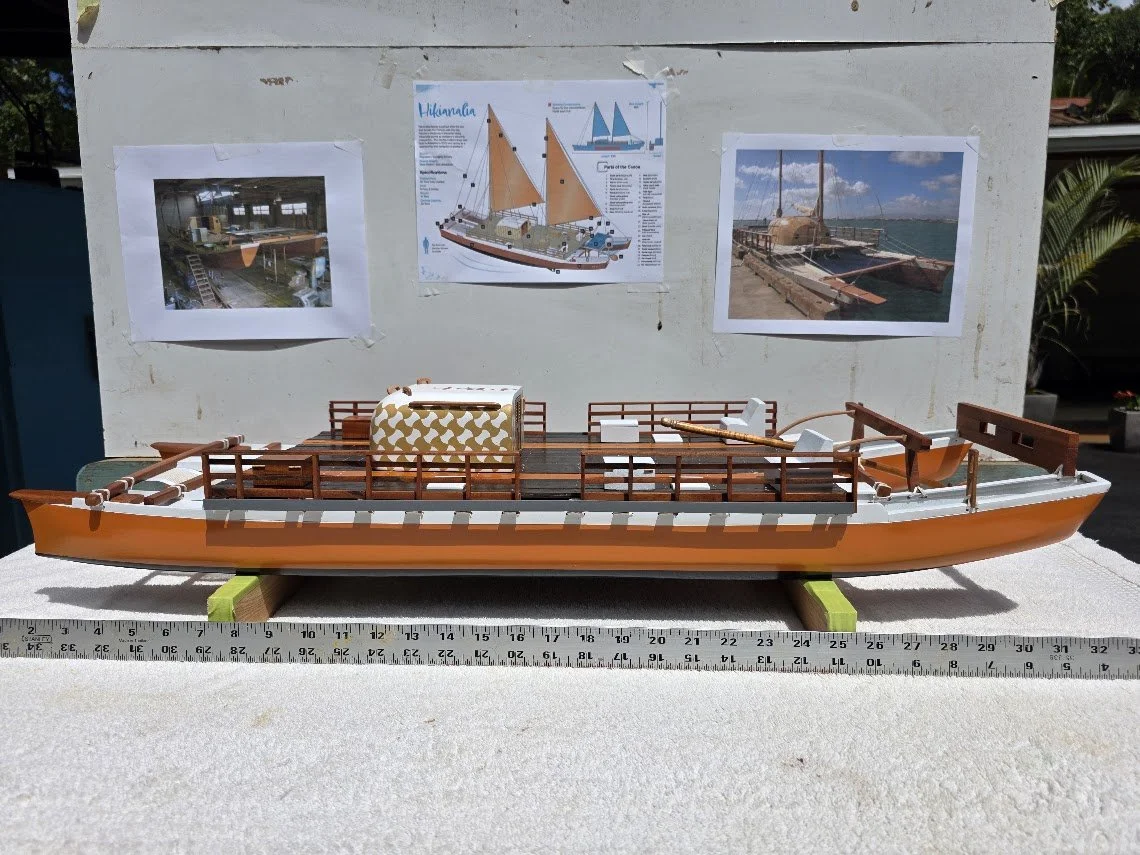
HIKIANALIA — Scale Model (Work in Progress)
Model length: 34 inches
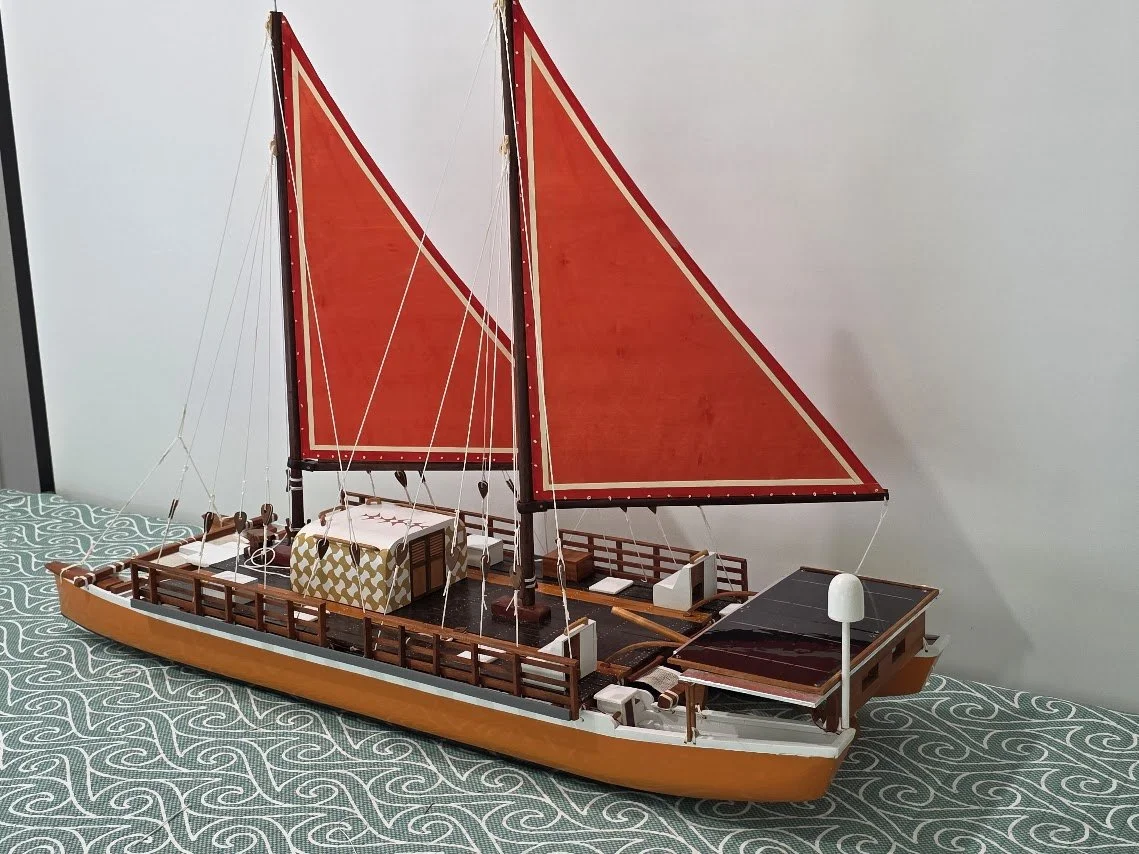
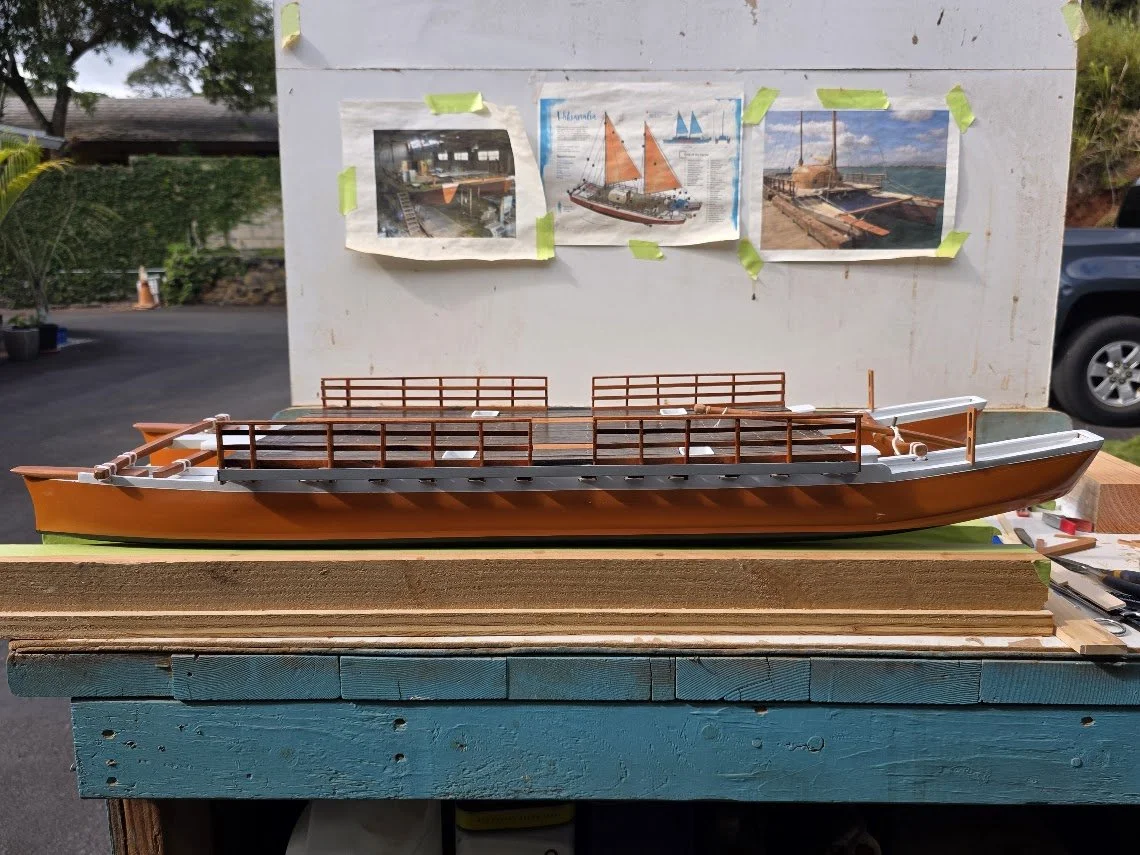
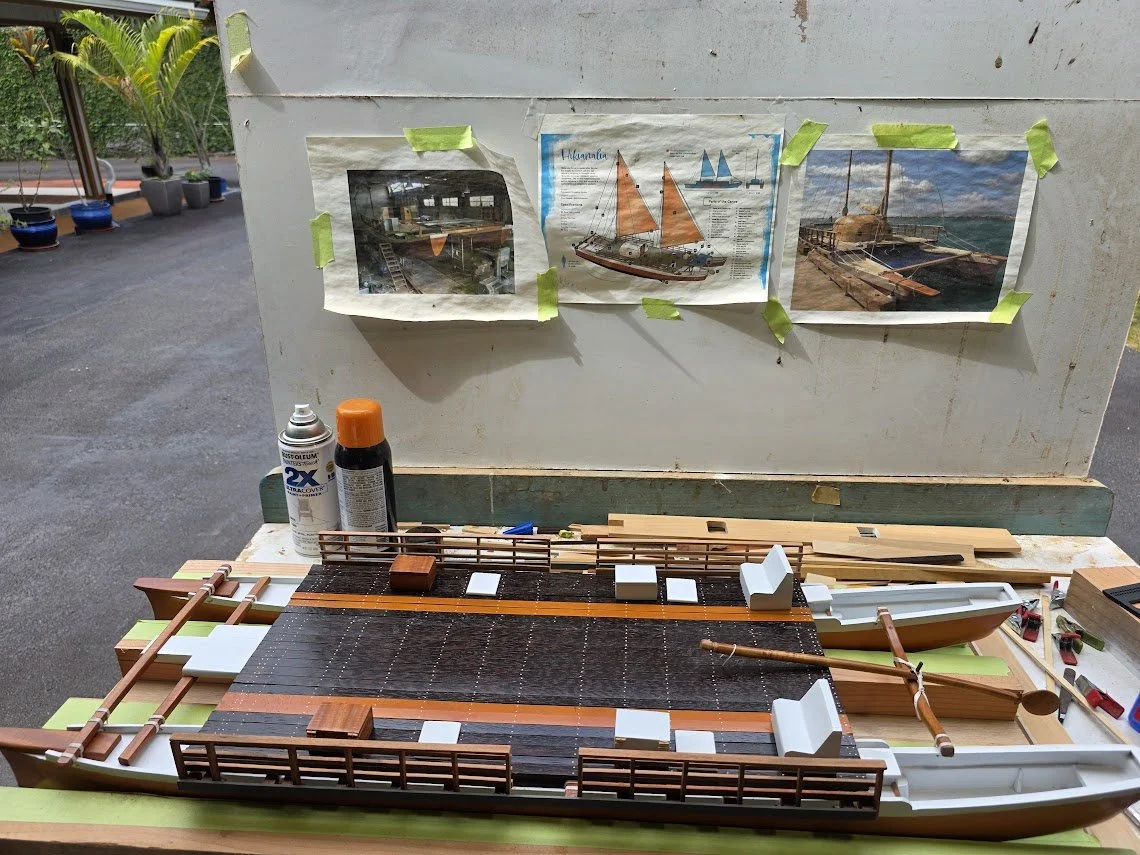
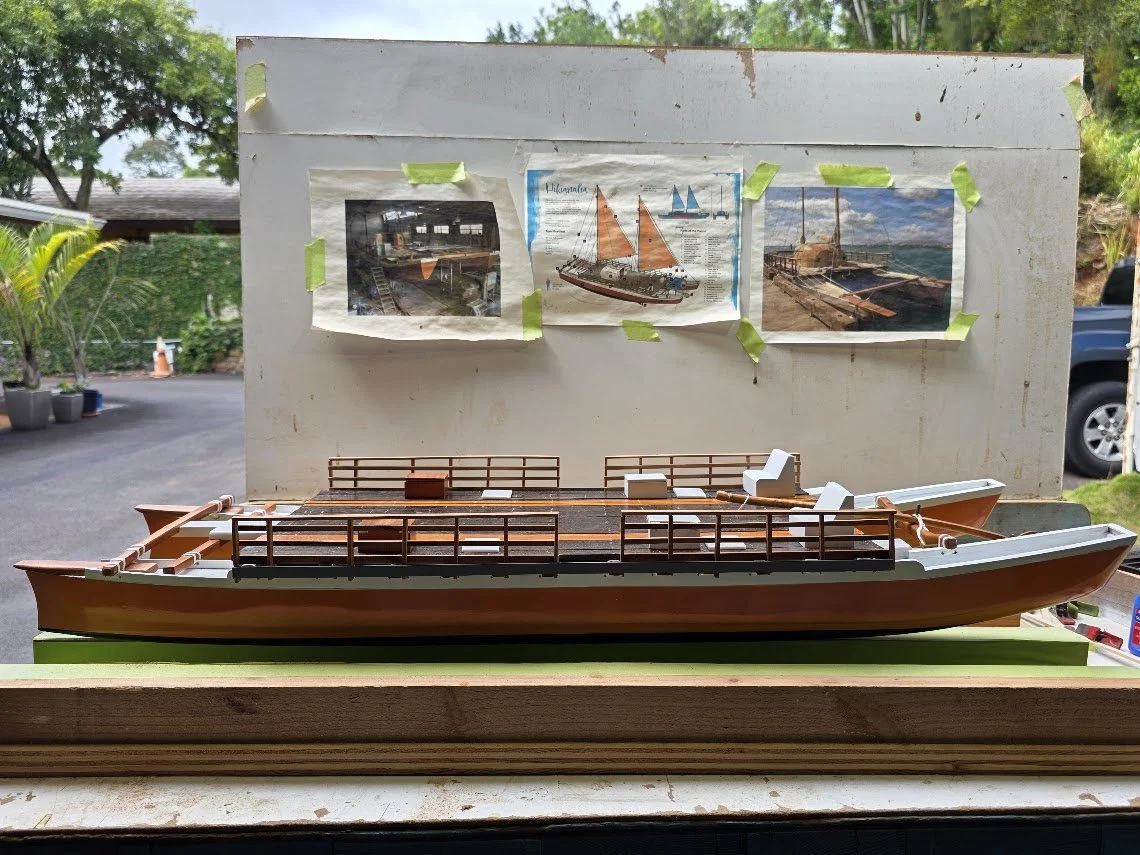
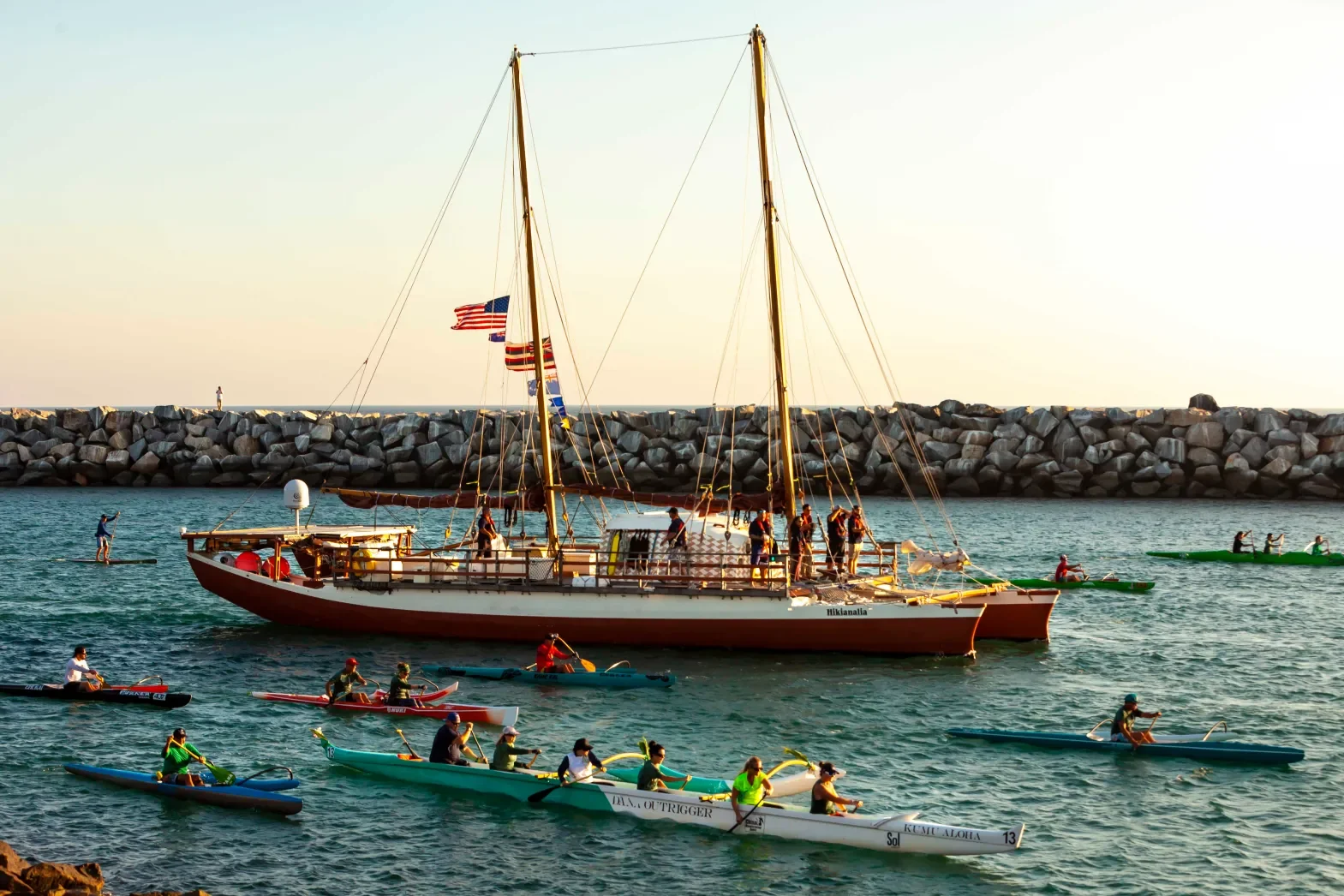
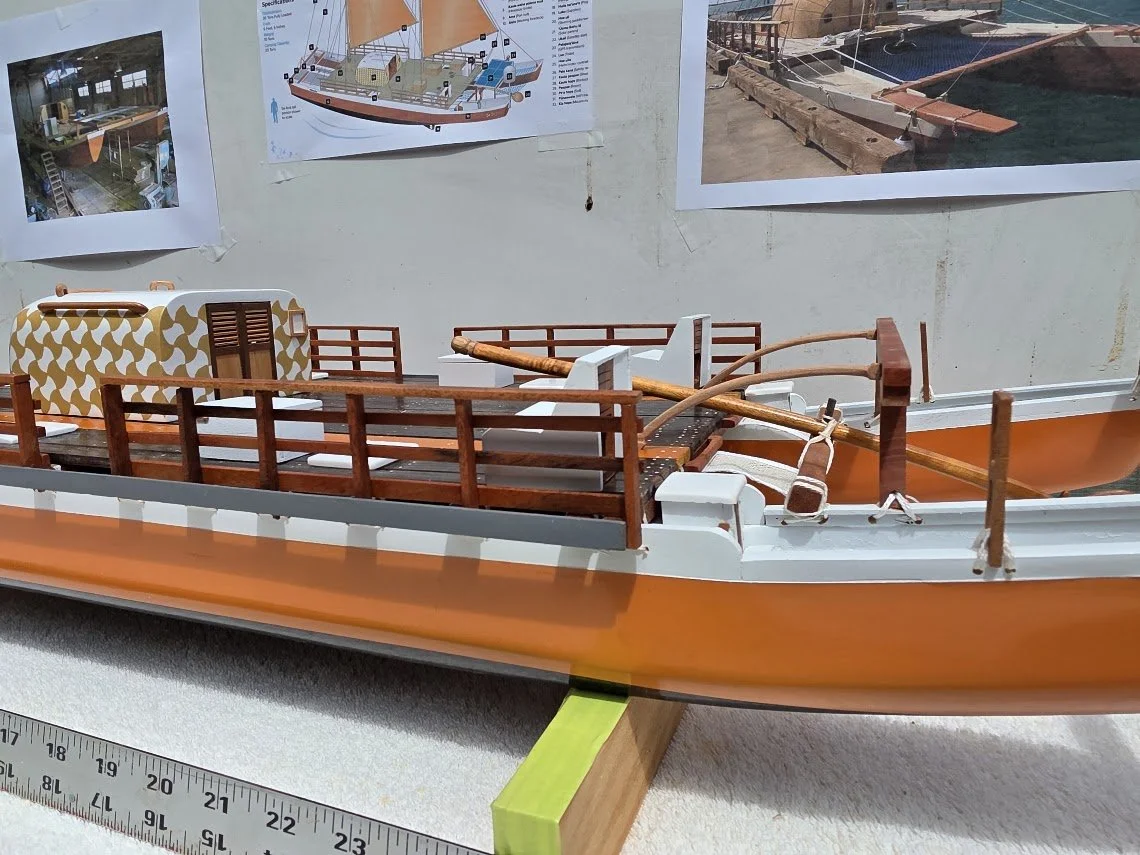
I have long hesitated to undertake a scale model of Hikianalia. The vessel’s hybrid design—combining catamaran attributes with features of a traditional Polynesian voyaging canoe—presents unique challenges in interpretation and construction. Nevertheless, at the request of a client who wished to include Hikianalia in a curated collection of Polynesian voyaging canoe models, I began this project three months ago.
A work in progress
A work in progress.
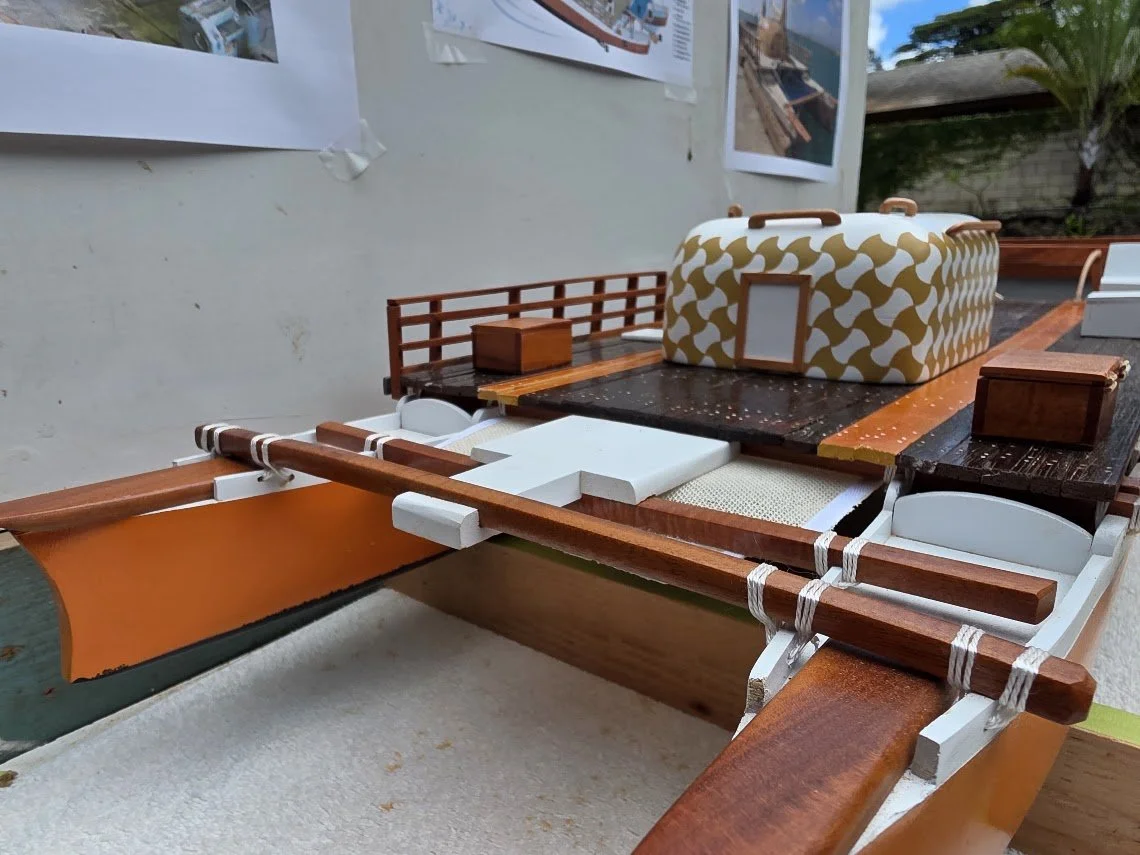
A work in progress
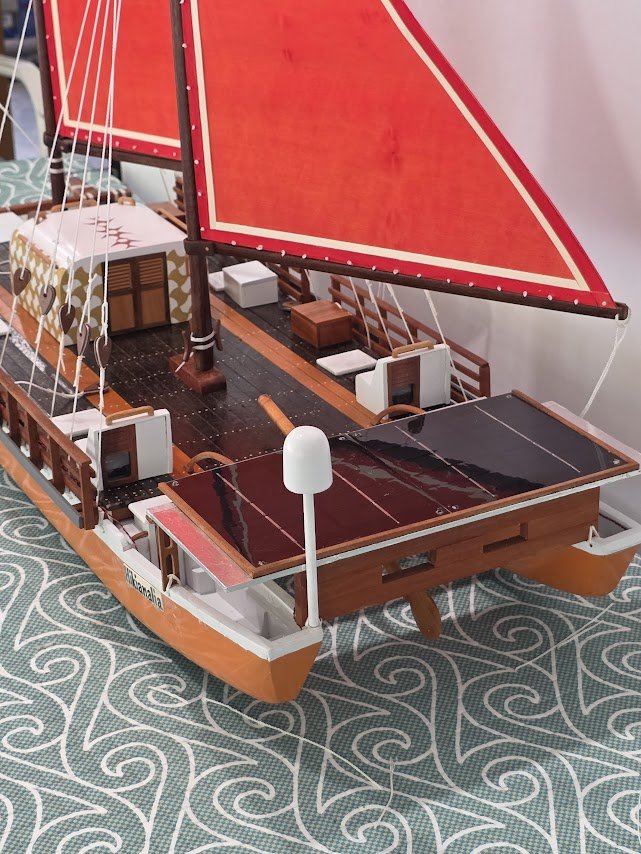
The “hale” or “hut” has now been added., so the back beams supporting the solar panels.
Nothing was easy to build on that model.
Forward section of Hikianalia..
https://www.youtube.com/watch?v=R5F4PqATcgY
I have always been fascinated by the Pacific cultures and the multitude of different type of canoes associated with them, in particular those carved within the Polynesian Triangle, Micronesia and Melanesia. So my interest, as a canoe modeler, does not simply rest in re-creating ancient types of Hawaiian canoes or reproduce the Hokule'a, but also to make models of some of the most amazing vessels that were constructed long ago within Oceania but have all but disappeared from its islands. More over, and this is always a particular and exciting challenge, I love to reproduce those larger voyaging canoes that have recently been built in the South Pacific. What ever the type of canoe I decide to reproduce; it is a task that requires in depth research and my lasting gratitude goes towards the late Herb Kane without whom we would not be able to know the beautiful shape of some Oceanic canoes. I also like to refer to the works of Hadden & Hornell and the beautifully illustrated volumes of Jean Neyret. The internet has replaced books and it is while reading online about the Lapita culture, which is at the root of Polynesian culture and famous for its pottery style, that I became interested in the Lapita Voyage Project whose principals were Klaus Hympendahl, a German author and photographer, explorer, sailor and ship architect of catamarans James Wharram, and Hanneke Boon who is Wharram's design partner.
The objective of the Lapita Voyage Project was to build two double hull canoes and sail them from the Philippines to the island of Anuta, a route of 4,000 miles believed to be the one used by the Lapita culture during their eastward expansion. The name of the two canoes would be "Child of the Sea" or Tama Moana. They would be based on the construction style of Hawaiian voyaging canoes and incorporate design principles from the islands of Anuta and Tikopia. Their size would be 37 feet in total length with a beam overall of 14 feet. The length of the above model is 38 inches (96.5 cm) and was completed in March 2011. The model is sold.
Click here to see photos of this canoe during phases of it's construction.
Further reading regarding the Lapita canoe:https://www.lapitavoyage.org/concept_canoes.htmlruction.
Port site view
Each sail is made up of 24 individual panels and set in such a way to create a sun at its center. It took me a few days of trial and error to build those sails.
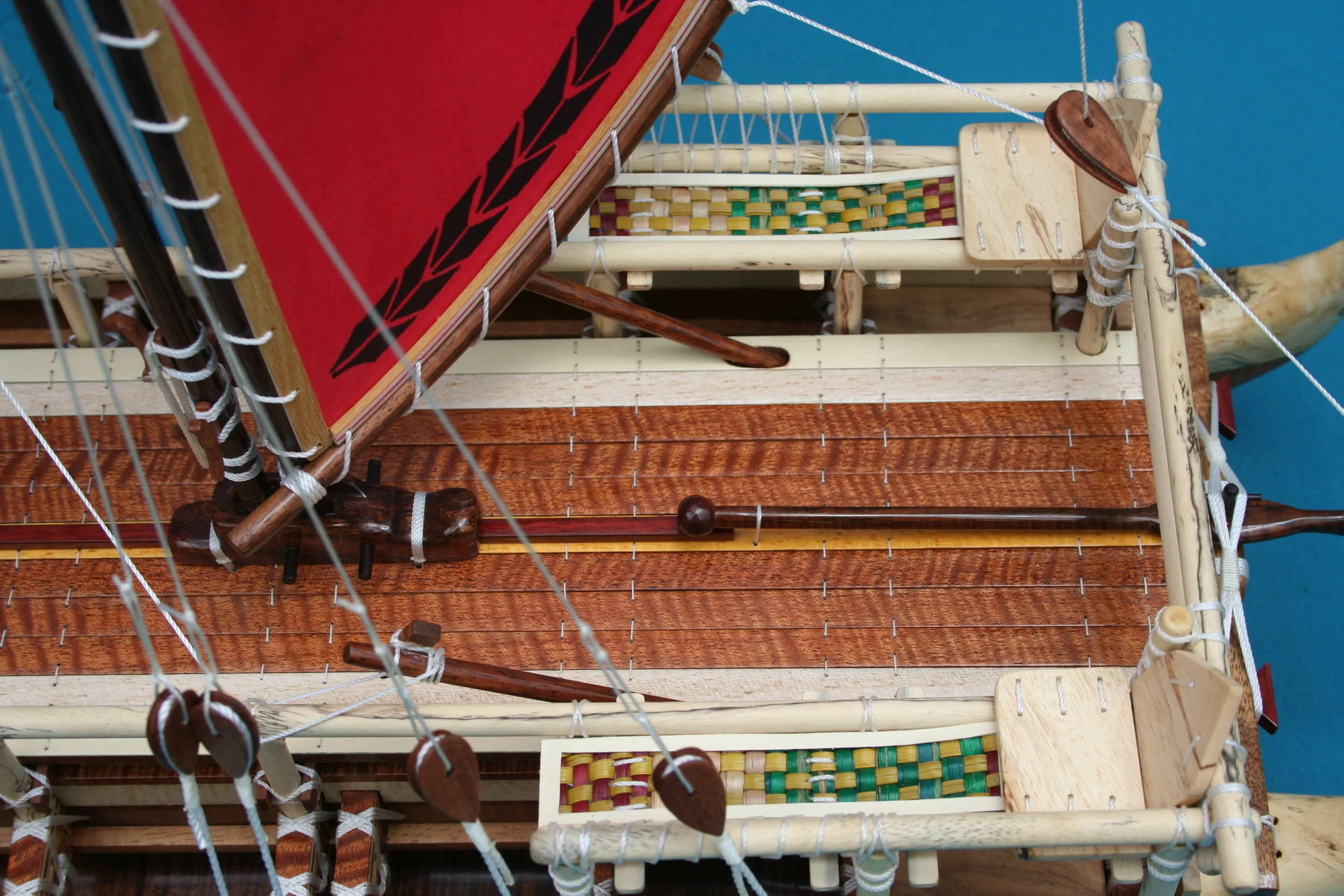
Showing part of the deck and the panels covering the hull. I have been using Koa for the deck and some beautiful Primavera wood for the fame of the panels.
Volumes have been written about the voyages of Hokule'a. TV documentaries have been shown worldwide testifying to the seaworthiness of this remarkable double-hull canoe. Songs have been composed to praise its beauty and relevance in the hearts of the Hawaiian people.
Hokule'a, a pioneer in its own right, was conceived in 1974 following a visionary proposal by the Polynesian Voyaging Society. The proposal aimed to construct a replica of an ancient Polynesian voyaging canoe and embark on a round-trip voyage between Hawaii and Tahiti. The voyage's purpose was to delve into the depths of Polynesian non-instrument navigation. Since its inaugural, and remarkably successful voyage in 1976, Hokule'a and its crew of skilled navigators and sailors have traversed the Pacific Ocean on numerous occasions, leaving a trail of awe and wonder in their wake.
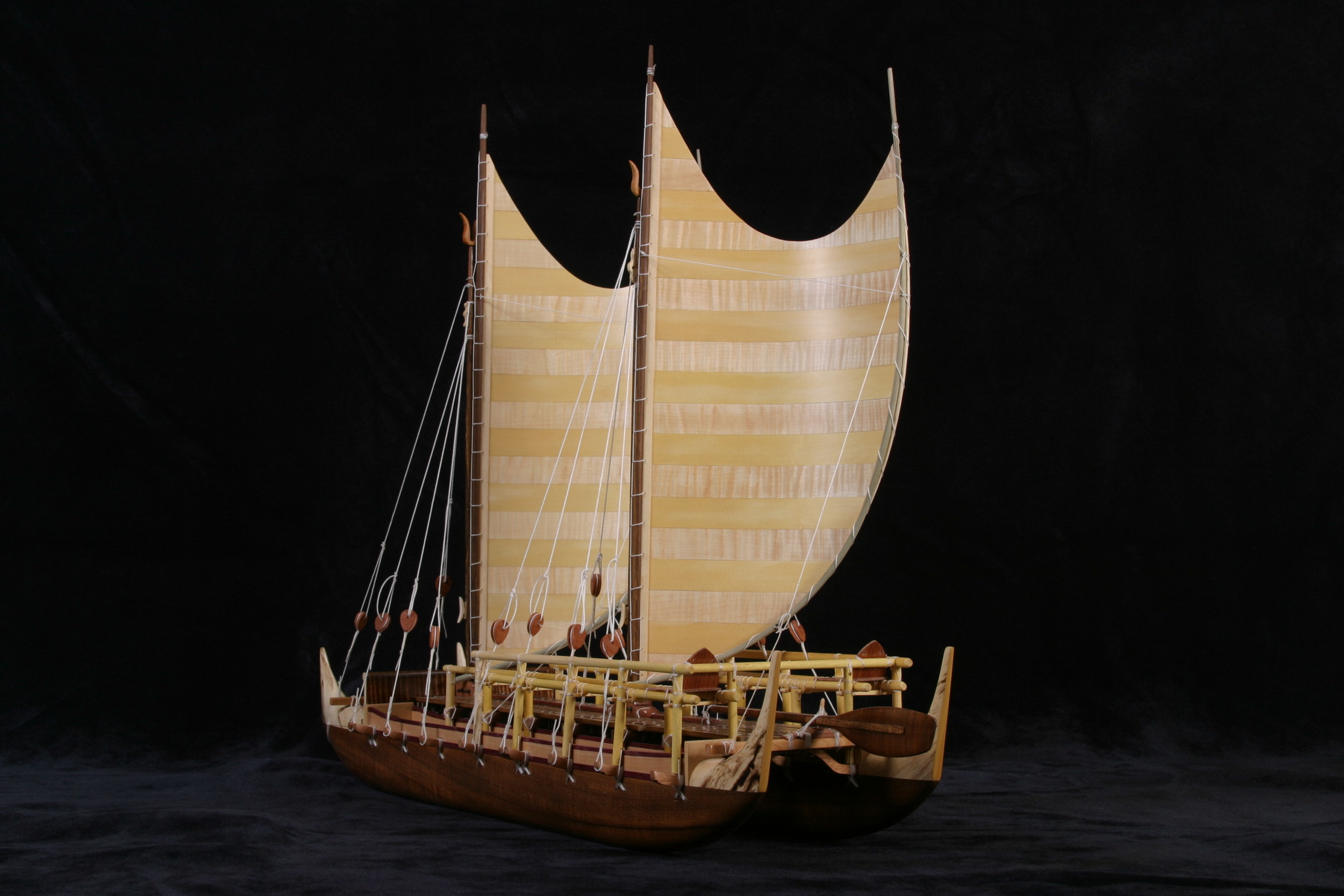
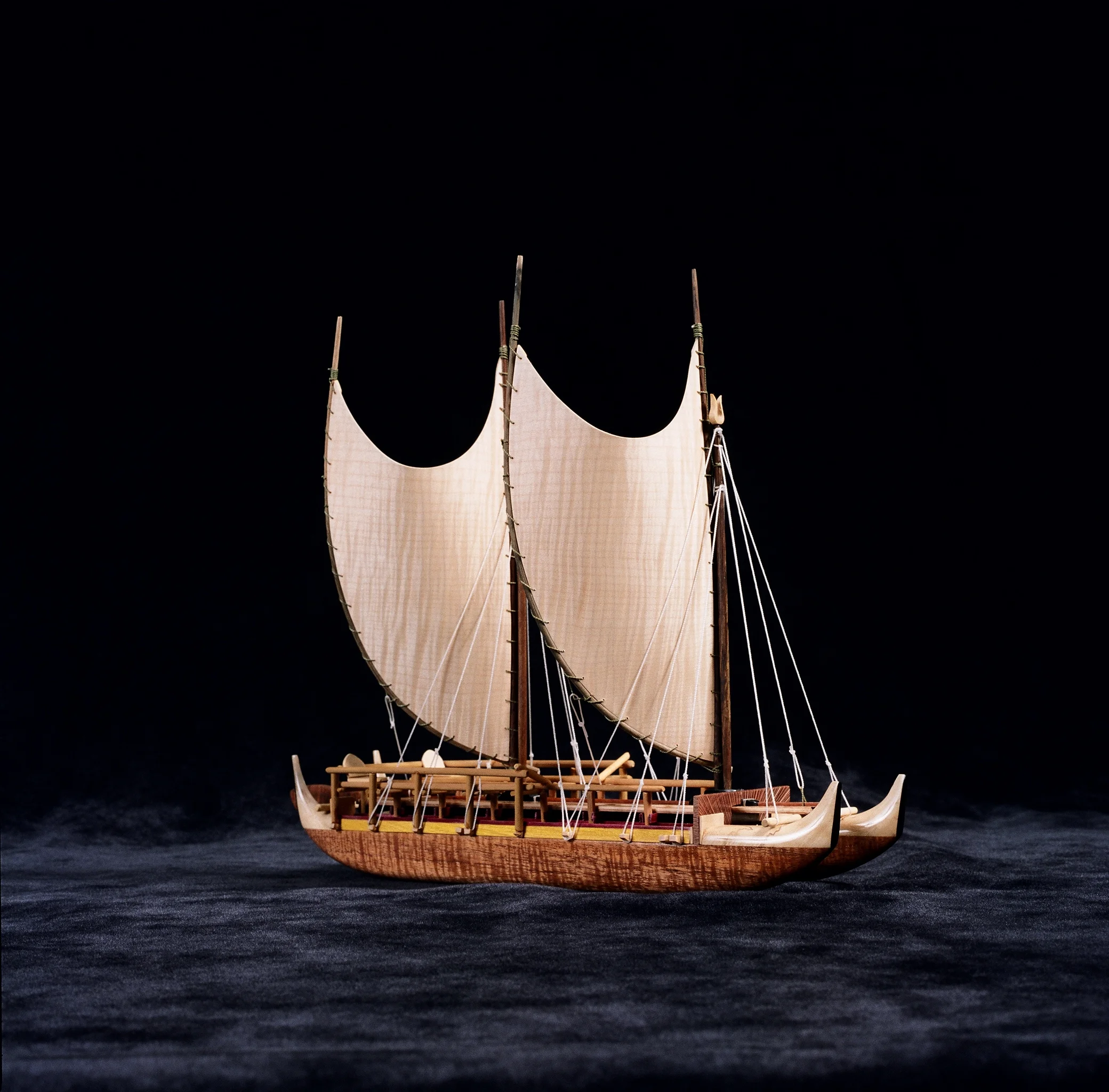
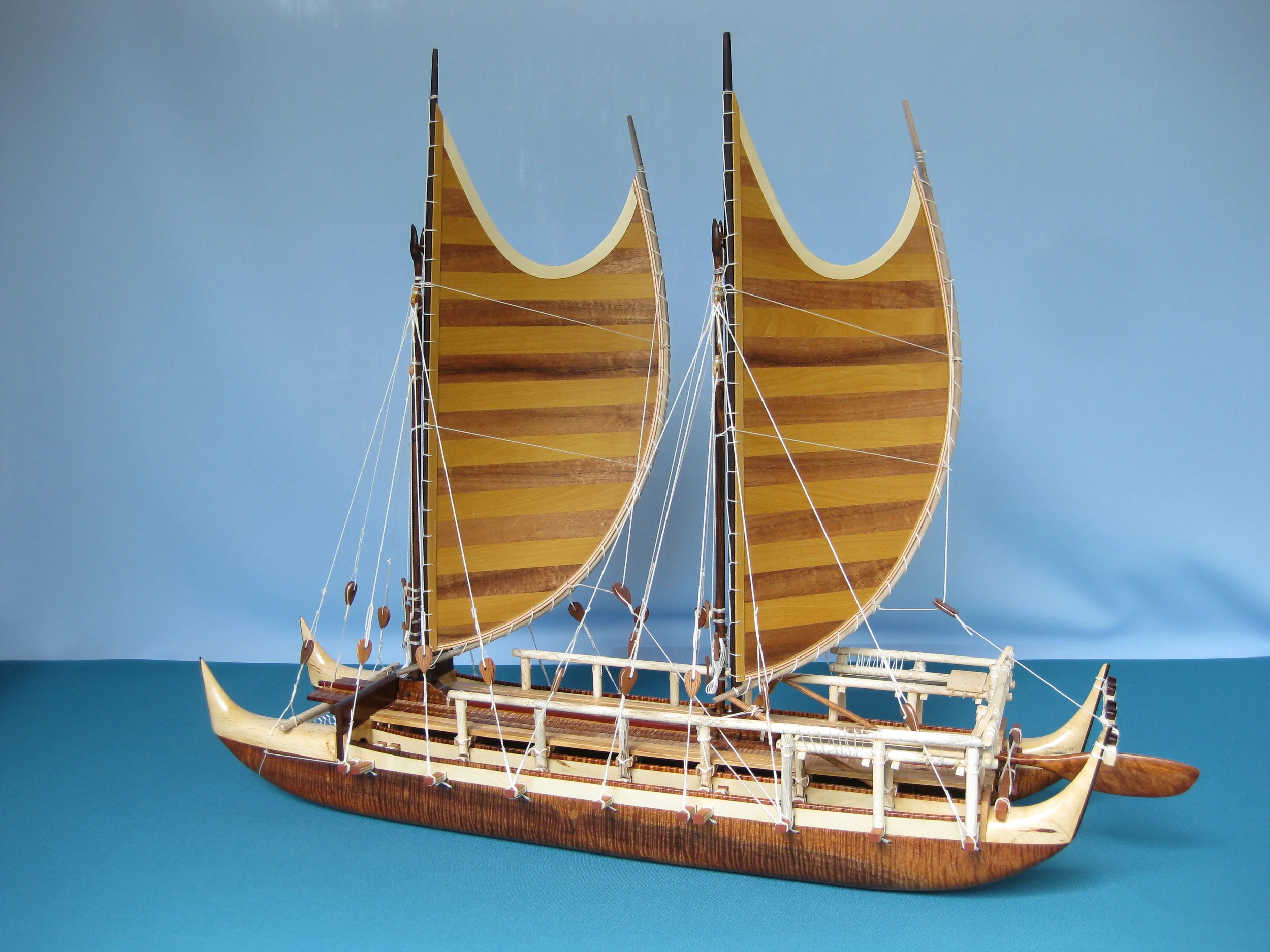
The design of Hokule'a is based on pictorial reconstructions by the late Herbert Kawainui Kane, who was an authority on Polynesian voyaging canoes. His book "Voyagers" contains beautiful images illustrating voyaging canoes. Those illustrations have inspired some of the model canoes in this section. This album is primarily dedicated to the double-hull voyaging canoe Hokule'a.
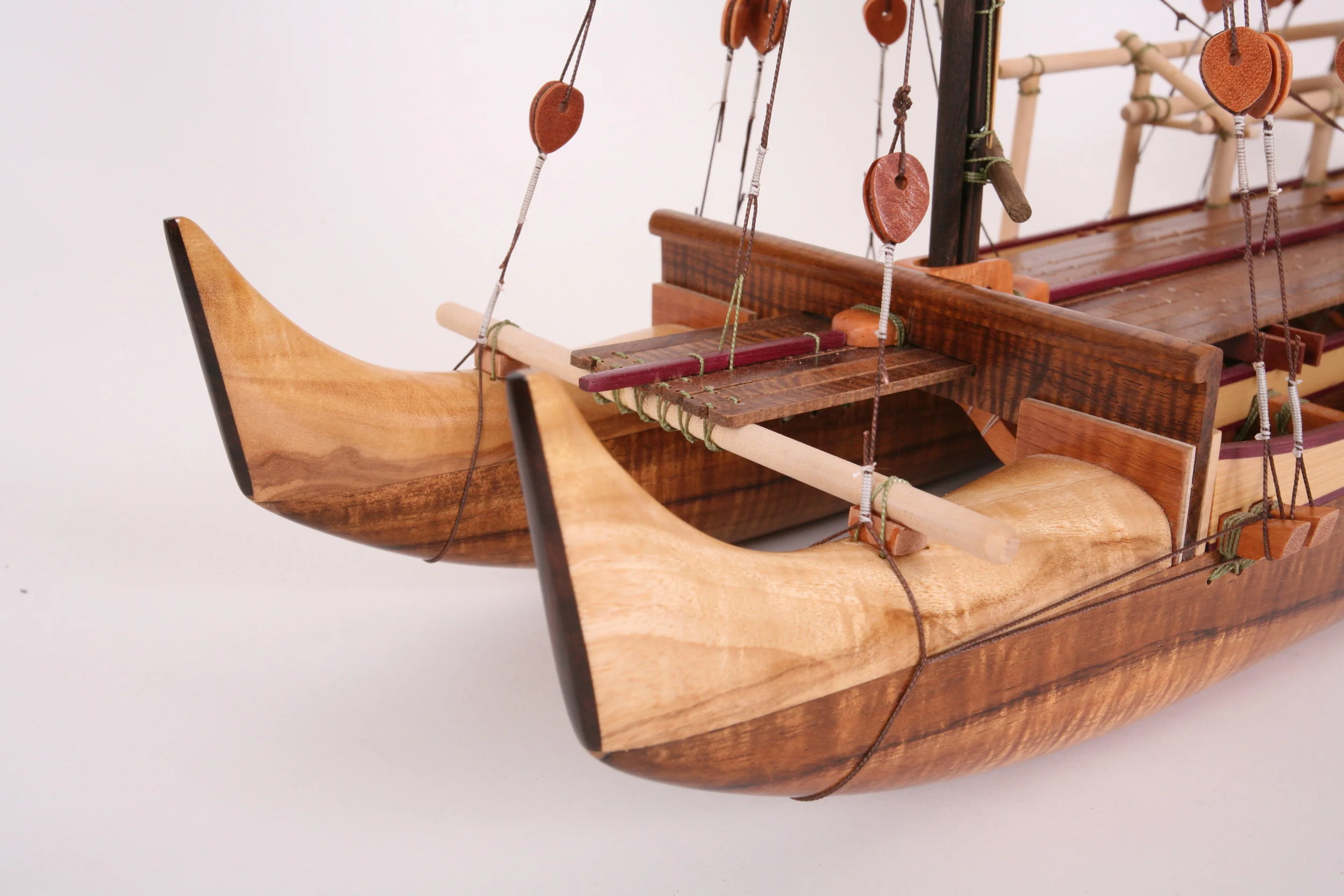
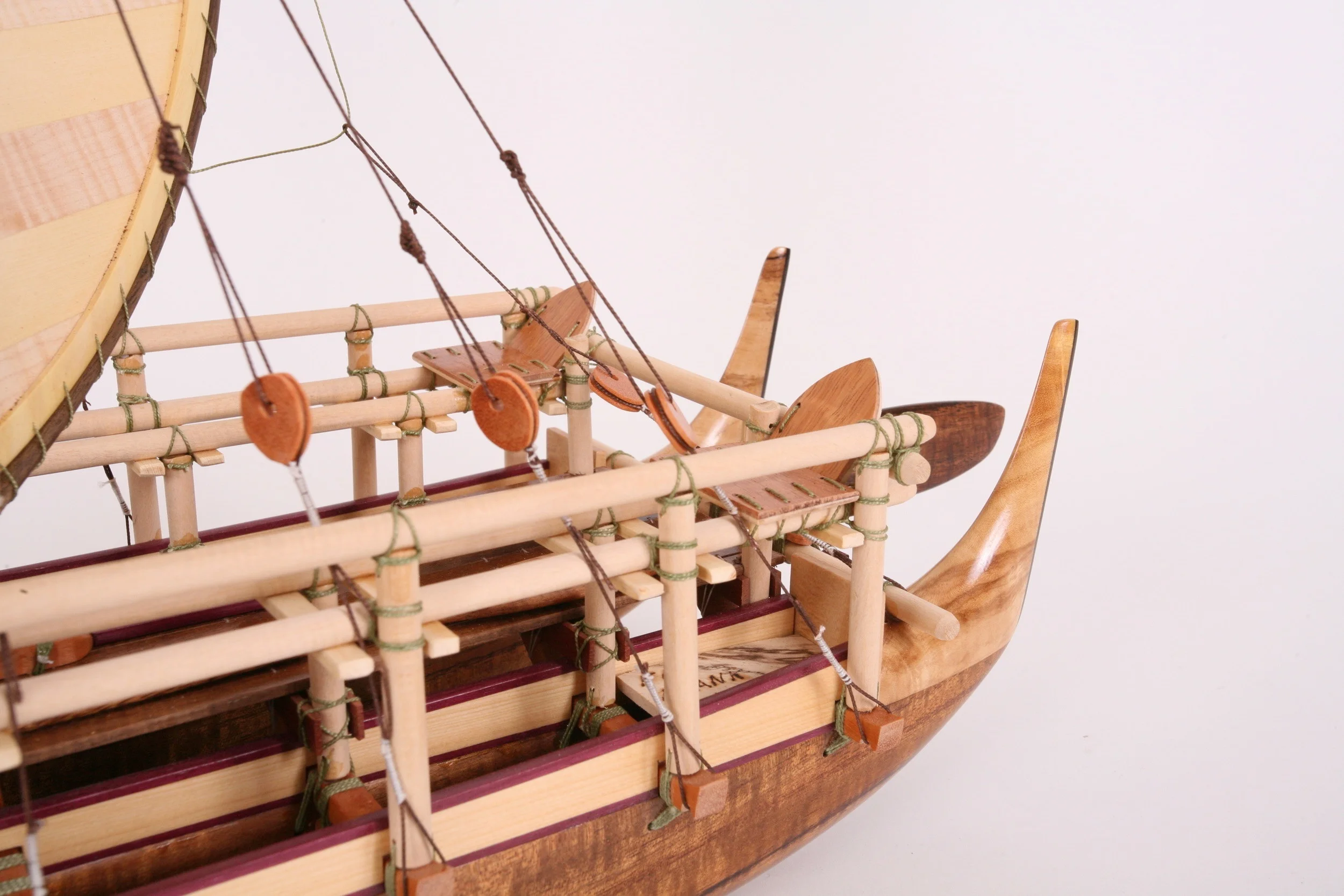
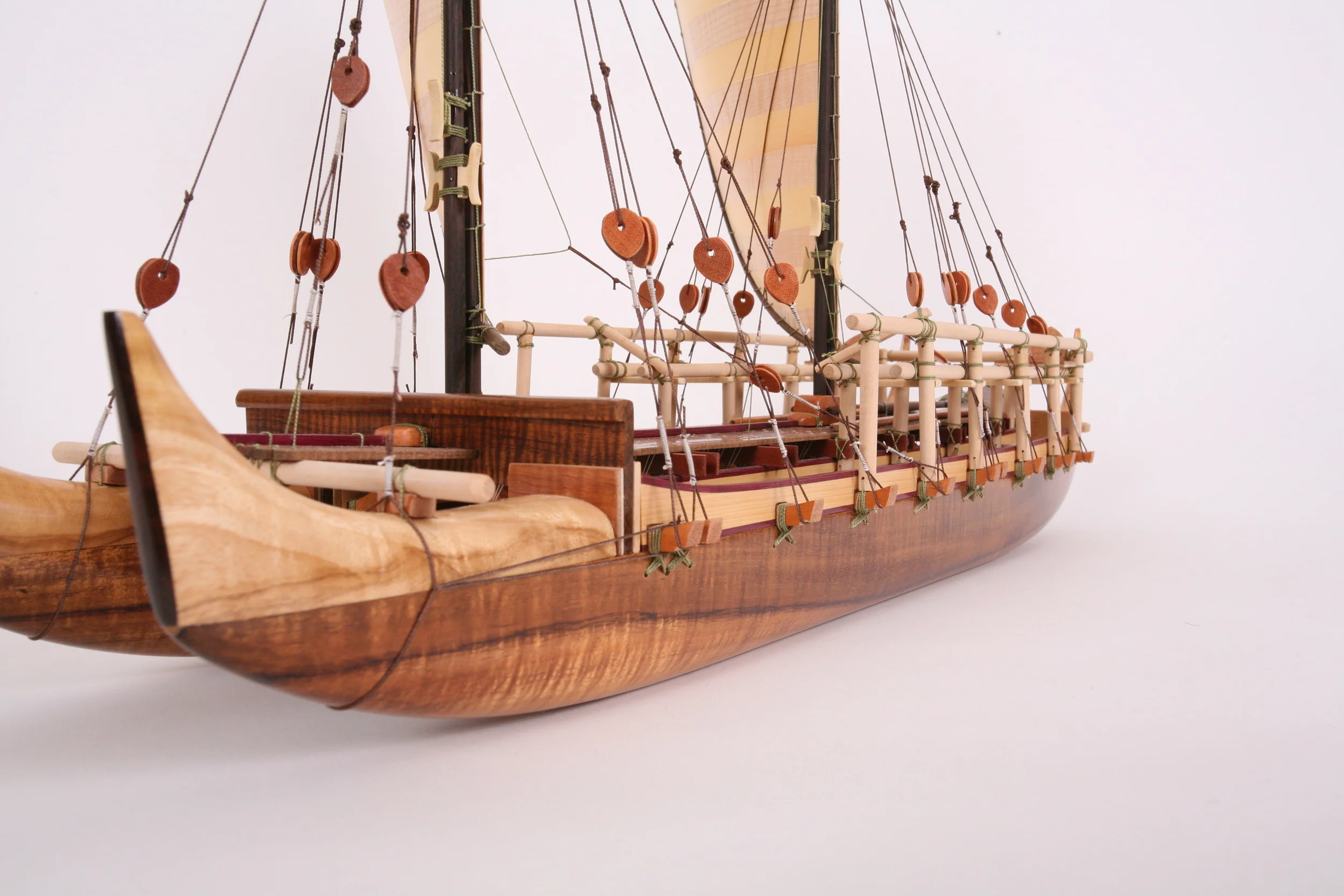
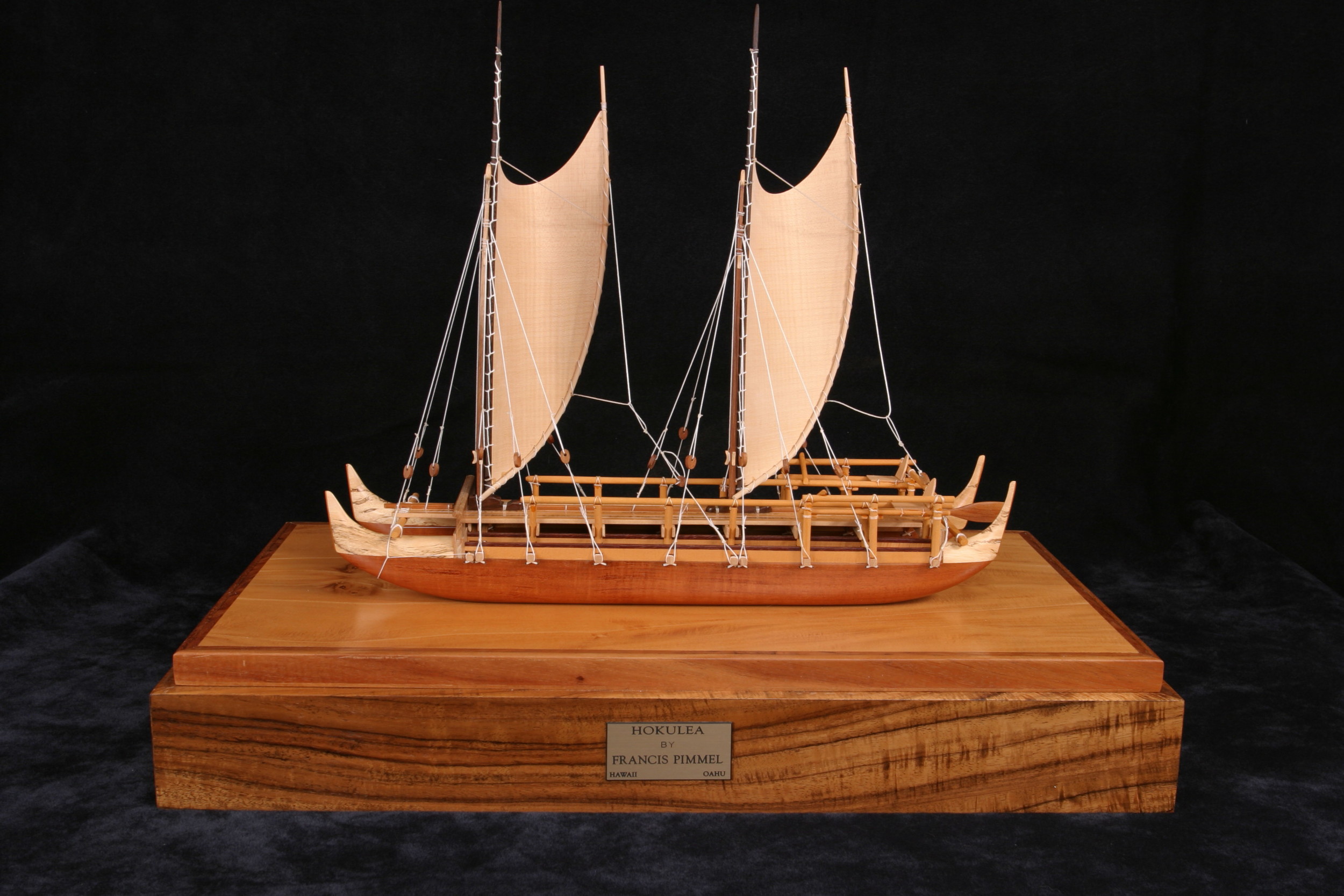
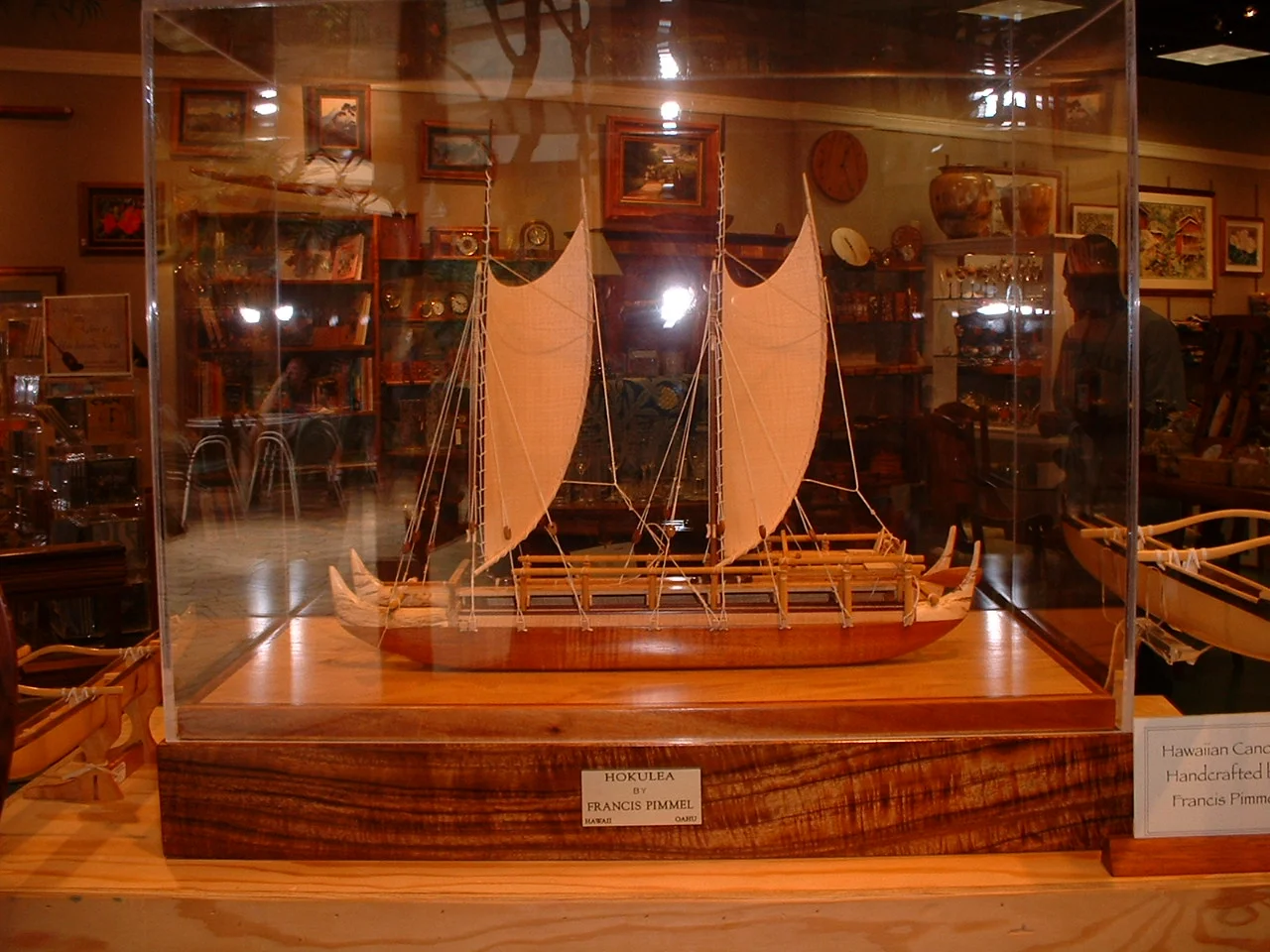
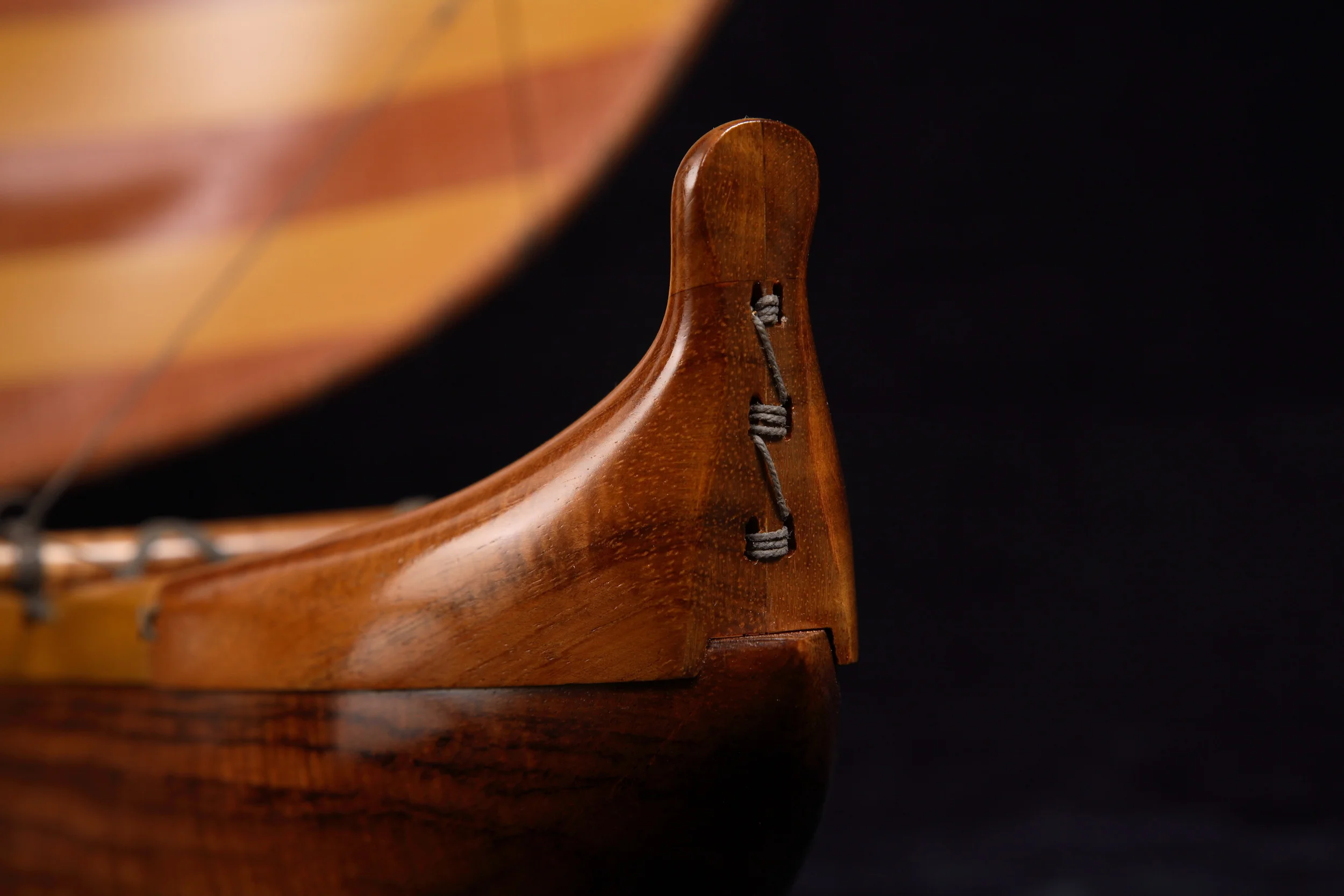
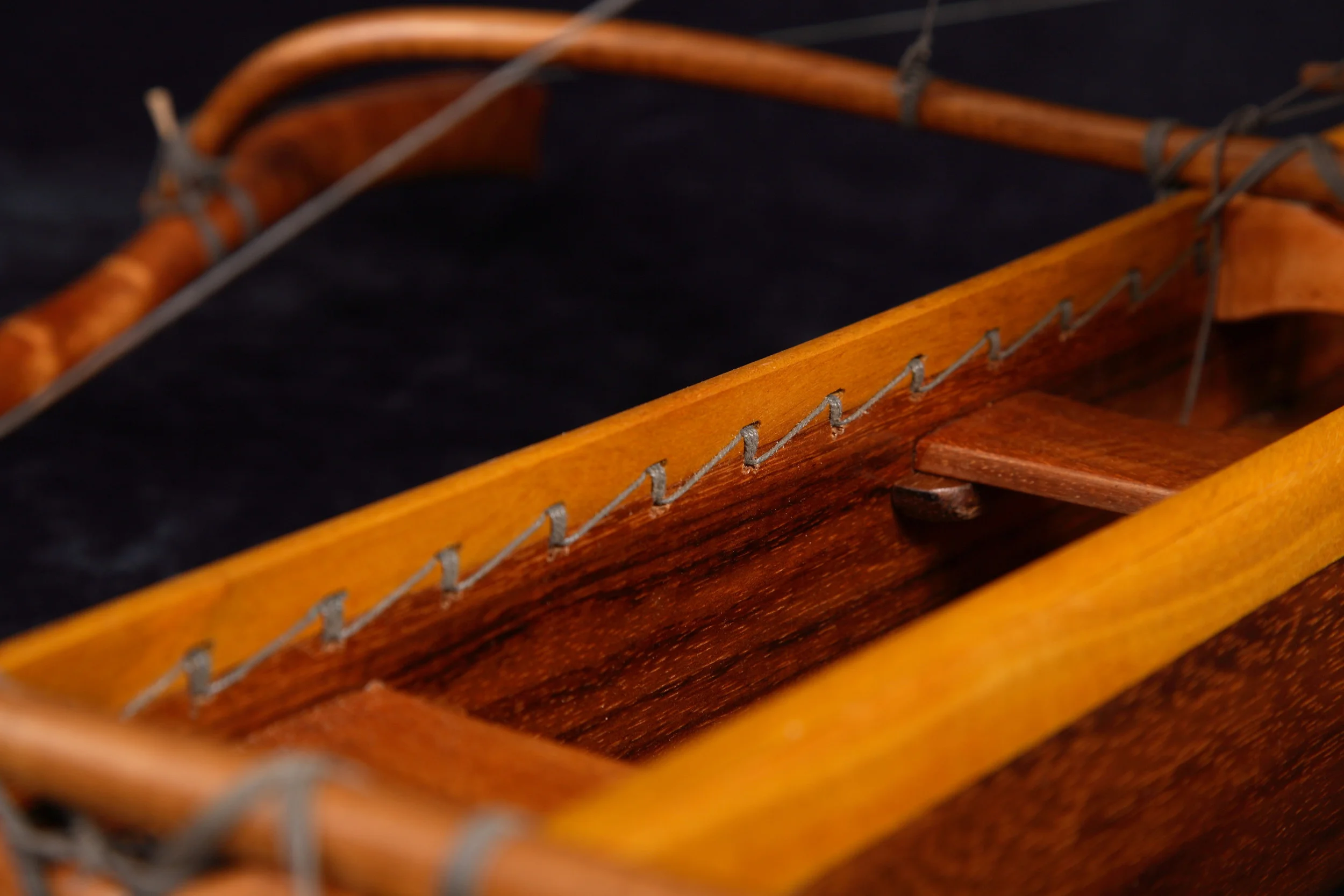
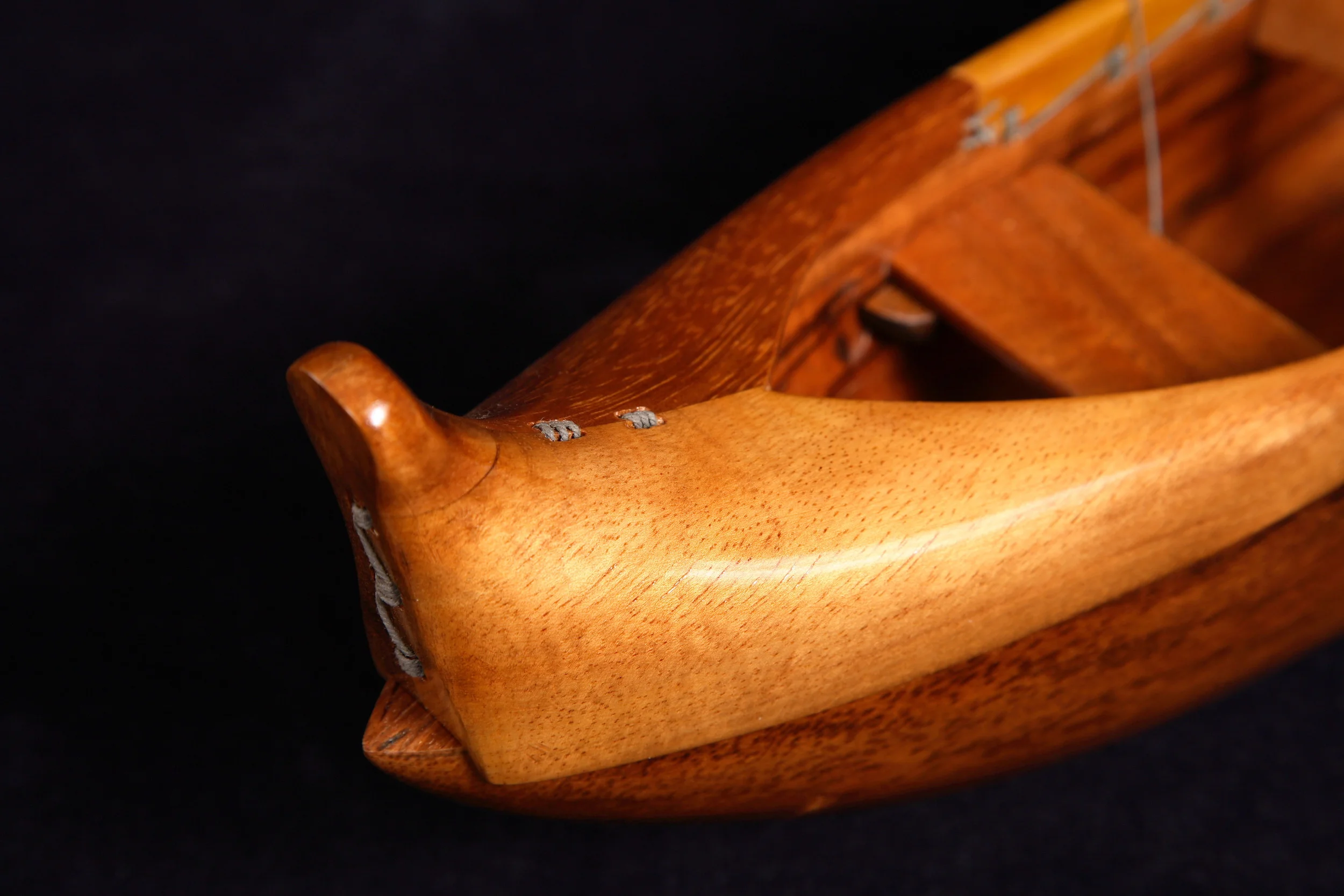
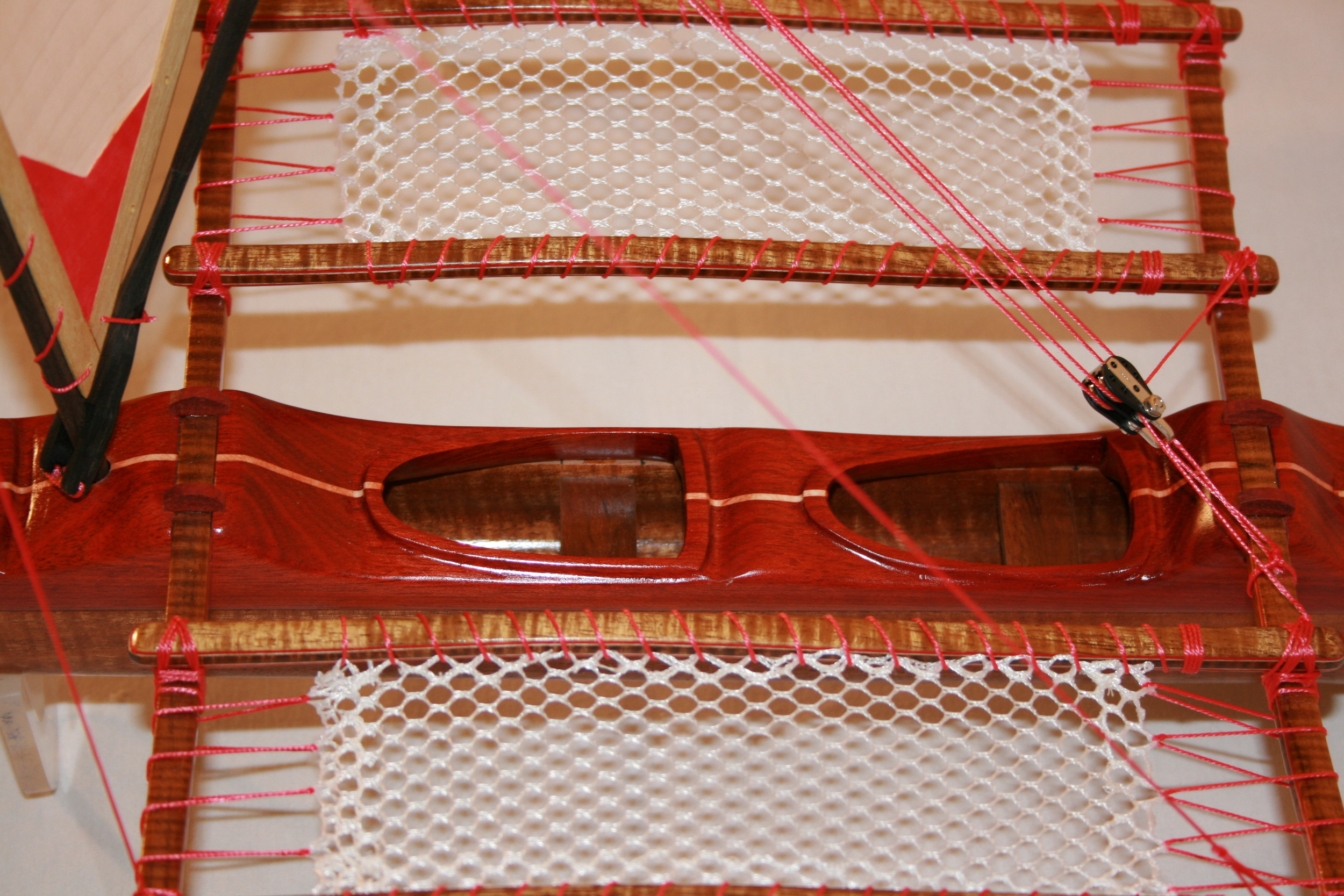
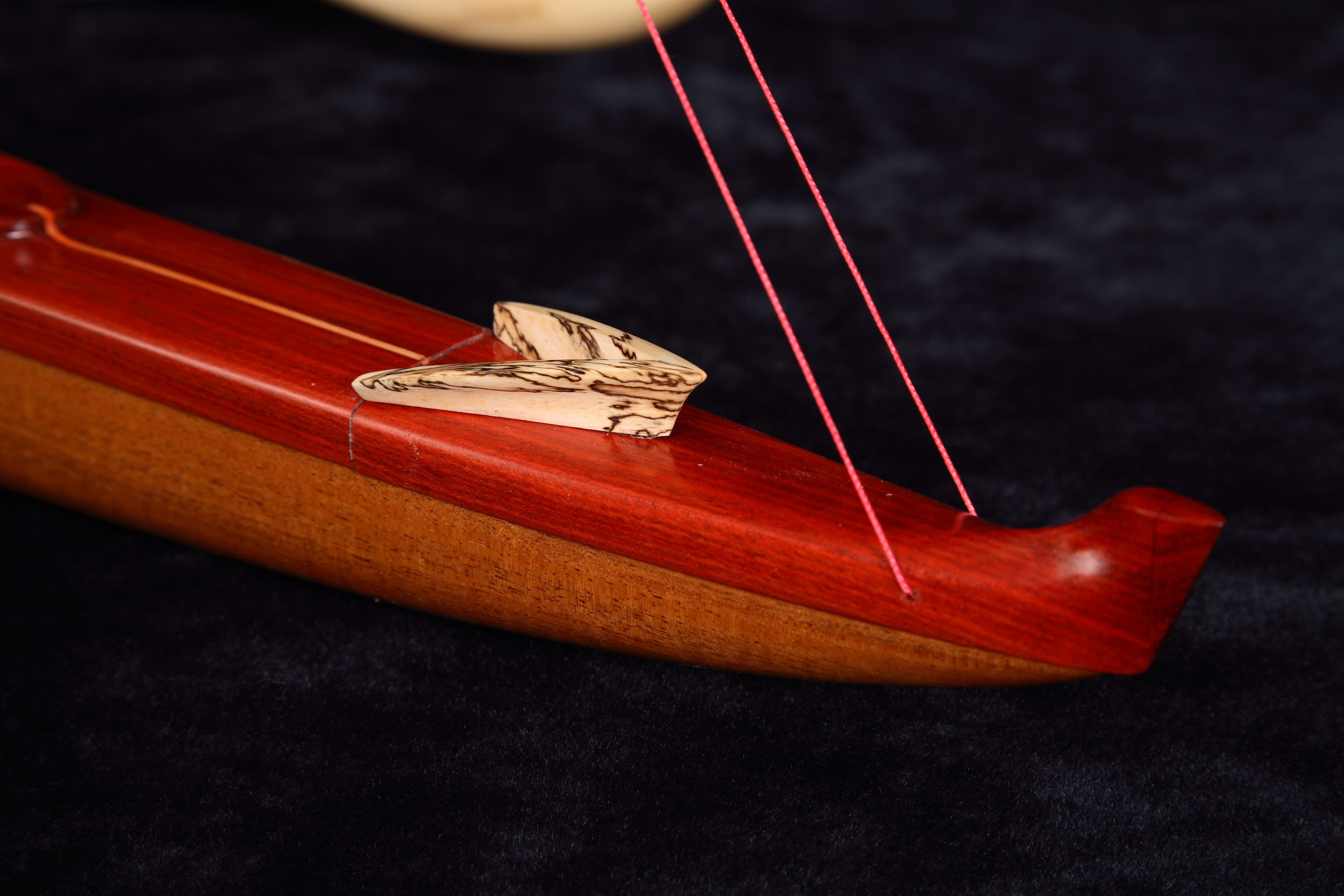
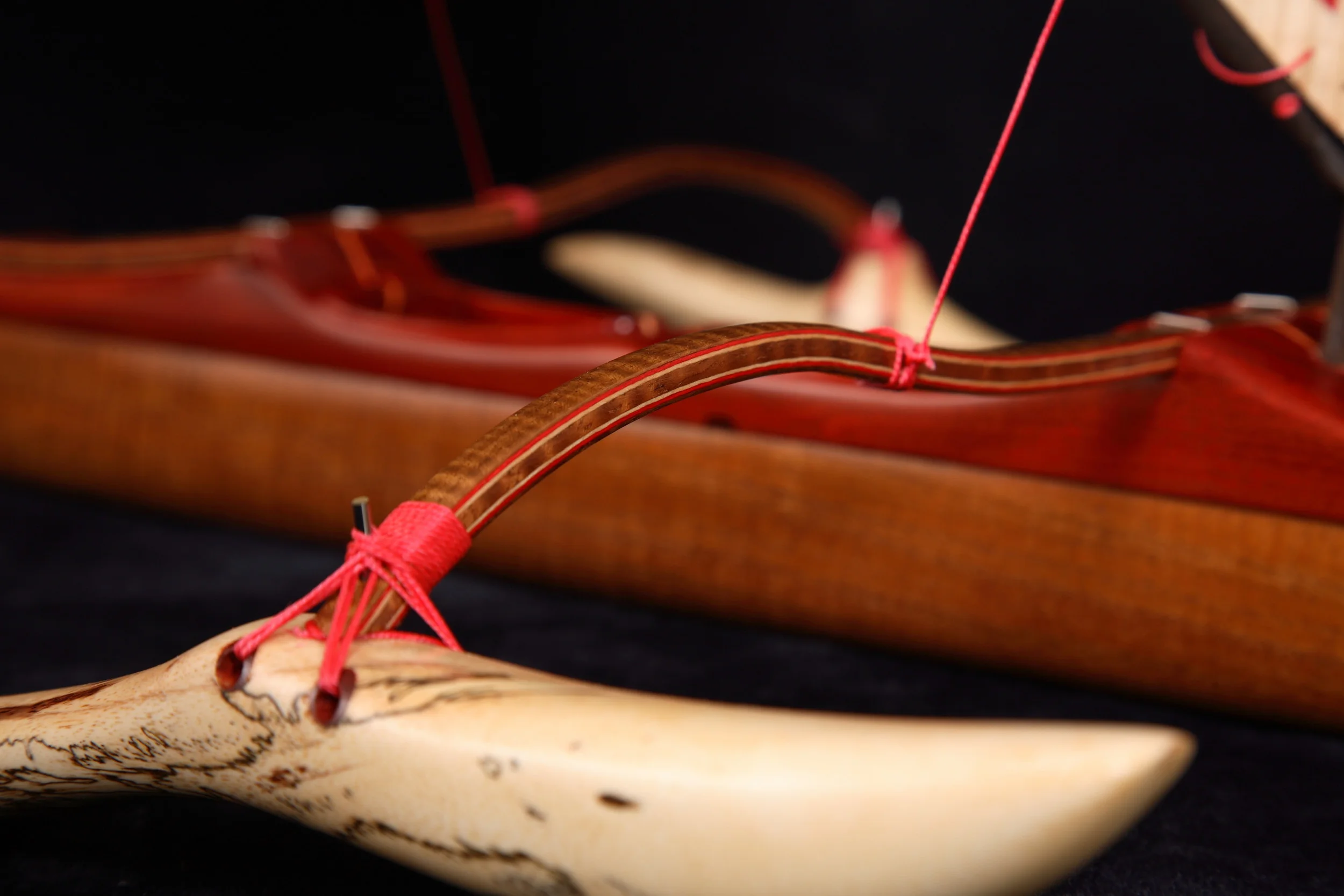
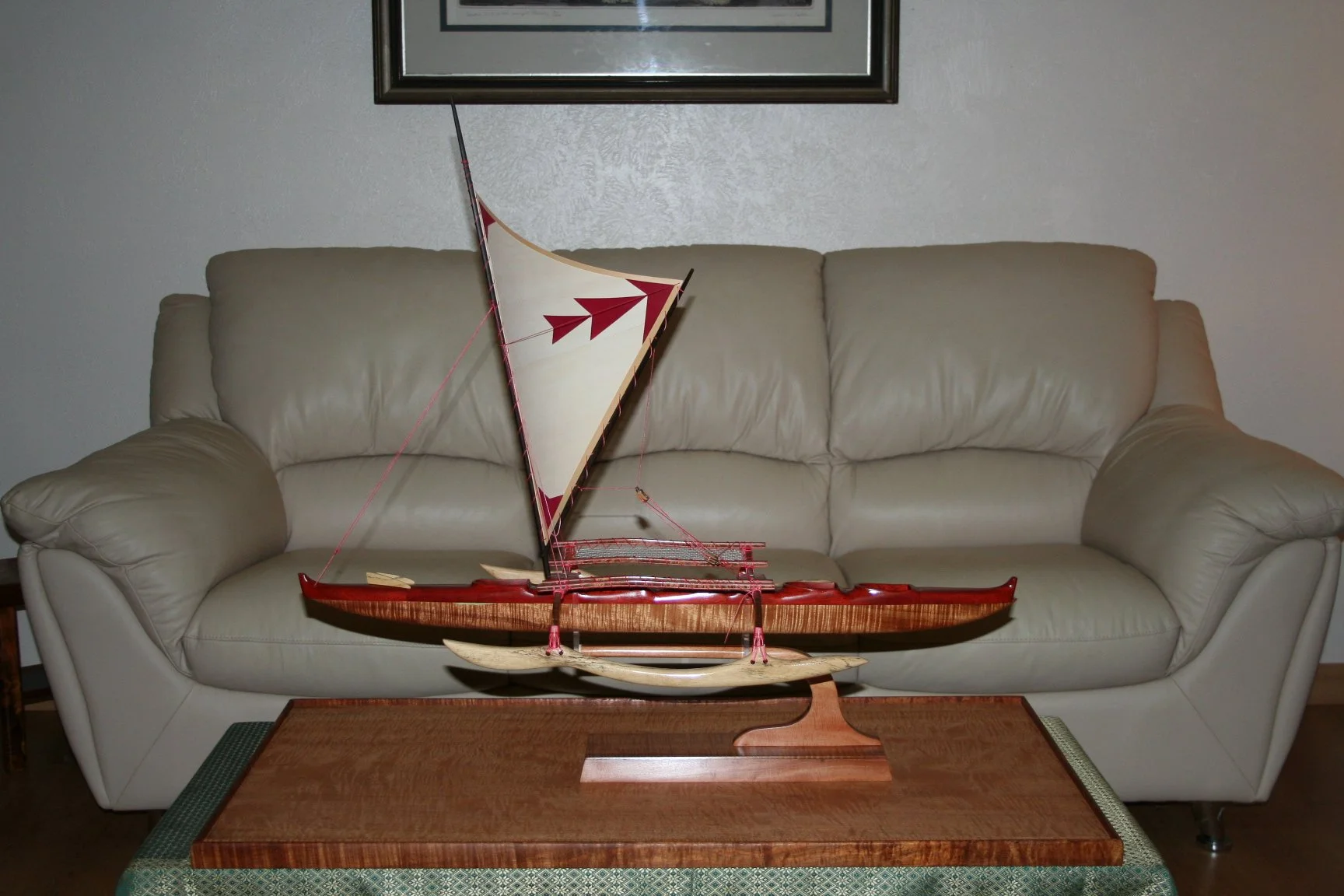
Each scale model of Hokule'a is a testament to the meticulous craftsmanship and artistic prowess of the creator. These custom-made works of art are lovingly crafted with local woods in Hawaii. Available in sizes ranging from 12 to 36 inches, or 30.5 cm to 91.5 cm, these models are a visual delight. More pictures can be explored at Flickr.com, offering a closer look at the intricate details that make each model a true masterpiece.
The model's size influences the level of detailing, a major factor affecting the price. In other words, the cost of a 36-inch model is not the one of a 12-inch model multiplied by 3 !
This model was commissioned and completed March 31st 2026.
The table supporting the model was constructed by my friend furniture make John Gonczar at http://gonczarswoods.com/
Built in 1991, this is the artist first ever scale model of the Hokule’a.
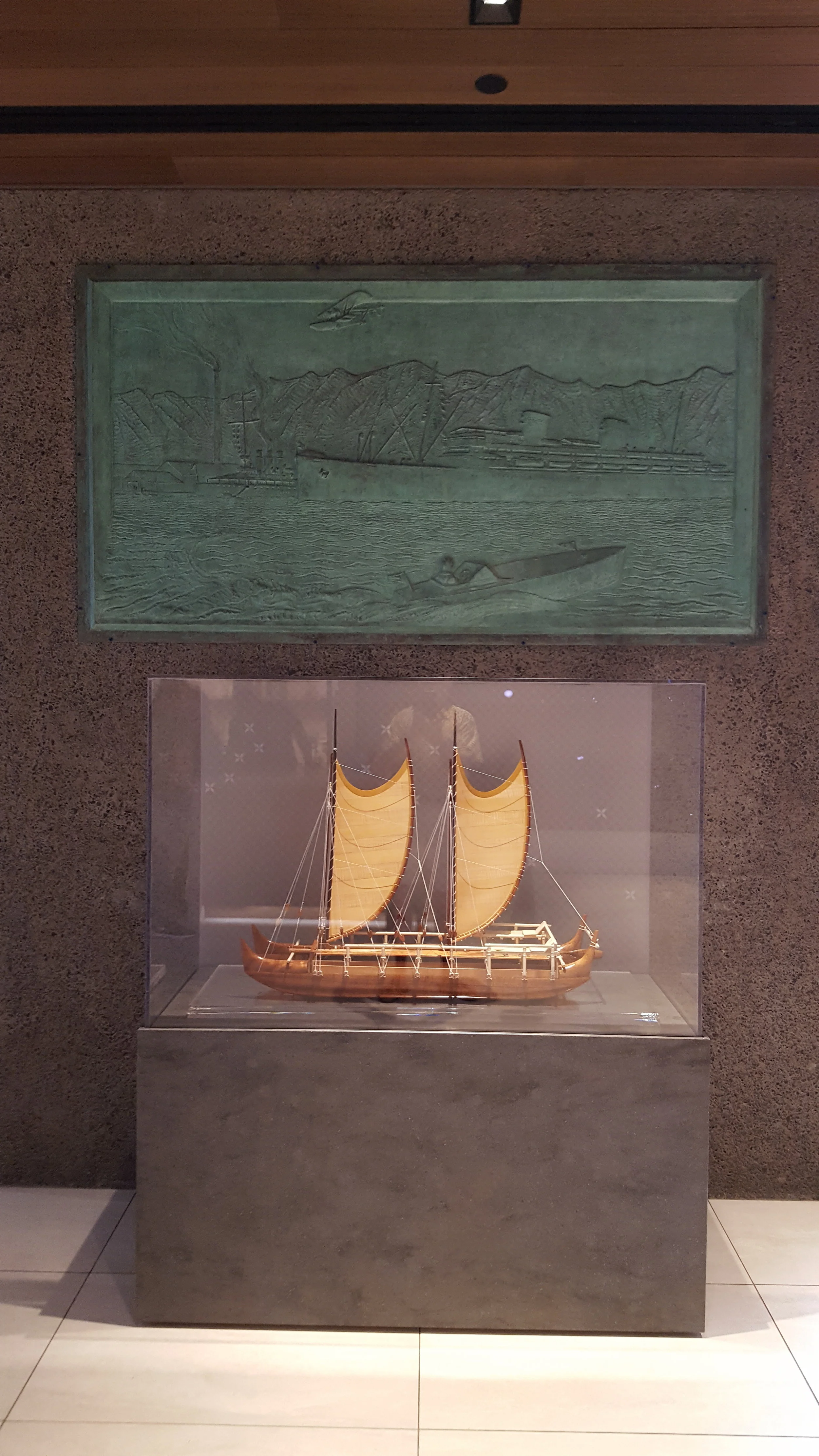
Setting up of a commissioned Hokule’a model at the Bank of Hawaii,
main branche, Honolulu
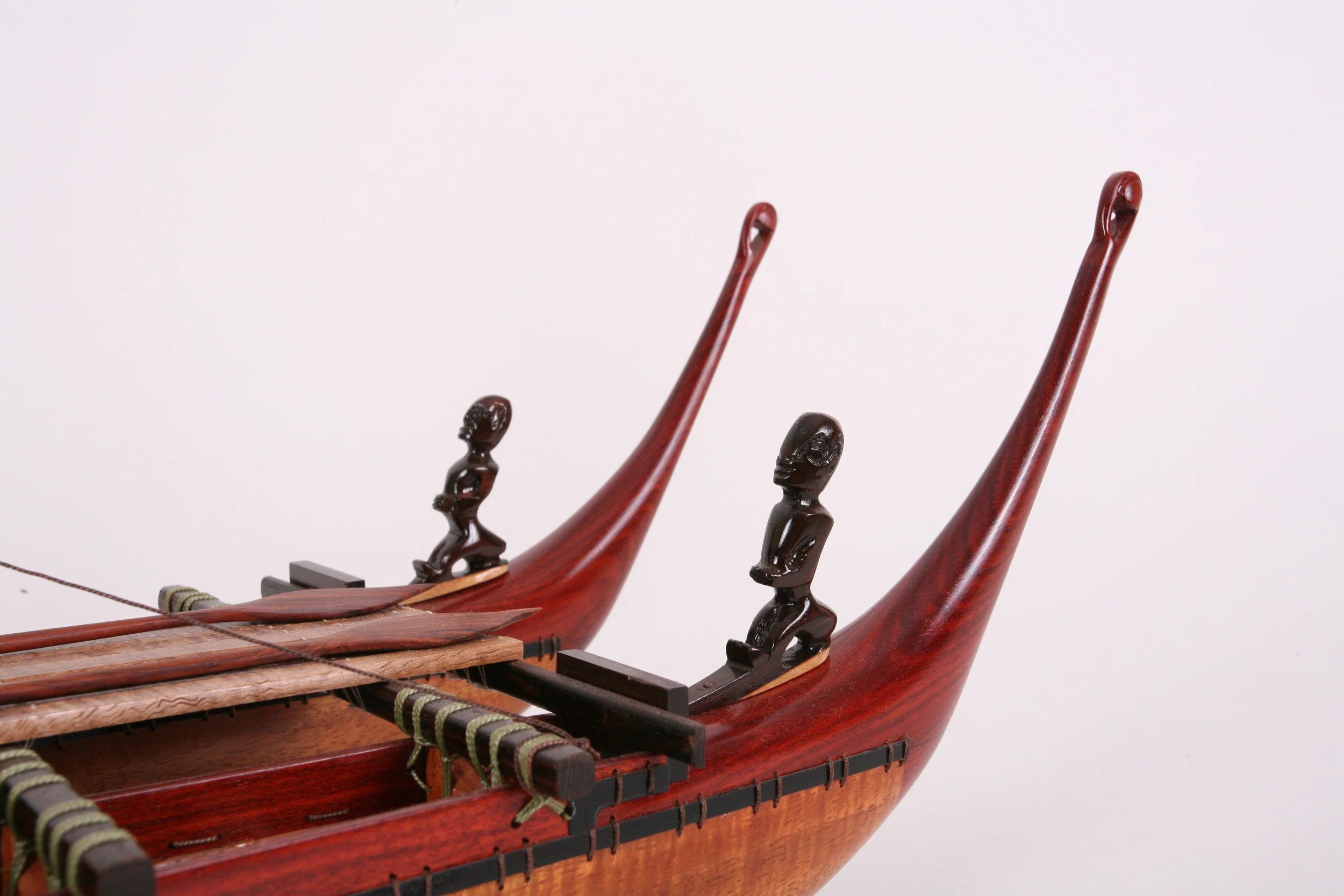
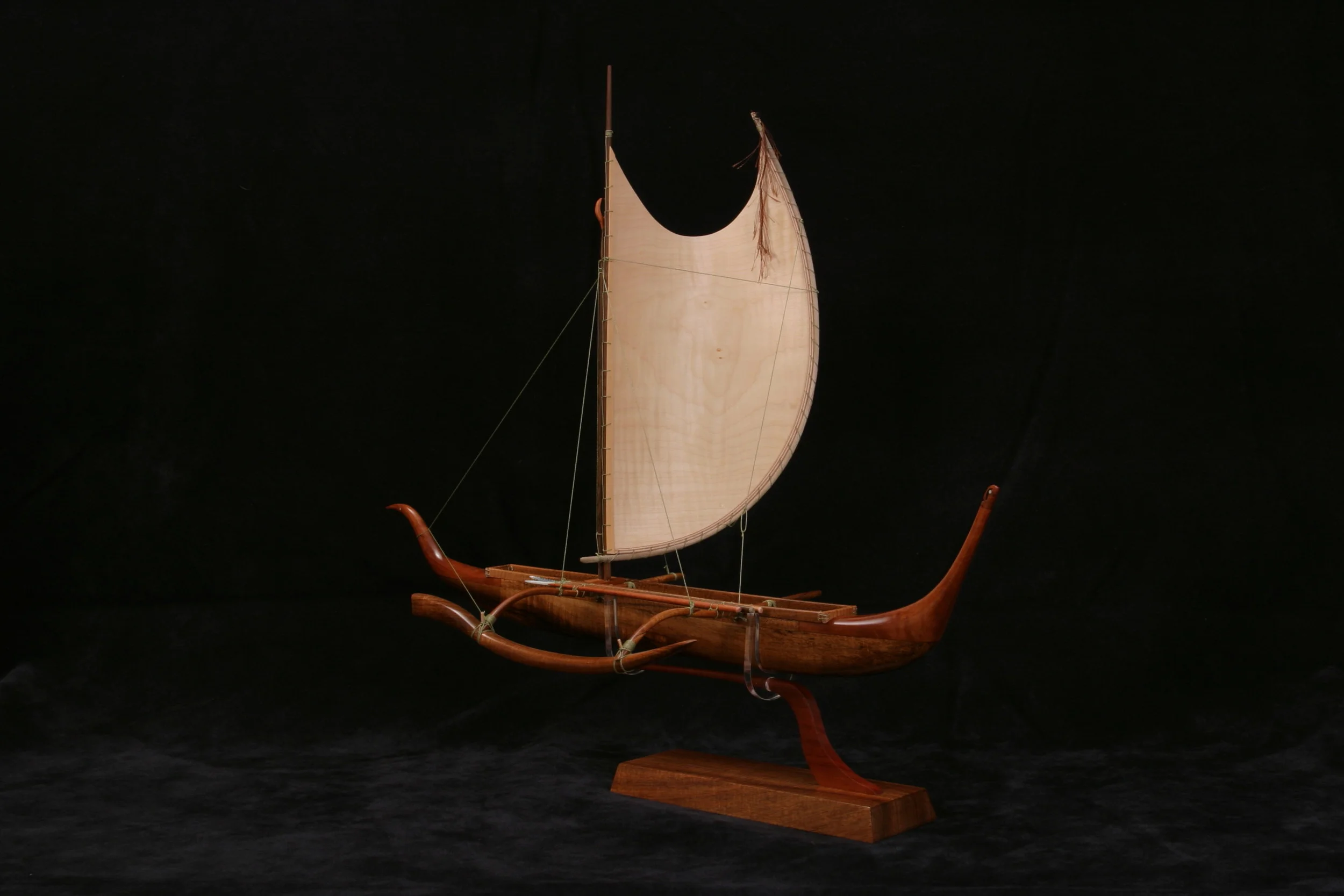
, While in our time, Hawaiian navigators traveled across the Pacific Ocean on the double-hulled canoe Hokule'a,legend has it that their ancestors sailed from the Marquesas Islands to Hawaii in similar canoes. This 36-inch long model, inspired by the artwork of Herb Kawainui Kane, is rigged with two sails and features prow and stern pieces typical of the Marquesas Islands.
SOLD
WA'A MOANA
When I learned that I would be taking my grandson to see "WA'A MOANA," my excitement matched his anticipation. However, my enthusiasm stemmed from a different reason. The film featured a Fijia outrigger canoe, a type of sailing vessel that I had been commissioned to construct a scale model of. I successfully completed this model in September 2021. It’s interesting to note that the ship showcased in "MOANA" closely resembles the Fijian Kamakau. This particular type of outrigger canoe is widely regarded as one of the most exceptional designs ever created. I feel fortunate to have had the opportunity to produce a scale model of such an impressive vessel.
Completed September 2021
Attachment sail to “Tau”
A view of the many cross-beams and connectives to the “ama” .
Starboard view of the canoe
A view of the railings and forward beam attachment .
Top view of the various cross-beams and seat (in black)
Delving into the past, this model is a reconstruction of the enigmatic Cook Islands double hull canoes from the island of Mangaia. Scant literature exists about these canoes, making this journey of discovery all the more exclusive. We know that the islanders ingeniously repurposed the same hull used for their outriggers to construct the double hull. Intriguingly, the double hull canoes of the Cook archipelago shared numerous features with those from Hawaii, the Marquesan Islands, and New Zealand. This model is a faithful representation based on the hull displayed at the NEW ZEALAND MUSEUM Te Papa Tongarewa.
COOK ISLANDS . "VAKA A'UA'U"
Cook Islands double hull canoe fully rigged.
A close up view of the many carvings and designs decorating the model.
Zoom into the picture and have a look at the many carvings and designs done and applied on this canoe. The top of the gunnels are fully carved and over 700 individual designs decorate the hulls. Similarly each seat is decorated with carvings in the manner of the Cook Islands ancient designs.
Reproducing on this model the majectic raised stern of the "VAKA A'UA'U" at the Museum of New-Zealand Te Papa Tongarewea.
Bow of the canoe hull showing carving details.
Showing the leeward side of a Chamorro (Guam) canoe model was built in 2016.
Magellan's chronicler, Pigafetta, who witnessed these vessels in 1521 at either Guam or Rota, described them as 'gondolas of Fusine but narrower', highlighting their unique design and historical significance.
Now centuries later, as it is also happening across Polynesia, there is much enthusiasm to revive the ancient sailing craft across the Marianas, as one can see by watching the various videos on YouTube, for example:
https://www.youtube.com/watch?v=k0O21EtjOX0
The name' Flying Proa' given to these vessels is a testament to the thrill of their speed, as they swiftly crossed the horizon at a distance, according to the account of Captain George Anson, who circumnavigated the globe aboard the famous flagship Centurion.
I had in mind, initially to paint the hull of the model red and black , this in accordance to chronicles about those vessels, but needed to respect the wishes of its collector and consequently embellished the hull only slightly with a red design.
This 20 inch long model was commissioned four years ago .
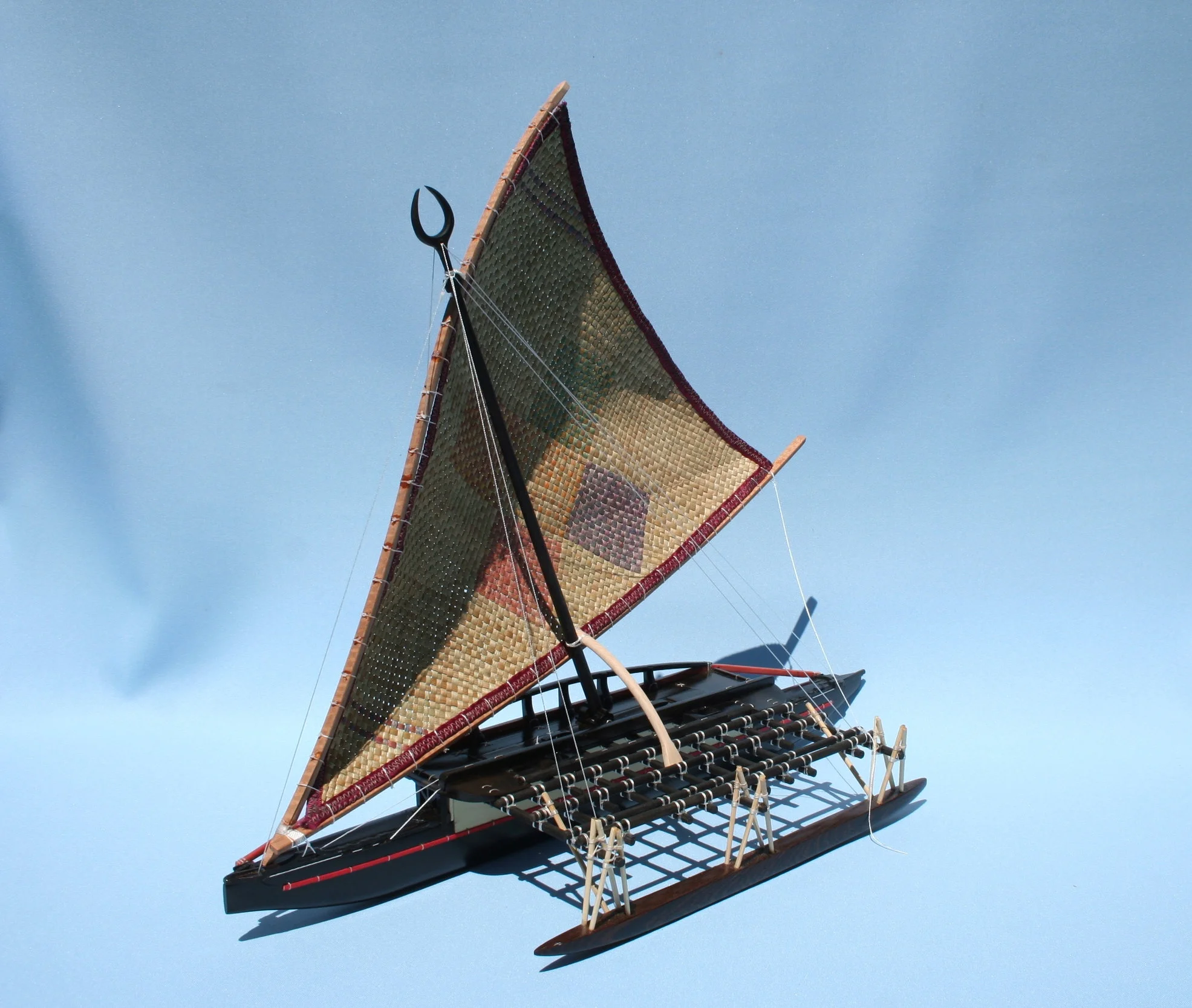
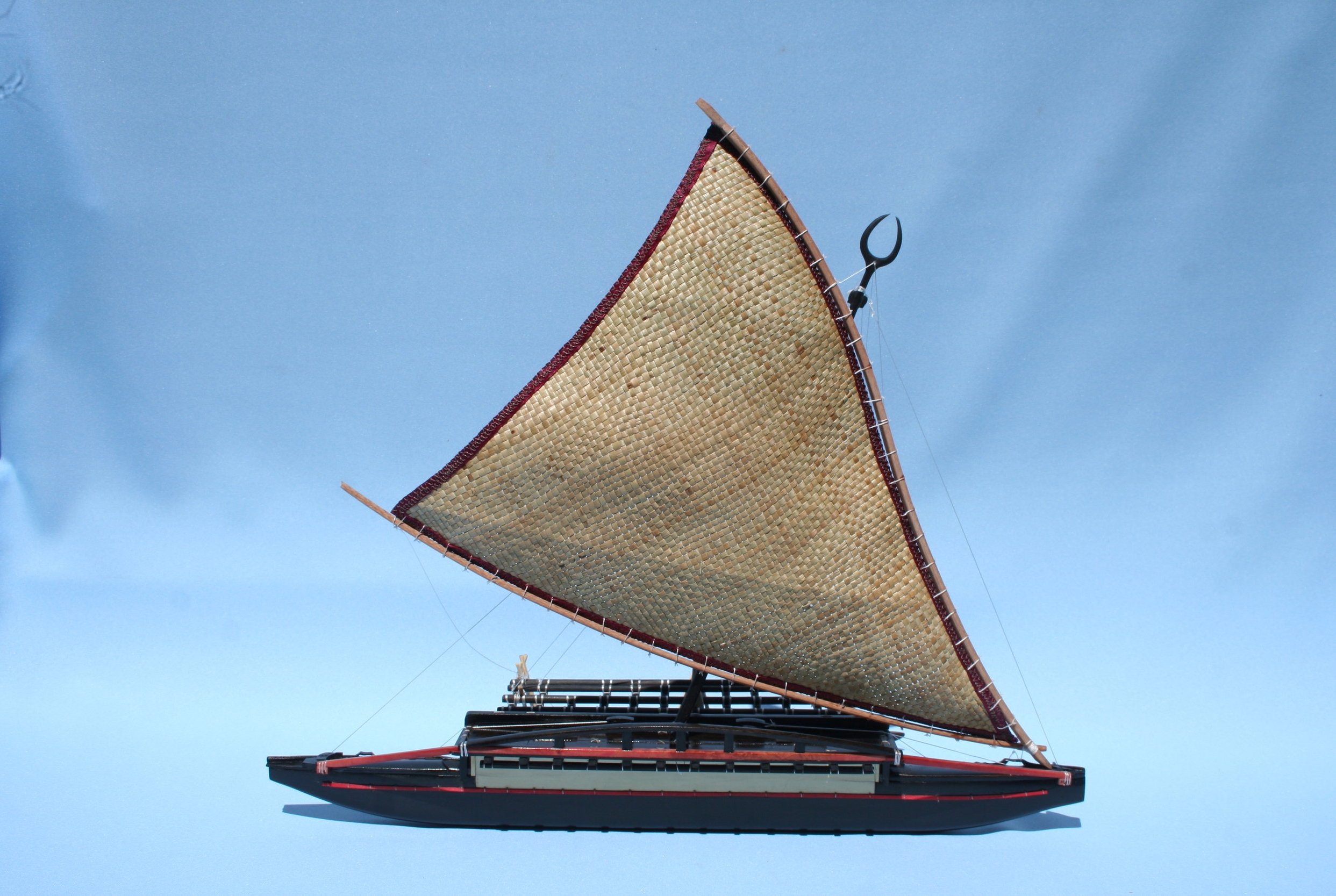
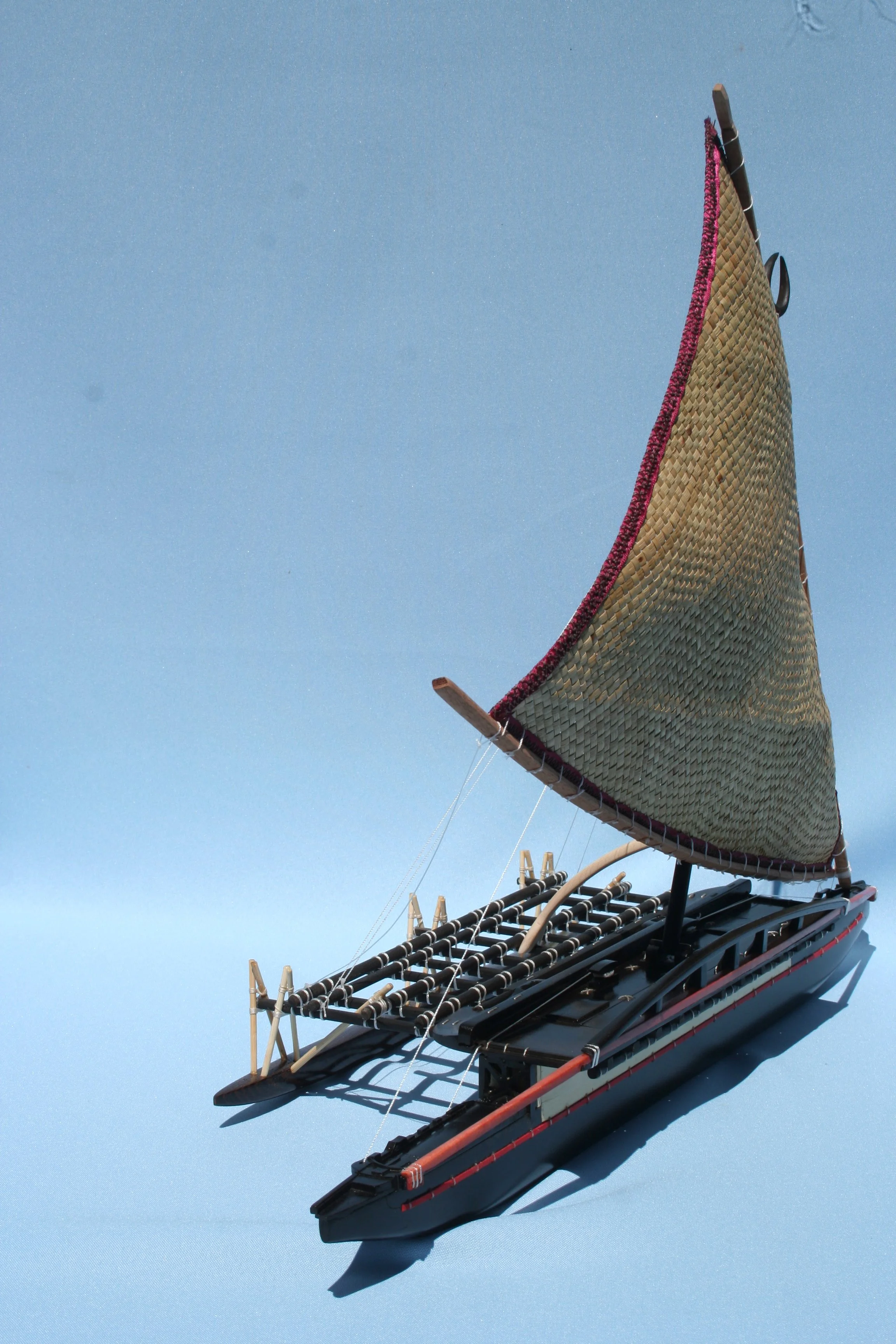
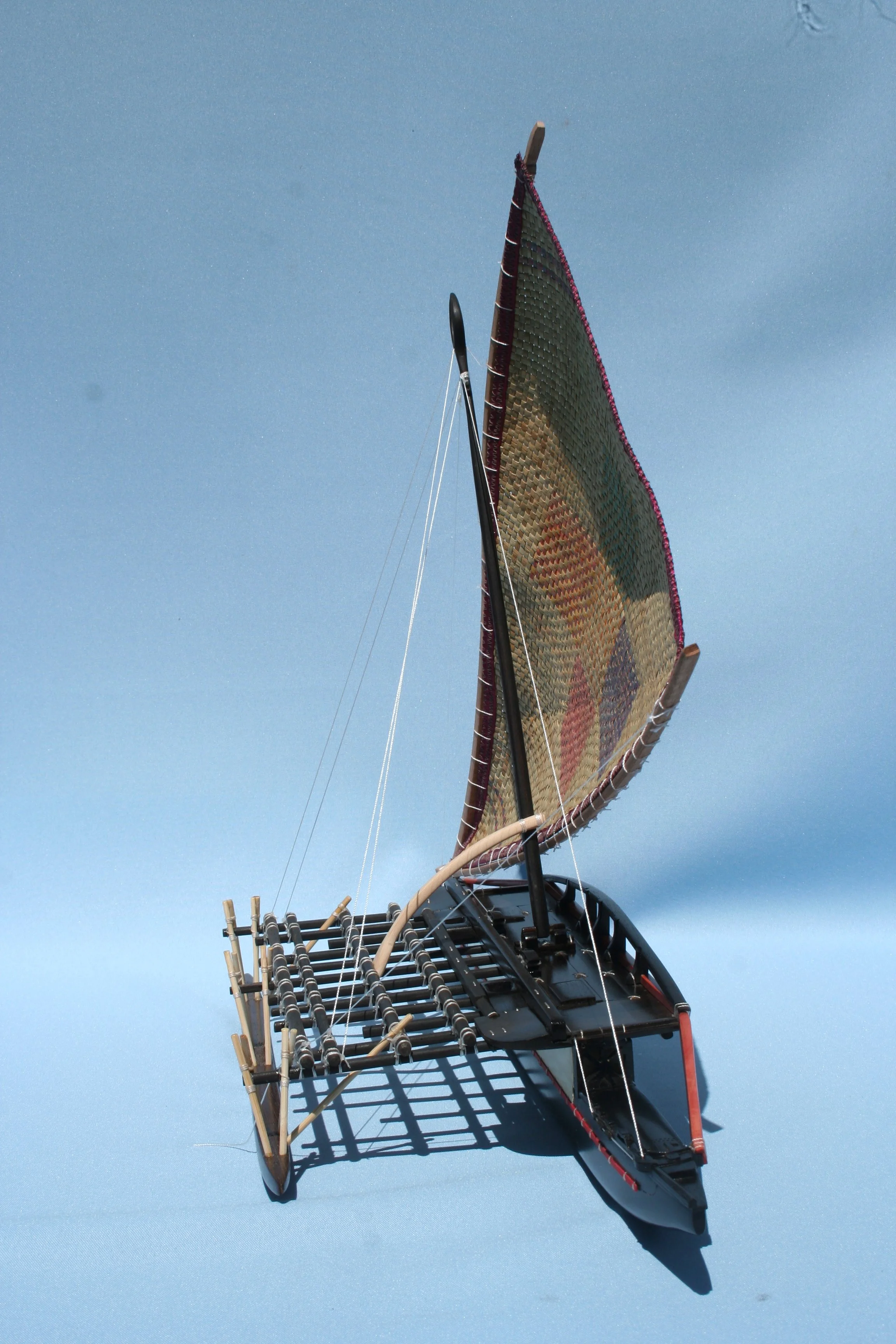
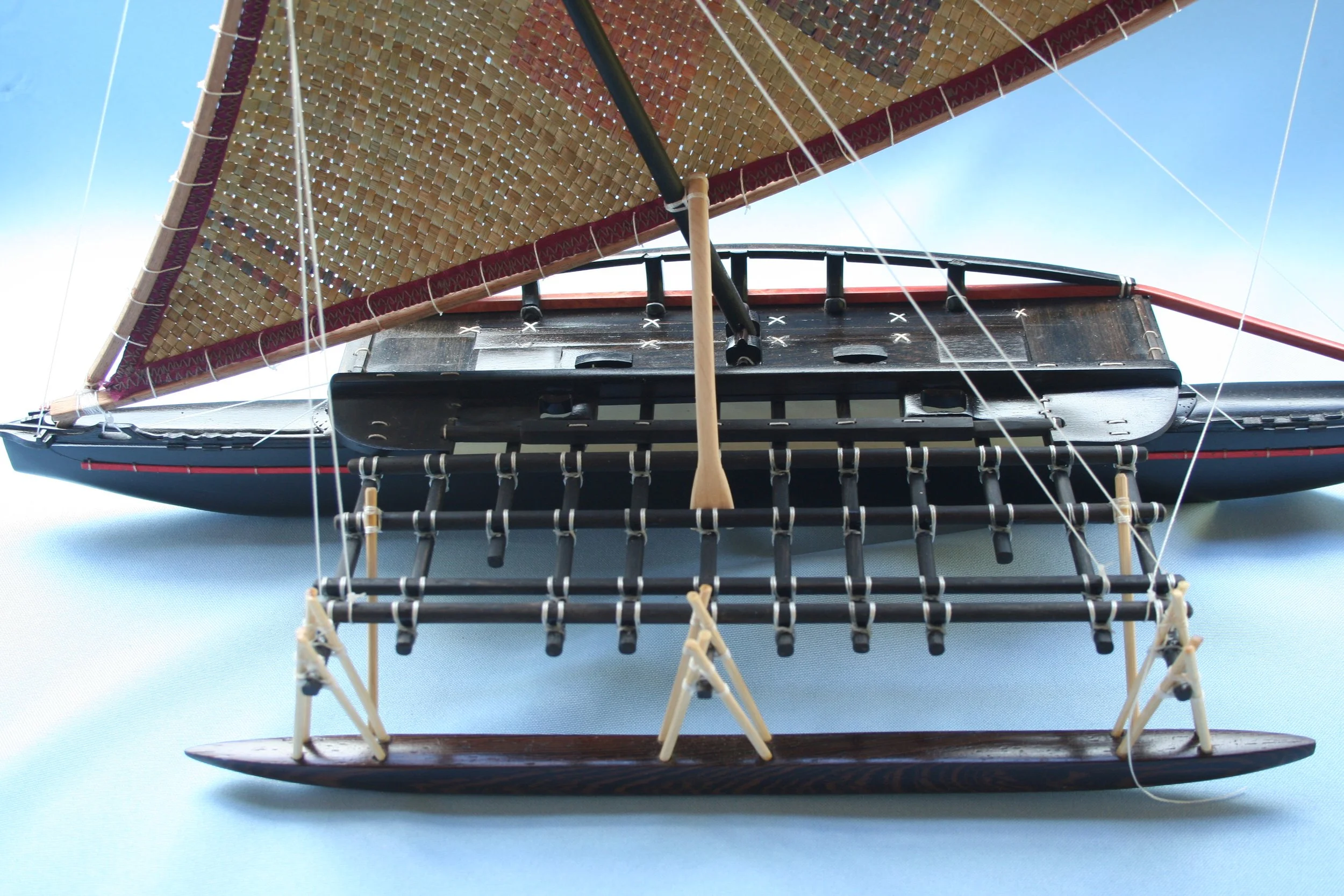
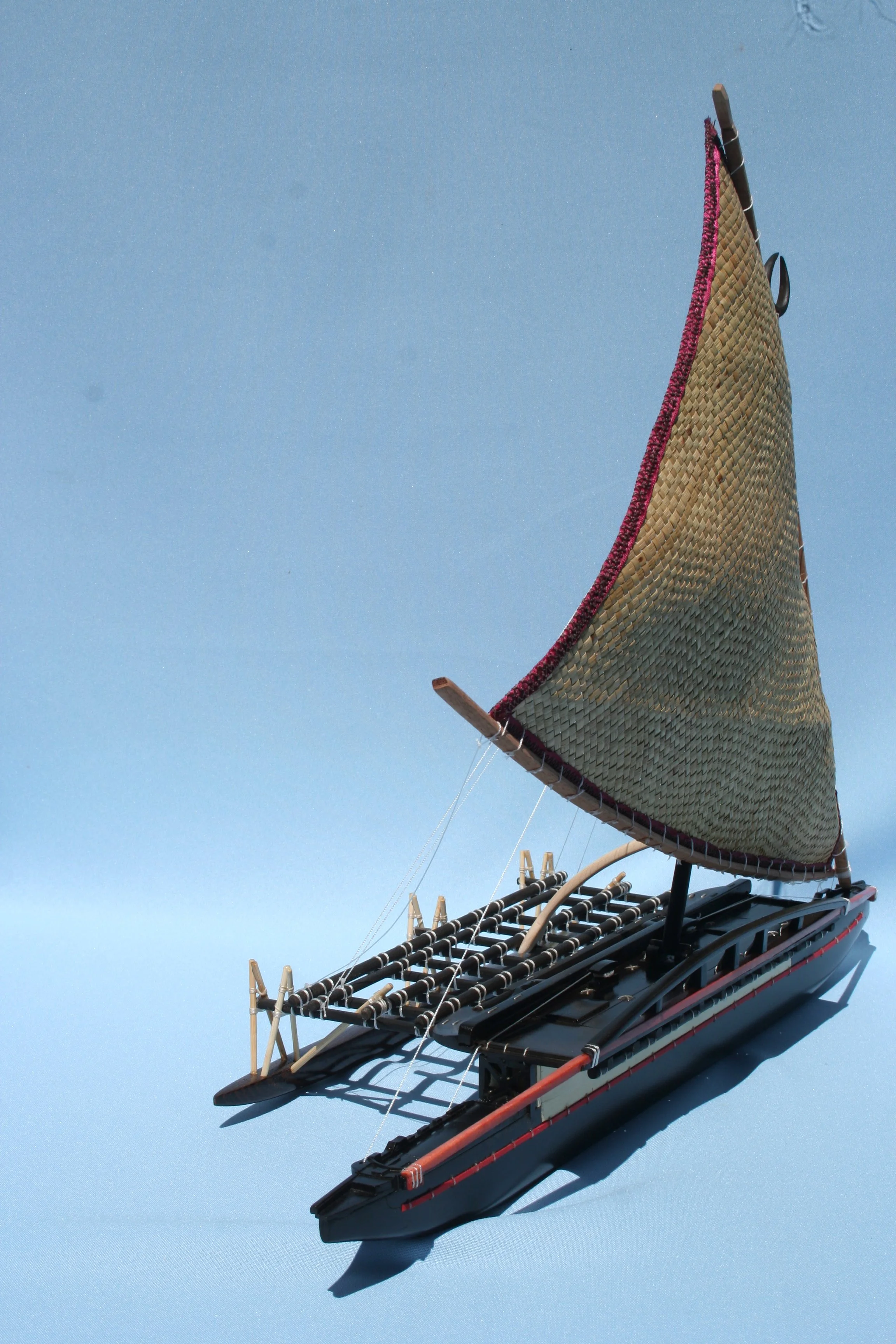
This model, long by 20 inches , wide by 7"1/2 and with a height of 16 inches is an accurate scaled down version of the Fiji single hull canoe on display at the Polynesian Cultural Center , Laie, Hawaii. The most intricate part on this vessel is the TAU, which is the bow’s top cover. It is therefore also the most difficult part to replicate on a smaller scale.
This single hull Fiji canoe is of the Camakau type primarily used as a voyaging canoe on the Melanesian islands of Bau, Rewa and Tailevu.
Like his bigger brother the Drua, the construction of the Camakau is awe-inspiring and it required me to visit the vessel a few time in order
to really understand how some elements were fitted together .
Here one can see the two identical extremities of the canoe called "Tau", the Ebony deck and arched railing .
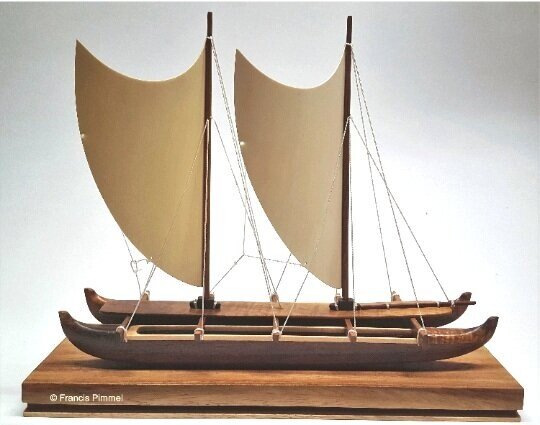
The simplified scale model of a Hawaiian Voyaging Canoe has been crafted in the workshops of Francis Pimmel who is indisputably the most famous canoe scale modeler of the State of Hawaii, whether that is building a true model of the famous HOKULE'A voyaging canoe or any other Polynesian or Oceanic canoe.
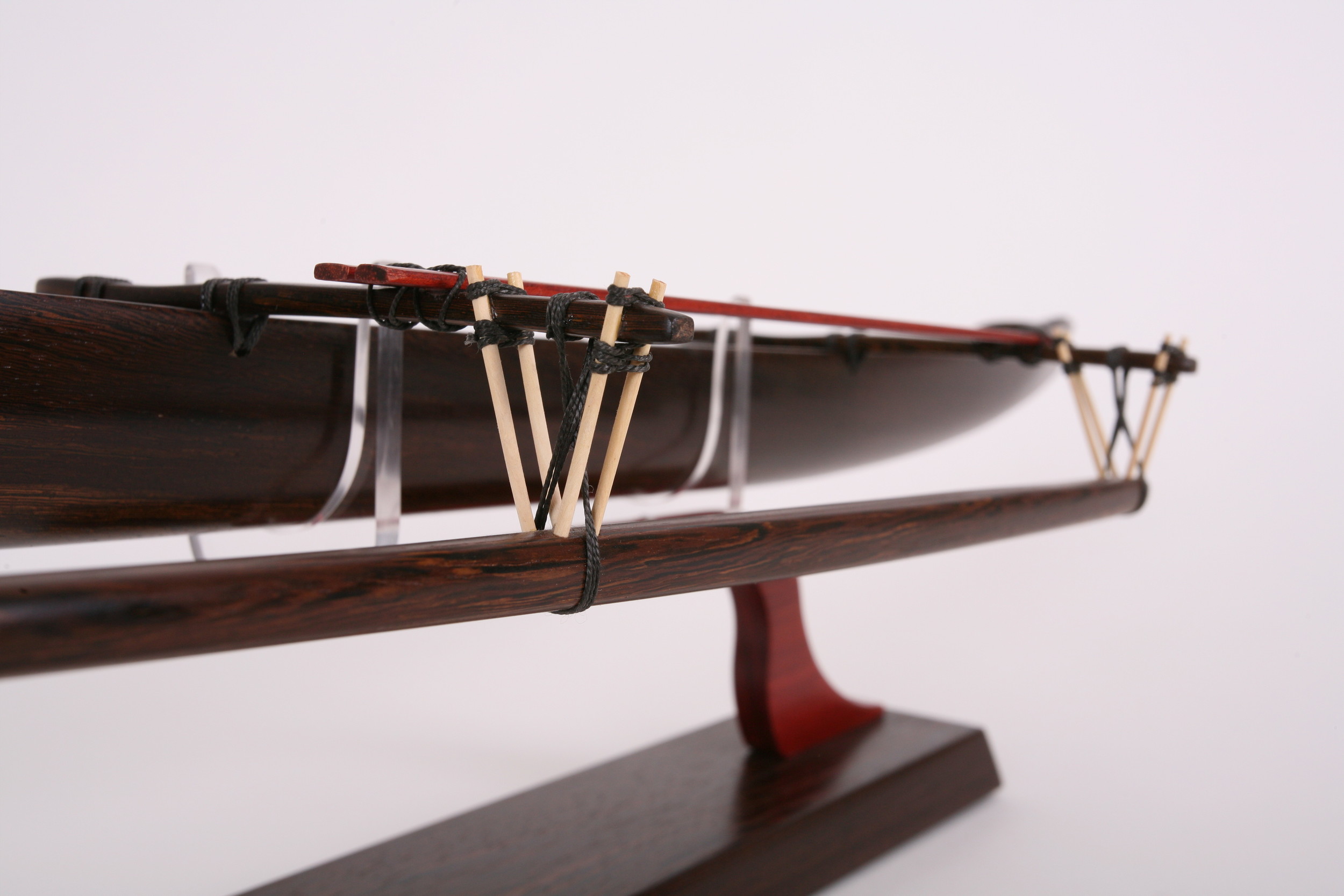
Carved out of Koa wood, the model is long by 11 ins, wide by 3.5 ins and is sold as shown, in an open-end acrylic showcase.
The model itself rests on a solid wooden base which can be removed from the showcase if needed.
The dimensions for the showcase are as follows: L: 11,5 ins W: 4 ins, H: 11 ins
Handmade using traditional native wood species makes this model Hawaiian in spirit but also by origin.
Home and Garden TV (HGTV) featured Francis Pimmel and his work on their nationwide show "MODERN MASTERS" on November 4, 2001.
Canoe models by Francis Pimmel do grace the lobby of the Four Seasons Hotel Resort, Manele Bay, Lana'i, the floors of the Kahala Hotel Resort formerly Mandarin, Honolulu, the Gallery of the Polynesian Cultural Center, La'ie, the Pacifica shop at the Bishop Museum, Honolulu, the lobby of the Bank of Hawaii, main branch, Honolulu, and many other places, collections and Institutions outside of the island of Oahu, Hawaii.
"The beauty of the Solomon Island canoes has excited the admiration of all voyagers, navigators and explorers from the time the islands were first visited by white men" wrote the British naturalist Sir Charles Morris Woodford.
Distinctive among the hundreds of different Oceanian canoes is the crescent-shaped, plank built, Tomako canoe with its slender lines and fascinating upwardly-projecting bow and stern decorated with shells and feathers. This was the black painted war canoe of the Solomon Island head hunters.
A 36-inch model of a 2-man Samoan fishing canoe. The model accurately replicates the ancient construction method of the planked hull and includes every element found on those canoes. The bow and stern covers are not decorated with cowrie shells to preserve the elegance of the canoe. Further detailed pictures are available on Flickr. Completed in July 2012. This item is sold.
A Tikopian canoe model from the island of Anuta.
Total length: 36 inches
Discover the rich history and culture of Anuta, a small volcanic island in the province of Temotu in the southeastern part of the Solomon Islands. It is one of the smallest permanently inhabited Polynesian islands and a significant Polynesian outlier community in Melanesia.
The inhabitants of this small island are still building this style of canoe today. The Lapita Canoe was inspired by the Anuta canoe.
Completed in 2010. SOLD.
Hawaiian Voyaging Canoes
This album illustrates Hawaiian Voyaging canoe models built over the years by Francis Pimmel. However, it does not include the Hokule'a , the most famous voyaging canoe, for which Francis created a separate album in this gallery.
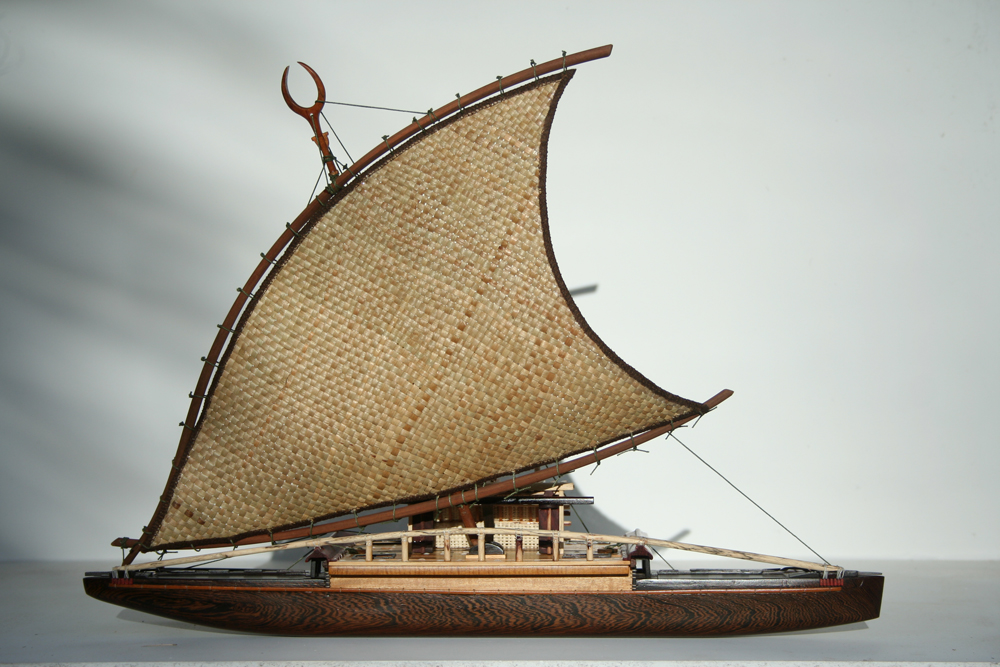
Ancient Hawaiian voyaging canoes consisted of two identical hulls connected by arched cross booms. The curved booms raised the decking well over water, eliminating wave resistance and affording drier and more comfortable positions for passengers and freight.
A narrow wooden platform (deck) called the "pola"was laid on top of the arched cross booms, making it better suited for long-distance voyages. Sometimes a small straw hut was built on the deck for added protection. Double-hull voyaging canoes were rigged with a uniquely Hawaiian form of oceanic spirit sail called a "crab claw." The sail material for the Hawaiian crab claw was often matting made of finely plaited lauhala leaves, also called pandanus. The mats were overlapped horizontally and sewn up in reverse positions, thus giving the visual impression of matting of two different colors.
The historical significance of the Hawaiian voyaging canoes is further underscored by the renowned French naval architect Admiral Paris and the Englishman John Webber's 1778 sketches of 'Sandwich Islands' canoes. These sketches accurately depict the rigging and unique design of the Hawaiian-type sail, a testament to the enduring legacy of these canoes in maritime history. In the account of Cook's third voyages, the size of the largest Hawaiian Voyaging canoe, as measured, is given as 70 feet long, 12 feet broad, and 3.5 feet deep.
It is truly awe-inspiring to learn that an old wrecked voyaging canoe on the coast of Hawaii was a staggering 108 feet long. These canoes were not just large, but also incredibly robust, capable of carrying up to 140 men. Such feats of maritime engineering are a testament to the skill and resourcefulness of the ancient Hawaiians.
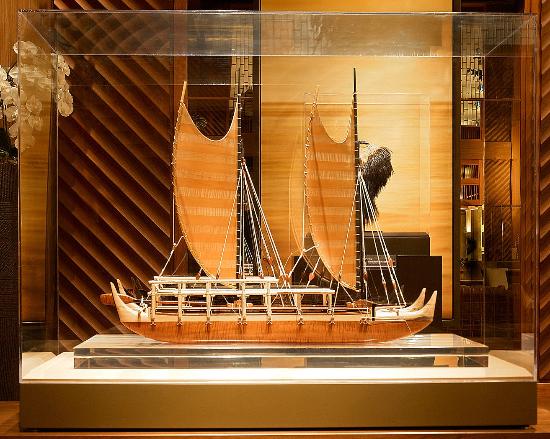
Commissioned in 2017 by the Bank of Hawaii, main branche, Honolulu.
The commissioned Hawaiian Voyaging Canoe being installed within its showcase at the Bank of Hawaiia, main branche, Honolulu.
On permanent display at the Bank of Hawaii, main branche, Honolulu.
"This is a 34-inch long scale model of the famous Tahitian Tipaerua canoe. Unlike most Oceanic vessels, the hulls of this canoe are not carved but instead planket, a technique I achieved after many trials and errors. You can view its gradual construction on Flickr."le model canoe of the famous Tahitian Tipaerua. The hulls of this canoe are not carved like most Oceanic vessels, but planket, a technique I achieved only after many trials and errors. You can view its gradual construction on Flickr.
The Pao Pao dugout canoe was the ordinary craft used for fishing along the shores. Another type of Samoan dugout fishing canoe was the Soatau. The difference between the Pao Pao and Soatau was that the former had washstrakes, end deckings, and were rigged for sailing, whereas the Soatau seldom had washstrakes and also had shorter decking, or Manu in Hawaiian.
A third type of Samoan canoe was the elegant VA'A Alo (commonly called the bonito canoe), which was plank-built. This type of canoe, of which Francis made several models, is considered the most graceful of all Polynesian canoes. The Samoan canoe builders had a very inventive spirit, which led to innovation in the execution of their trade. For example, the Samoans formed the bow of their canoe to resemble the open mouth of a shark, which became known as a cutwater. This design divided the water as the canoe moved forward and allowed the canoe to move at higher speeds.
"The Fijian double canoe (wangga ndrua) was the largest and finest sea-going vessel ever designed and built by natives of Oceania before contact with Europeans."
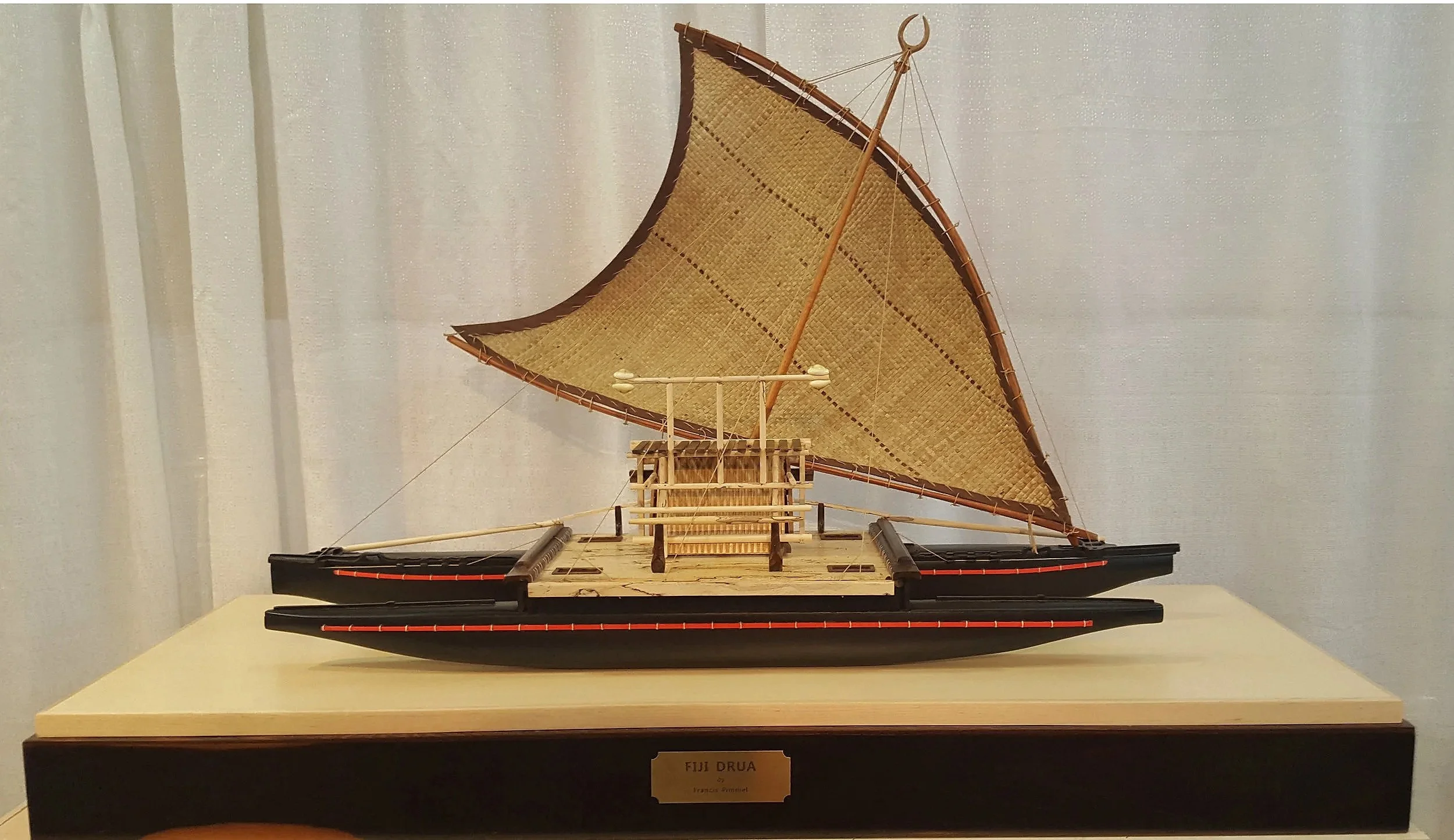
Druas were large, up to 100 feet (30 m) long, and could carry over 200 people. Despite being called canoes, they were not dugouts but plank-built ships. Today, Fiji druas are still a symbol of Fiji, and Fiji's telephone booths are decorated with the characteristic mast-tops of druas. Fourty man were required for the handling of this fine vessel.
The model shown here is a scaled-down version of the Ratu Finau War Canoe in the Fiji Museum of Suva. You can view a photo stream showing the gradual construction of this exceptional and difficult-to-build model on Flickr.com
Commissioned at the end of 2012, this 17 3/4" long model was shipped to its Taiwanese collector in March 2013.
Since that date, Francis built only 1 additional very large scaled-down version of the Fiji Drua, which can be admired at the Polynesia Cultural Center, Lai'e, Oahu, Hawaii.
This 36 inch long model was built in 2016 and his on display at the POLYNESIAN CULTURAL CENTER, Lai'e, Hawaii.
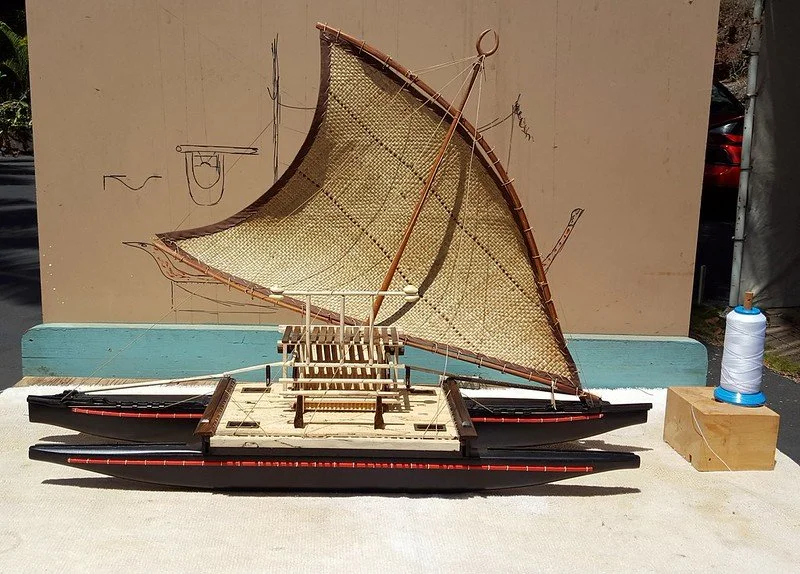
The Fiji Drua model resting on a 4 feet wide working table, my favorite place to adjust the halyards on models with sails. Here I am finishing some touches before displaying it at the MADE IN HAWAII FESTIVAL 2016. The model was later acquired by the Polynesian Cultural Center, Laie, Hawaii.
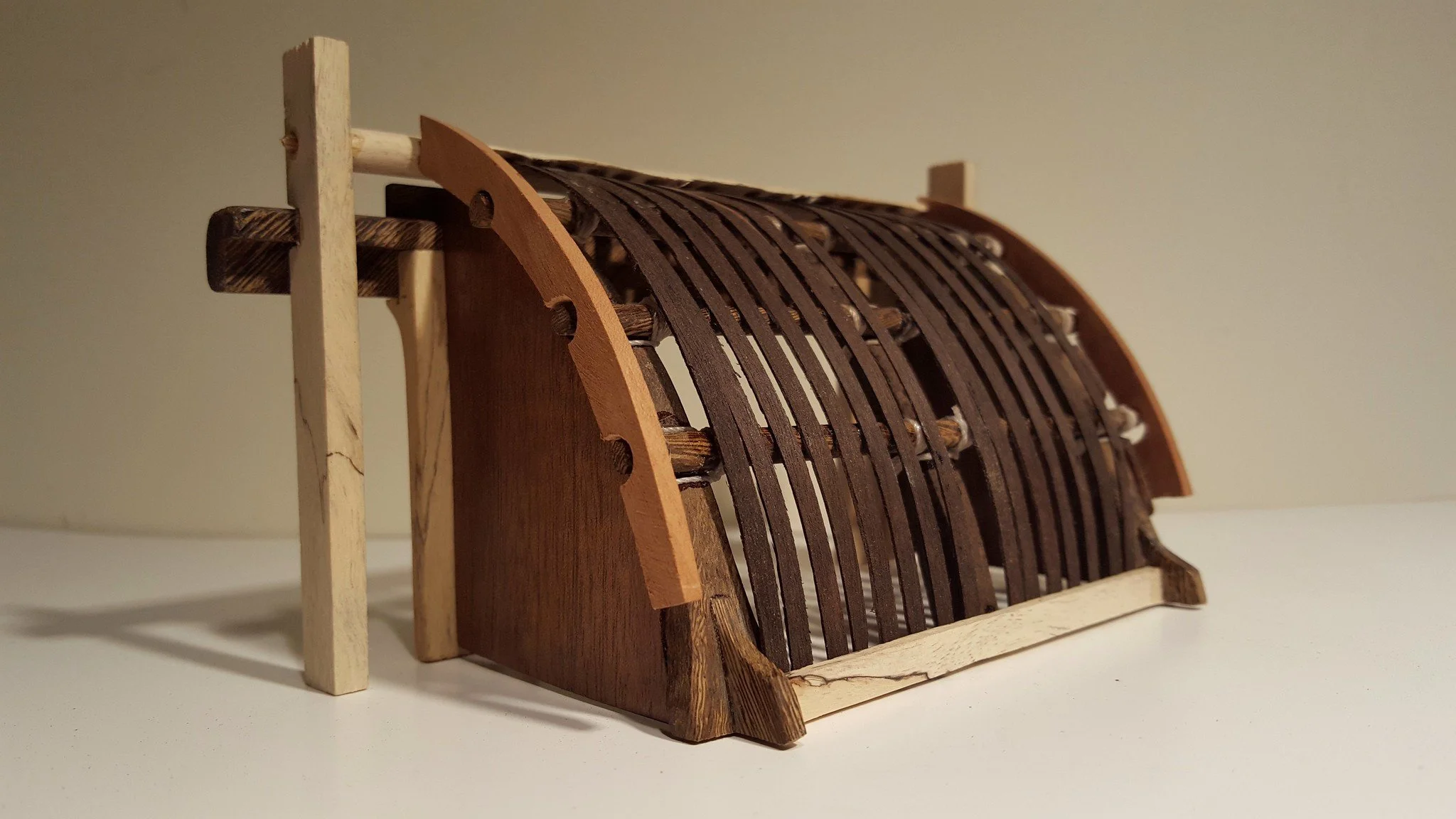
The heel of the arched beams had the shape of a horse shoe and were anchored onto the deck plank using a tenon.
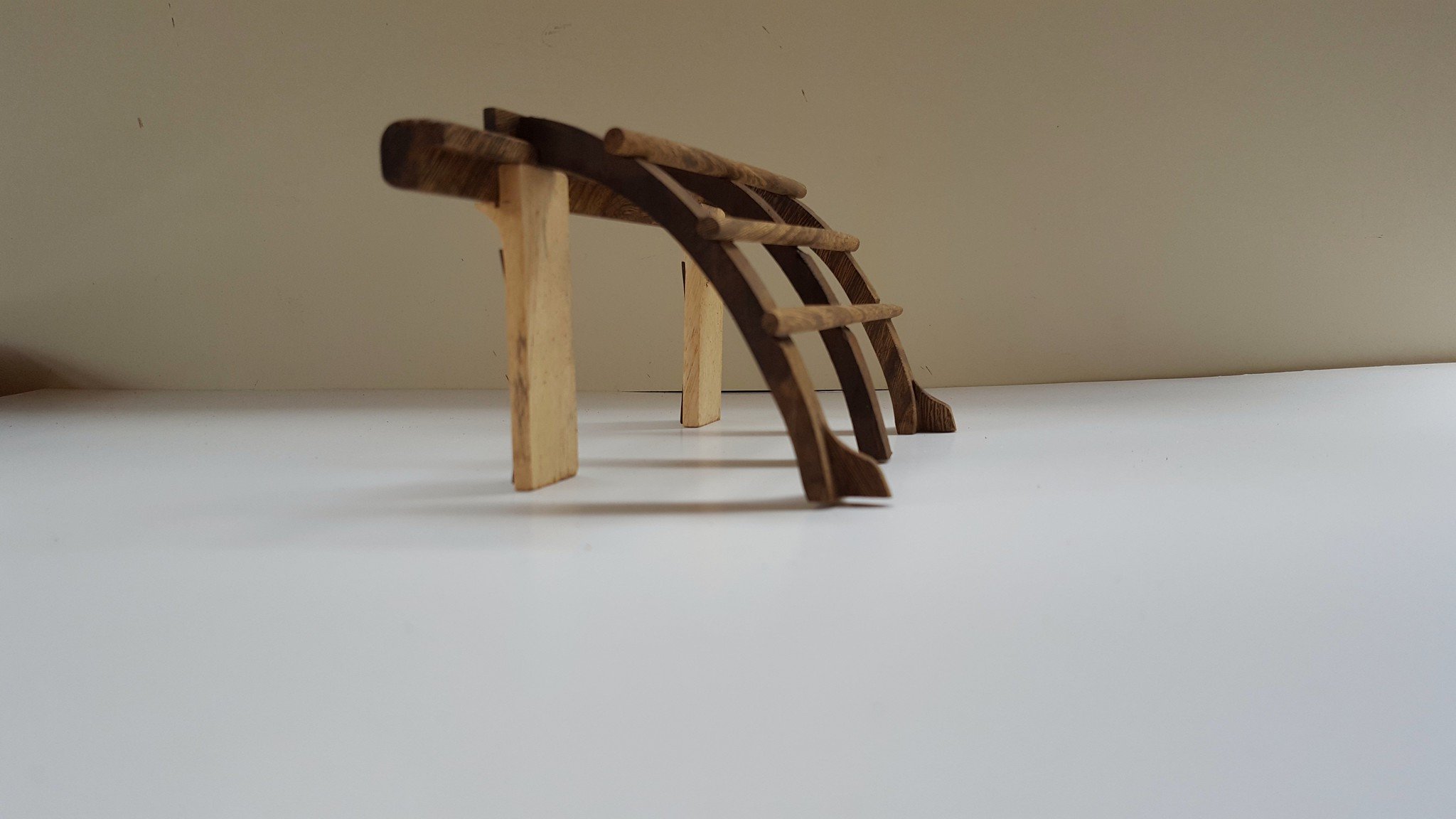
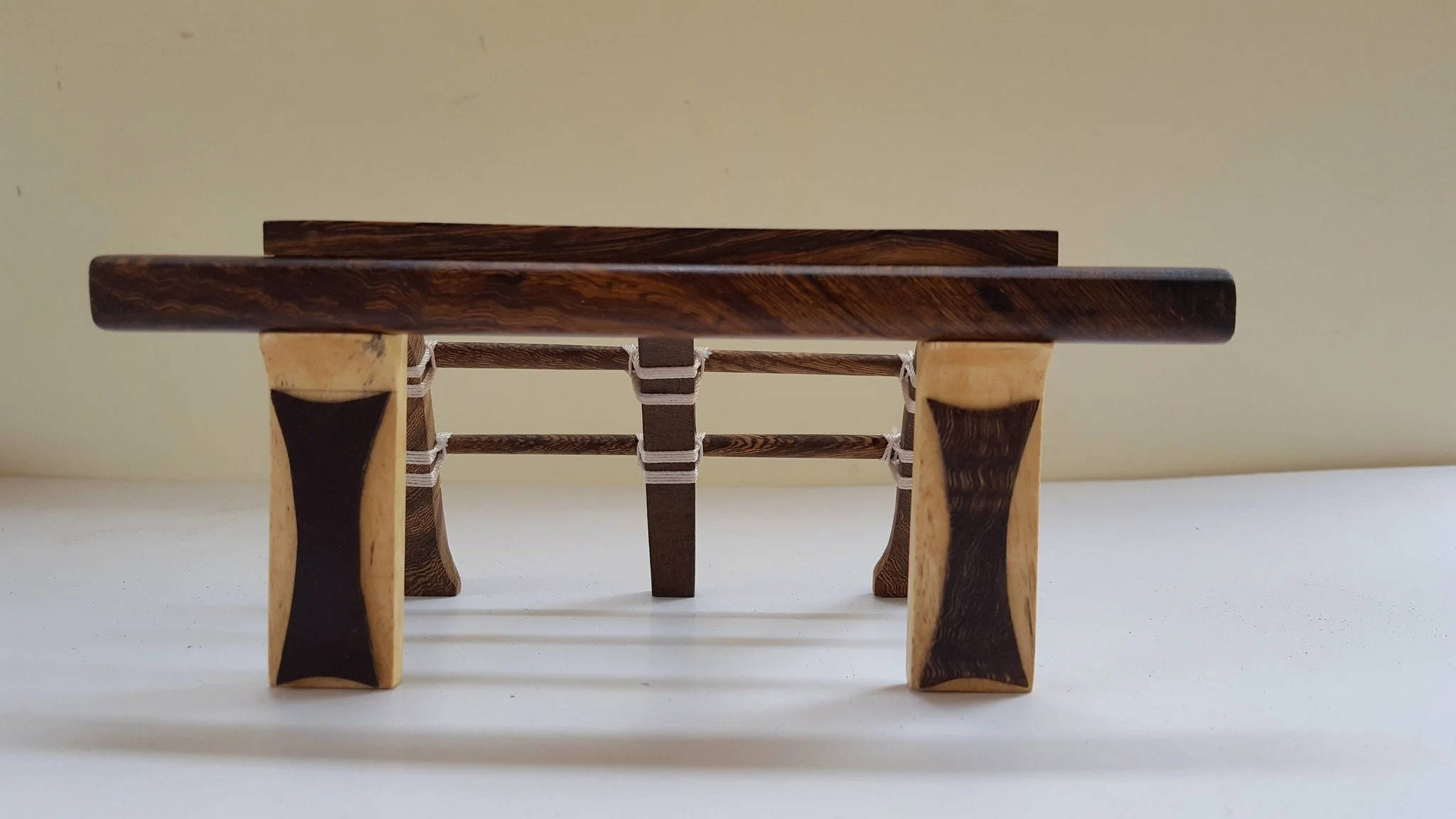
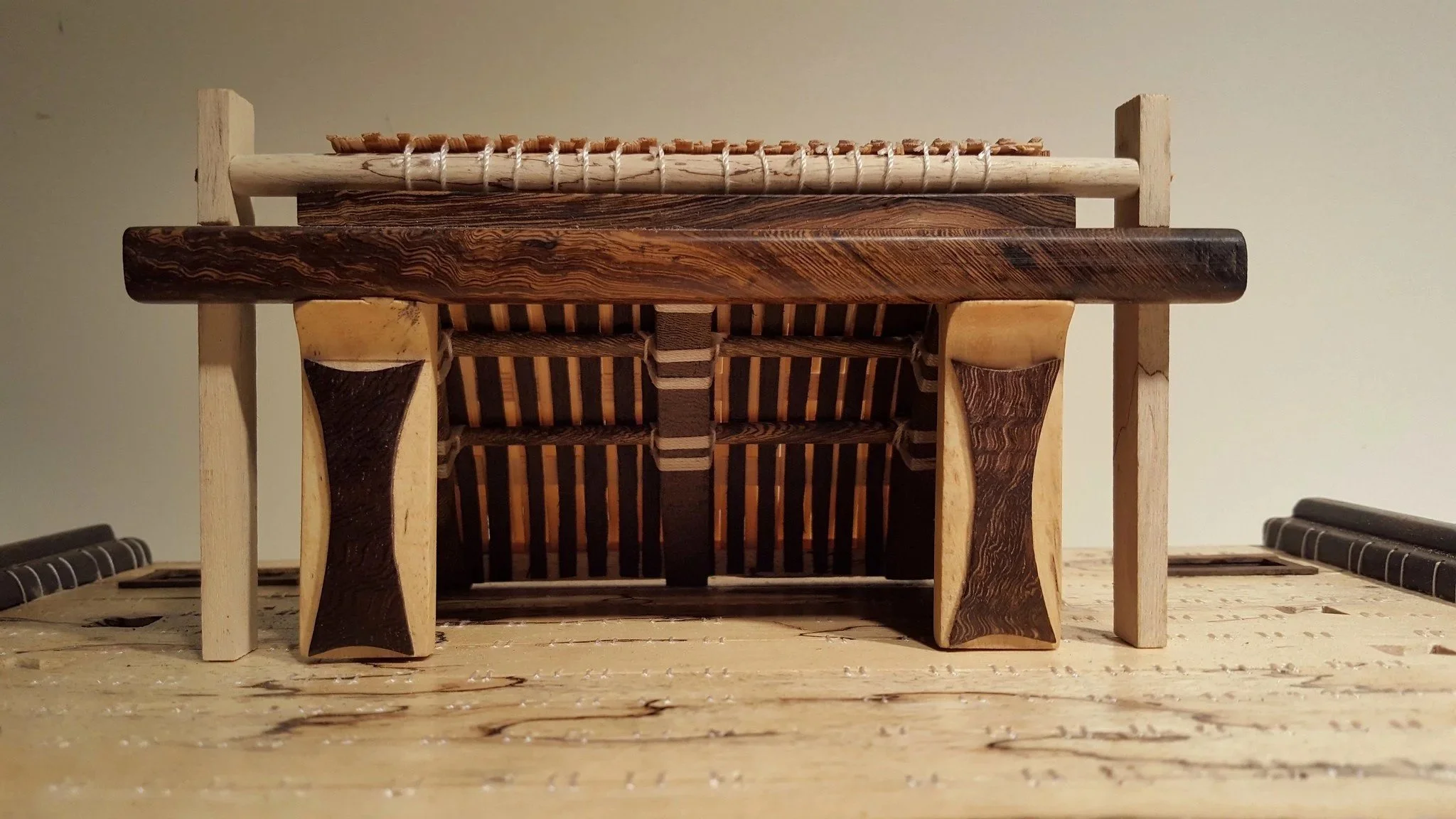
Deck hut construction. In the foreground the massive cross-beam " ai vorati" resting on 2 pilasters.
The deck hut of the Fijian Drua served 2 functions and the most important of those 2 is not what comes to mind a priory. Indeed the deck hut main purpose was to act as a buffer against the mast which (not yet installed in this picture) is located in front of the hut. The second function was of course to act as a shelter. The deck hut basic construction consists of 3 major elements:
a) two or three pilasters (2 in this picture)
b) a very heavy beam resting on the pilasters
c) 3 or 4 arched beams anchored into the deck forming the roof of the deck hut and acting as a buttress to support and reinforce the cross-beam resting on top of the pilasters.
Final construction of the hut prior to install the upper deck "quila"and railings "vaca lakeba"
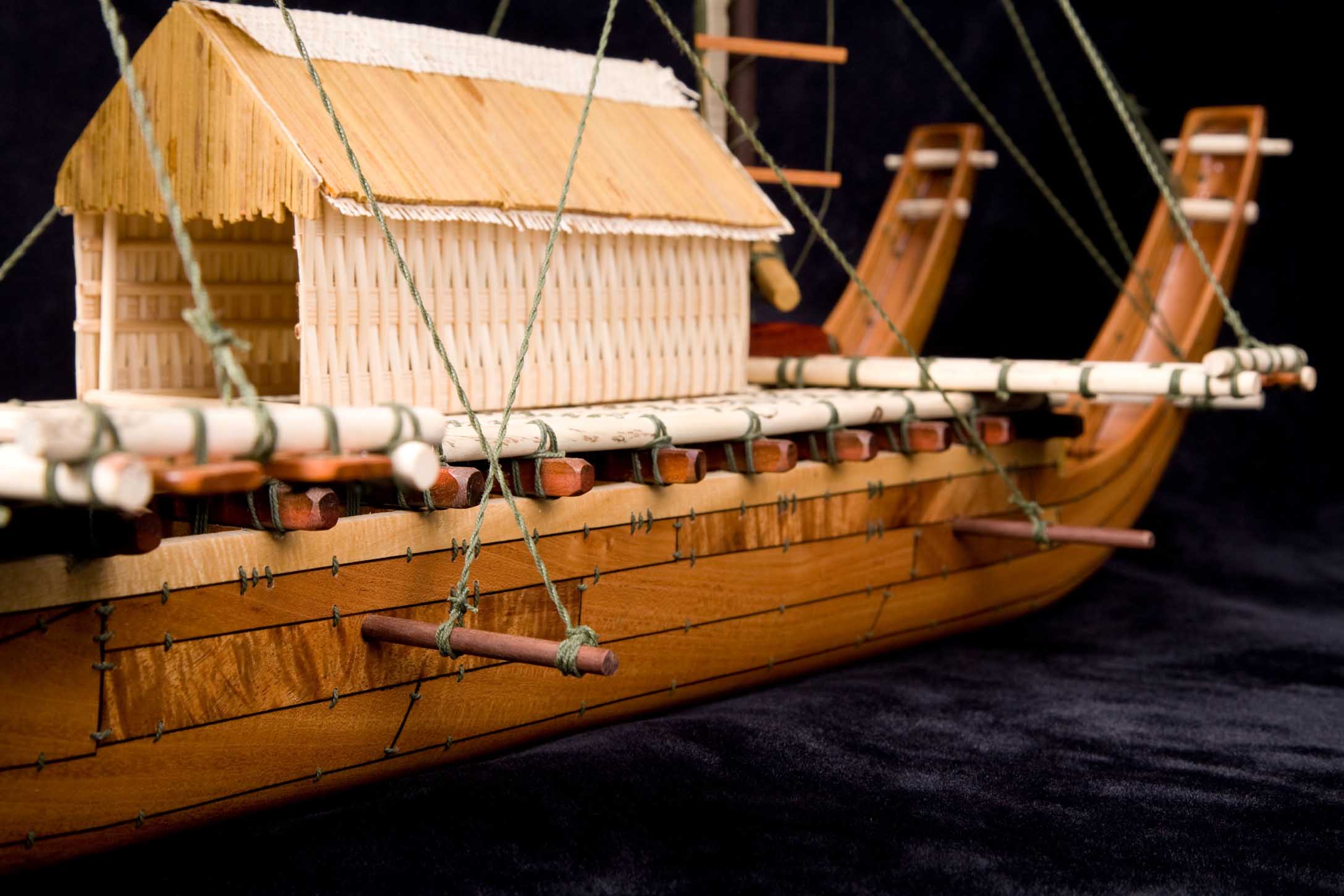
Fiji Drua hut anchored on top of the deck. Notice the many lashings holding the deck planks onto the cross-beams, over 200 if I count well.. Noticeable are the 27 cross beams connecting the larger hull "kata" to the smaller hull "thama", the 4 hatches, and the 4 butterfly shaped sculling holes.
The deck with its hut. The upper railings of the hut are decorated with cowrie shell on the life size canoe
A scale model of the Fiji Camakau at the Polynesian Cultural Center.
In 2011, Francis Pimmel was inspired by the visit of the Pacific Voyagers, a fleet of seven ocean-going canoes representing various islands of the South Pacific, during their visit to Hawaii. This fleet was supported by "The Okeanos Foundation for the Sea." This inspired Pimmel to create a model reminiscent of the double-hulled voyaging canoes, using the elegant lines of the Va'a alo Samoan canoes. The model is 40 inches long, 29 inches high, and 11 inches wide. Its twin hulls are planked in the same manner as the ancient Samoan carpenters did hundreds of years ago, with the various flanges of the hull clearly visible. The canoes of Samoan and Solomon islanders were built by planking, starting with a keel. In this model, the red bottom part of the hull represents the keel, which is also visible inside the hull. The Samoan carpenters were unique among Oceanic canoe builders in starting the bow with a "cutwater," similar to most contemporary boats. The model features a cutwater on the forward section of the hull. After extensive research online and in museums worldwide, Francis Pimmel concluded that he may be the only contemporary scale modeler to replicate the beauty of these canoes with all their elegant lines, streamlined bows, and beautifully decorated tops. Today, this exquisite model is on display at the FOUR SEASONS HOTEL RESORT, Manale Bay, Lanai, Hawaii, alongside a scale model of Hokule’a, highlighting the rich maritime heritage of the Pacific Islands.
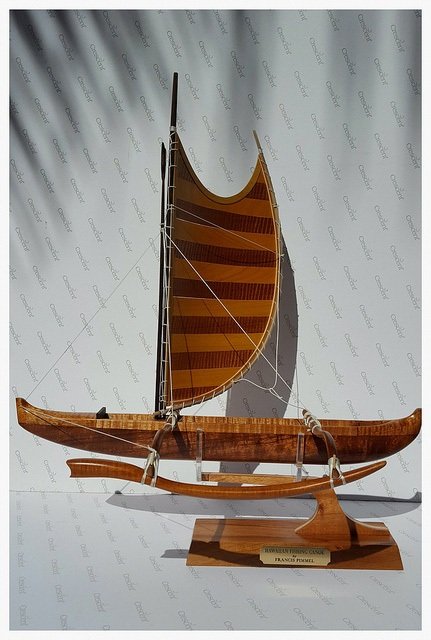
Let's explore the historical significance of these fishing canoe models from Hawaii. These models not only display the diverse shapes and sizes of canoes used in Hawaii until the early 20th century, but also provide insight into the construction techniques of that era.
One key feature that distinguishes Hawaiian canoes from those of other Polynesian islands is the use of Koa wood for canoe hulls. Koa Acacia is a type of wood native to the Hawaiian islands.
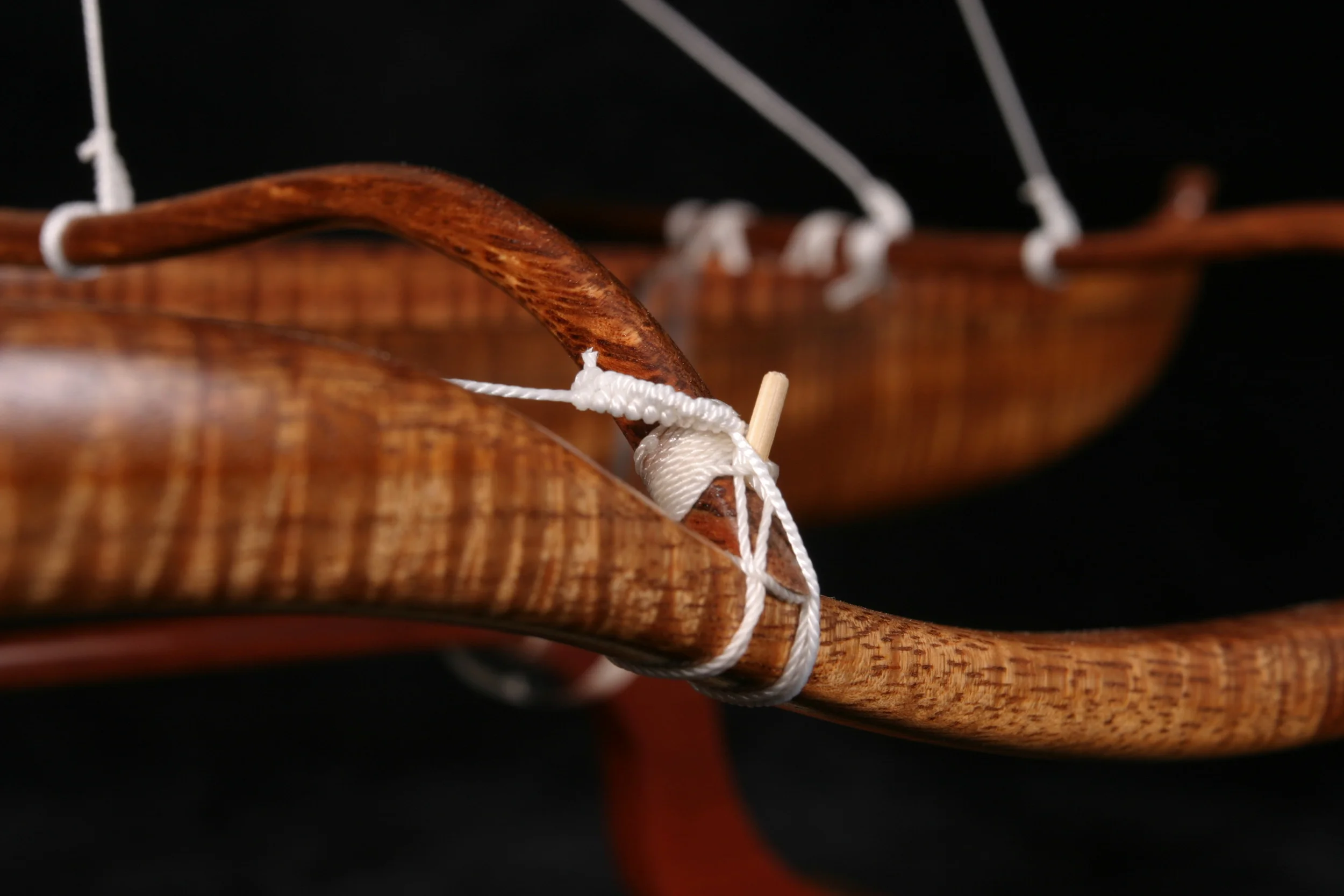
For the outriggers (known as iako in Hawaiian), Hau wood was used, wiliwili wood for the outrigger float, or Ama in Hawaiian. Additionally, the lashing of various parts on a Hawaiian single-hull or double-hulled canoe differs from the techniques used on other Polynesian islands such as Tahiti or Samoa.
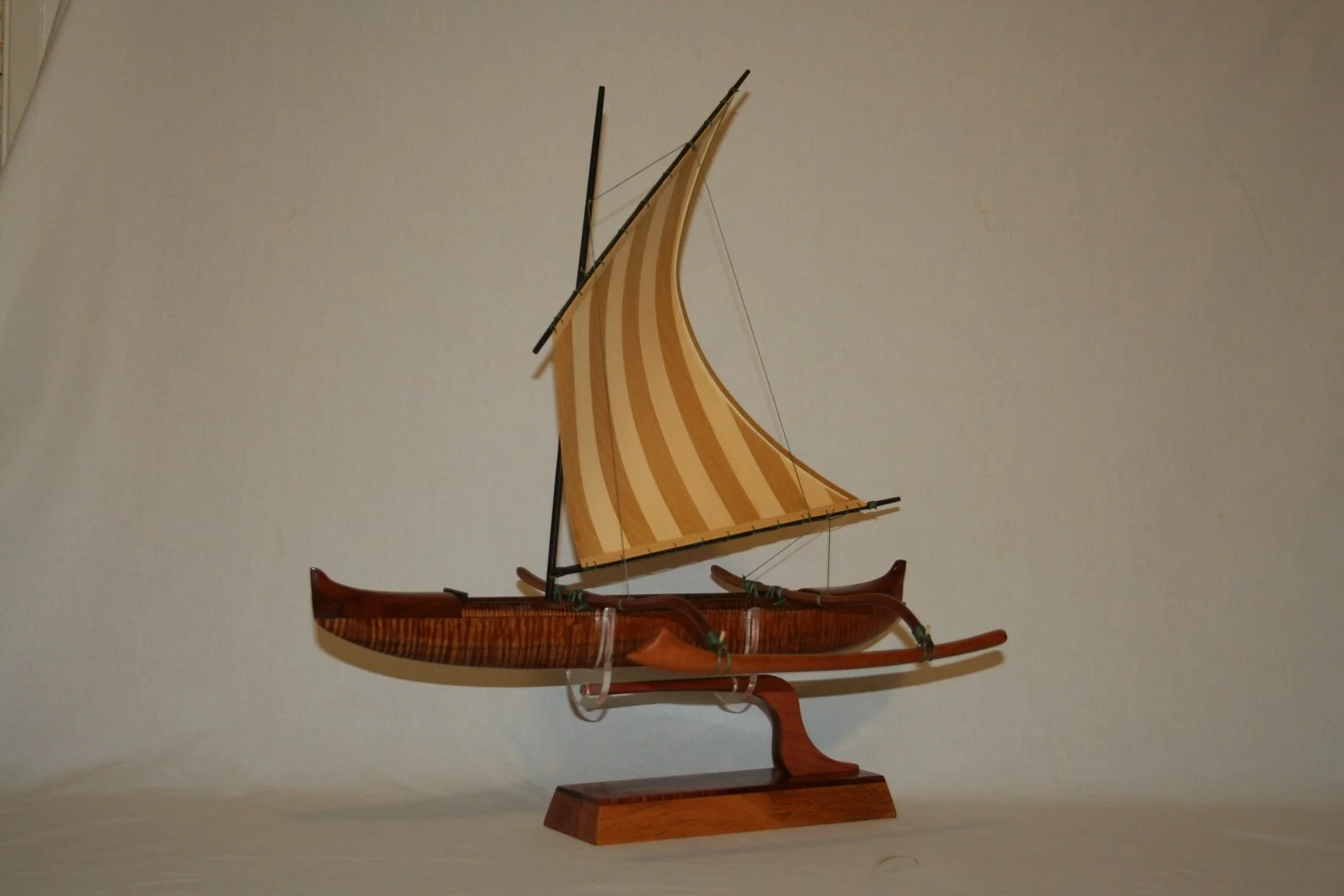
This model is 18 inches long, equipped with a striped sail.
Hawaiian Fishing canoe equipped with a striped lug sail
This 32-inch-long model is one of five canoes commissioned by the Kahala Resort and Hotel, Oahu, some years ago. Racing canoes with sail are generally very colorful, and I wanted to imitate that feature in the model. In particular, I tried to use wood species with striking colors that coordinate well. I am aware that this type of canoe is called a sailing canoe in Hawaii, and I would like to distinguish between the double-hulled canoe with a sail of old times and the contemporary double-outrigger with sail used for racing.
Orders for the same color model are subject to the availability of wood species.
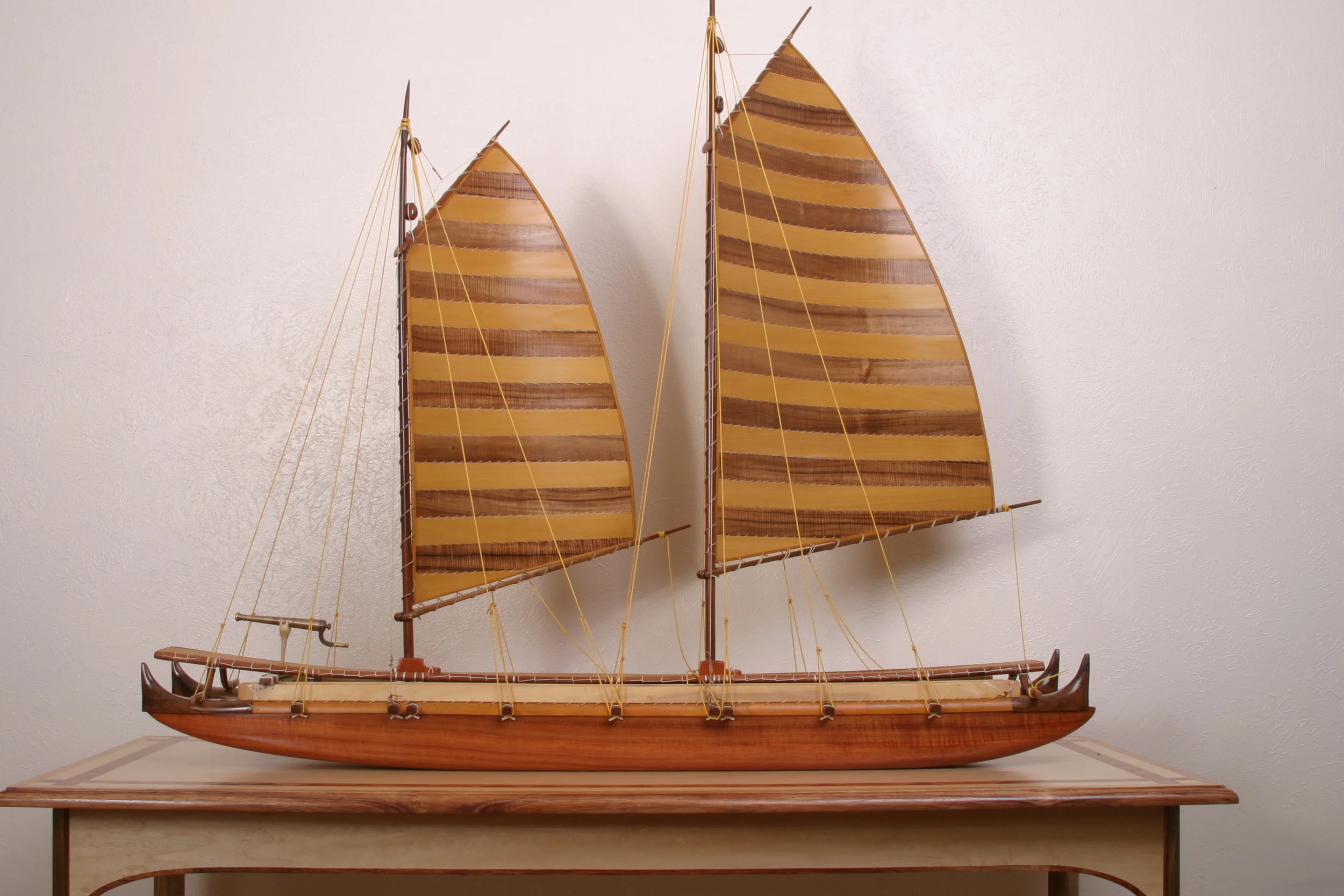
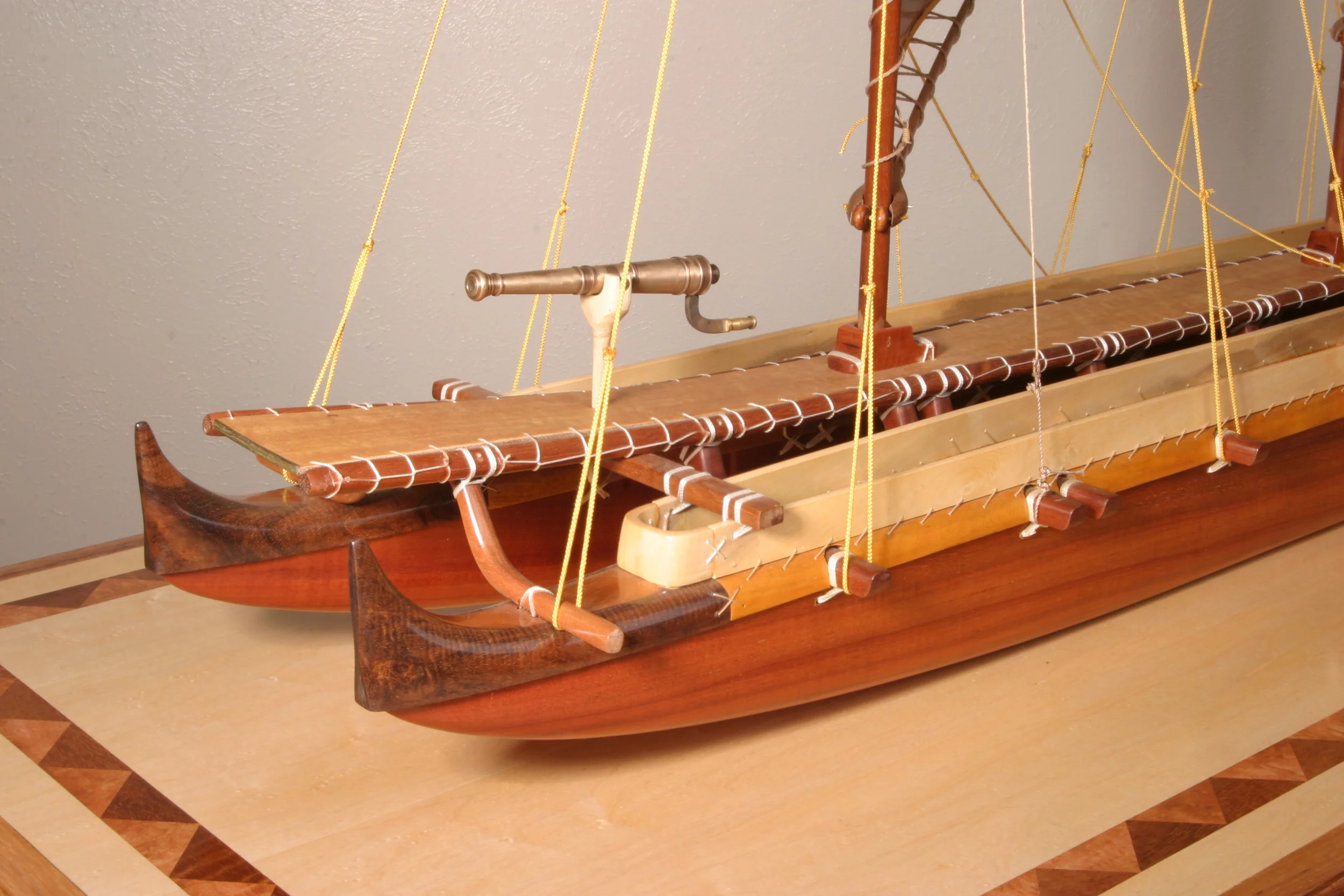
This type of double-hulled canoe, with its impressive dimensions of about 70 feet in length, holds a significant place in history. Legend has it that over 120 vessels of this type were built by King Kamehameha I around 1796 for his conquest of Kaua'i. It serves as a testament to the advanced maritime technology of the Polynesians. Most remarkable was the European-style rigging, namely the schooner rig, a clear indication of the Polynesians' adaptability and innovation. Some of these canoes were even equipped with swivel cannons, which King Kamehameha received from the English in return for the sought-after sandalwood. This model, a scaled-down version from the original drawings, measures 4 feet in length and 8 1/2 inches in width, serving as a tangible reminder of this historical achievement.
Together with the model canoe, I was tasked with building a table that would complement the characteristics of the model. The table top was adorned with inlaid filets and koa-shaped triangles of different colors.koa-shaped triangles of different colors.
The cannon, long by 4 inches was fully milled in bronze.
Herb Kawainui Kane's illustration of "The Story of Laka" inspired the creation of a particular type of canoe depicted in his work "Voyagers." The legend recounts the tale of Laka, who constructs a canoe to journey to a remote island in order to avenge his murdered father and enslaved mother. Accompanied by seven companions, Laka's canoe is assaulted by demons and a giant squid. However, Laka and his men successfully defeat the attackers and rescue his mother. This story, along with variations of it, is narrated across the Pacific, and the canoe serves as a representation of the canoes from the Marquesas Islands.
The hulls of Samoan canoes are known for their remarkable elegance and ideal hydrodynamical shape. They are extremely profiled, with the prow resembling a shark's head and the stern ending like an elegant tail. Samoans were skilled carpenters and are credited with developing the plank-built canoe method using hidden lashings. Additionally, Samoans adorned their canoes with sculptures and shells.
Over the past 30 years, Francis has been crafting scaled-down Hawaiian outriggers, ranging from 20 inches (50.8 cm) to 6 feet (1.82 m) in size. These models are based on existing sea-going racing canoes or ones found in museums, such as the A'a', a large and heavy canoe displayed at the Bishop Museum in Honolulu.
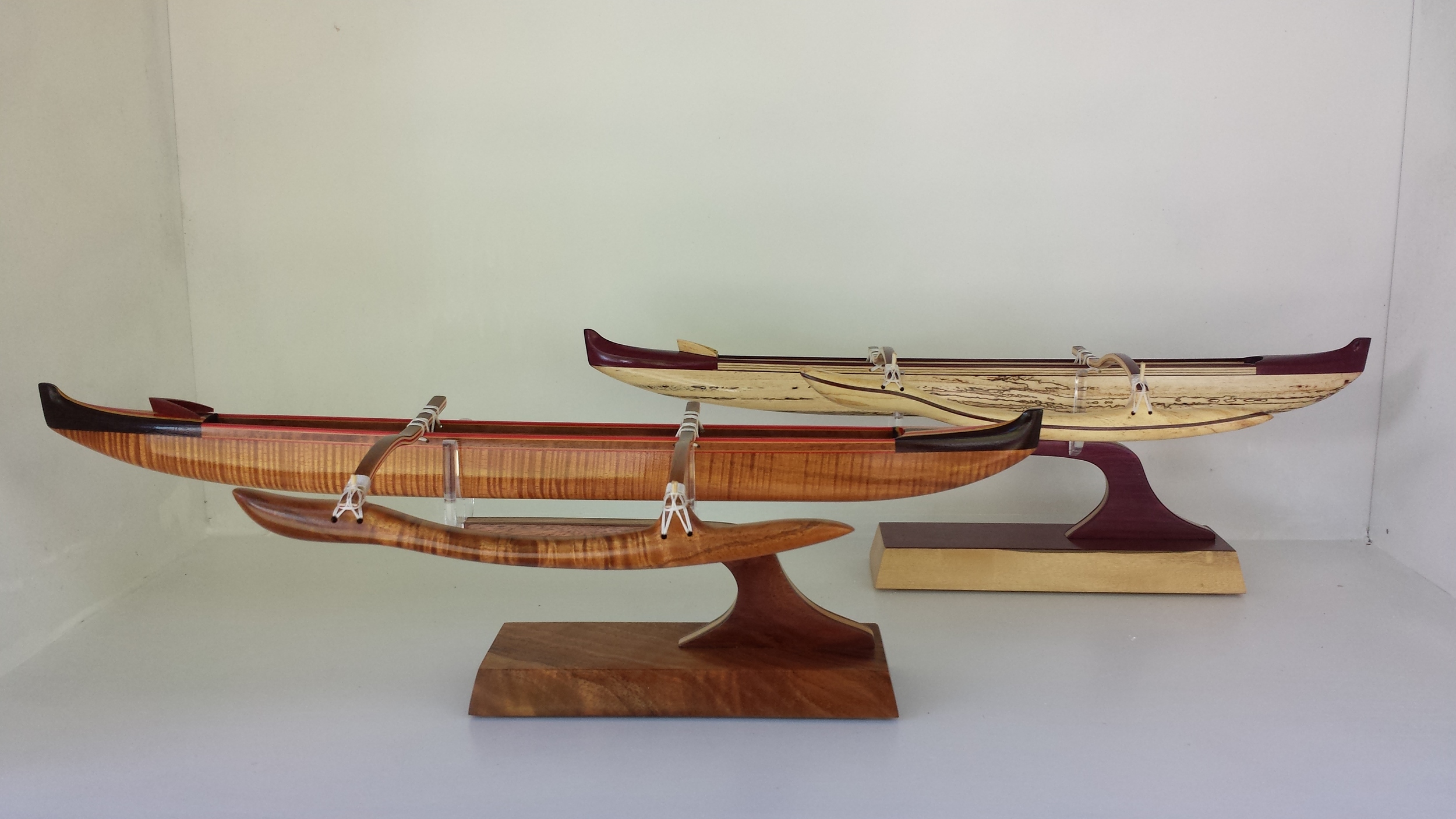
Some of Francis's canoe models are readily available right here in the SHOP, or art galleries across the islands, while others have been commissioned works. They are crafted in various types and sizes, with some built in the traditional Hawaiian way using Koa wood for the hull. Others may bear a more contemporary look with Tamarind wood for the hull, or may have inlay work on the canoe's top bow and stern (known as "manu" in Hawaiian). Over the years, Francis has built scale models of the OPELU fishing canoe, the DOWSETT, the MALIA, the famous KA-MO'I, and the slender A'A canoe.
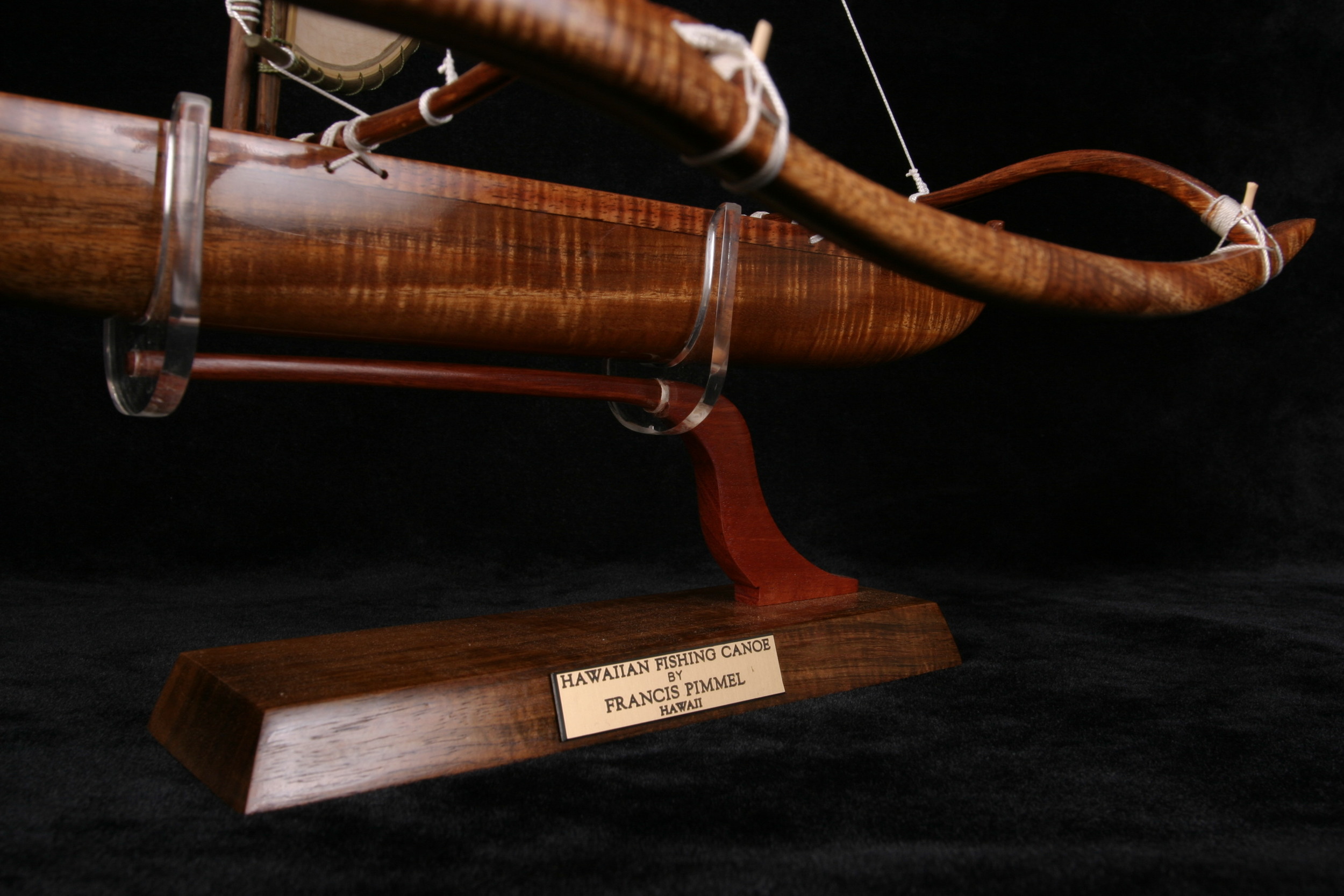
24 inch long Hawaiian outrigger with signature stand as illustrated.
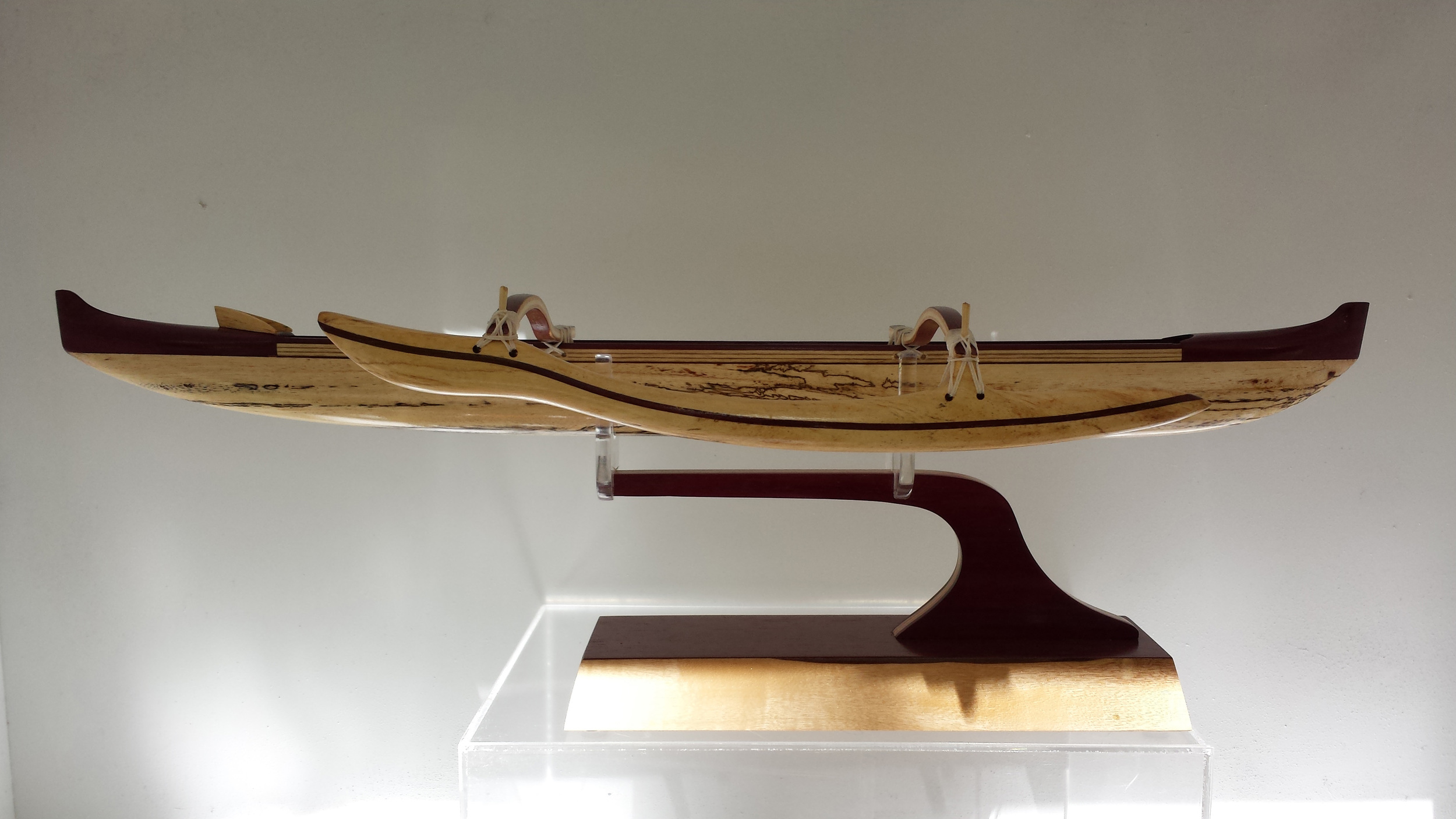
Long by 20 inches and carved using rare spalded Tamarind wood.
Both long by 20 inches , one model carved using a beautiful curly Koa, the other Tamarind wood.
This is a 6 foot long model that won am award in 2001.
The A’a model long by 6 feet and the smaller model, a 20 inch long Malia.
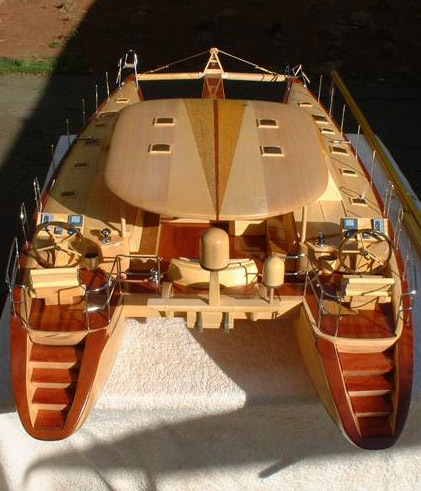
The catamaran vessels of today are the direct descendants of the highly evolved Polynesian sailing canoes. Double-hulled canoes had two essential qualities: good buoyancy and stability, and these two qualities led to the development of the modern catamaran. Early attempts at building catamarans started in 1662 when Sir William Petty built his "Double Bottom" to race in Dublin. He beat all comers and established the speed potential of catamarans in the Western Hemisphere. Most early steamboats were catamarans with the paddle wheel protected between the hulls. The connecting structure between the hulls was used for navigation and since became known as "the bridge".
Western perception of the catamaran has been shaped by yachting rather than commerce.
In the world of yachting, catamarans have earned a unique reputation as 'multi-hulls'. They stand out as the most sea kindly vessels on all points of sail, offering a level of safety and comfort that is unparalleled in the cruising boat category.
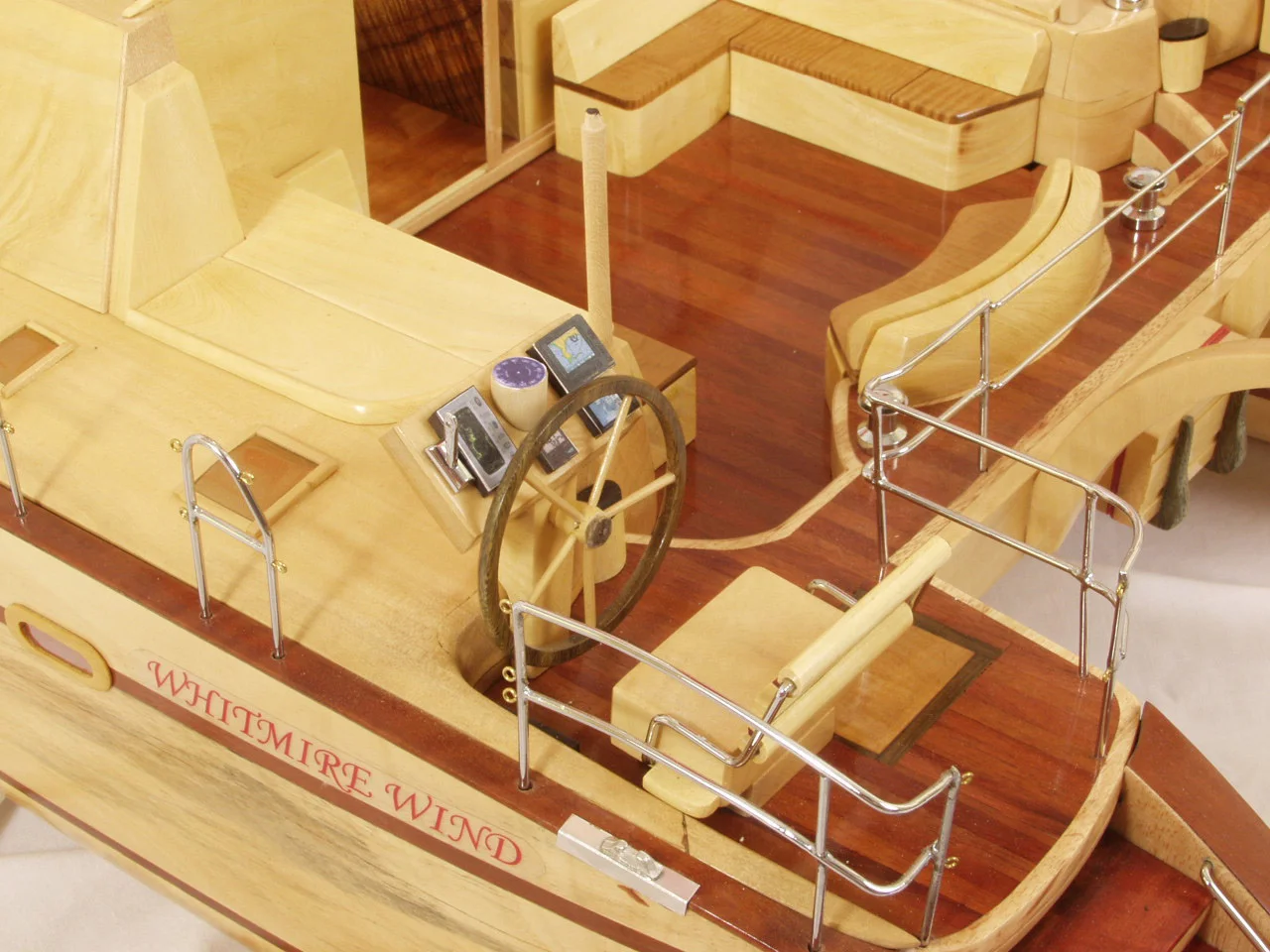
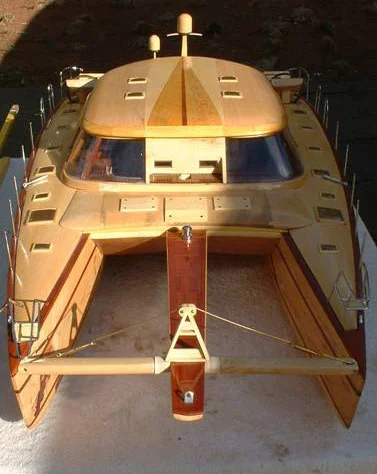
Looking at a modern catamaran, we can see the evolution from its ancient Polynesian voyaging canoe roots. The cross-beams that once joined the two hulls, on which the deck rested, have been replaced by a bridge or platform. This structure, cutting directly into the starboard and port hull topsides, now serves as the central hub of the vessel. On top of the bridge, we find the cockpit, where the catamaran is steered, the saloon for socializing, the skipper's area for charting maps and using navigational instruments, and the crew's shelter.
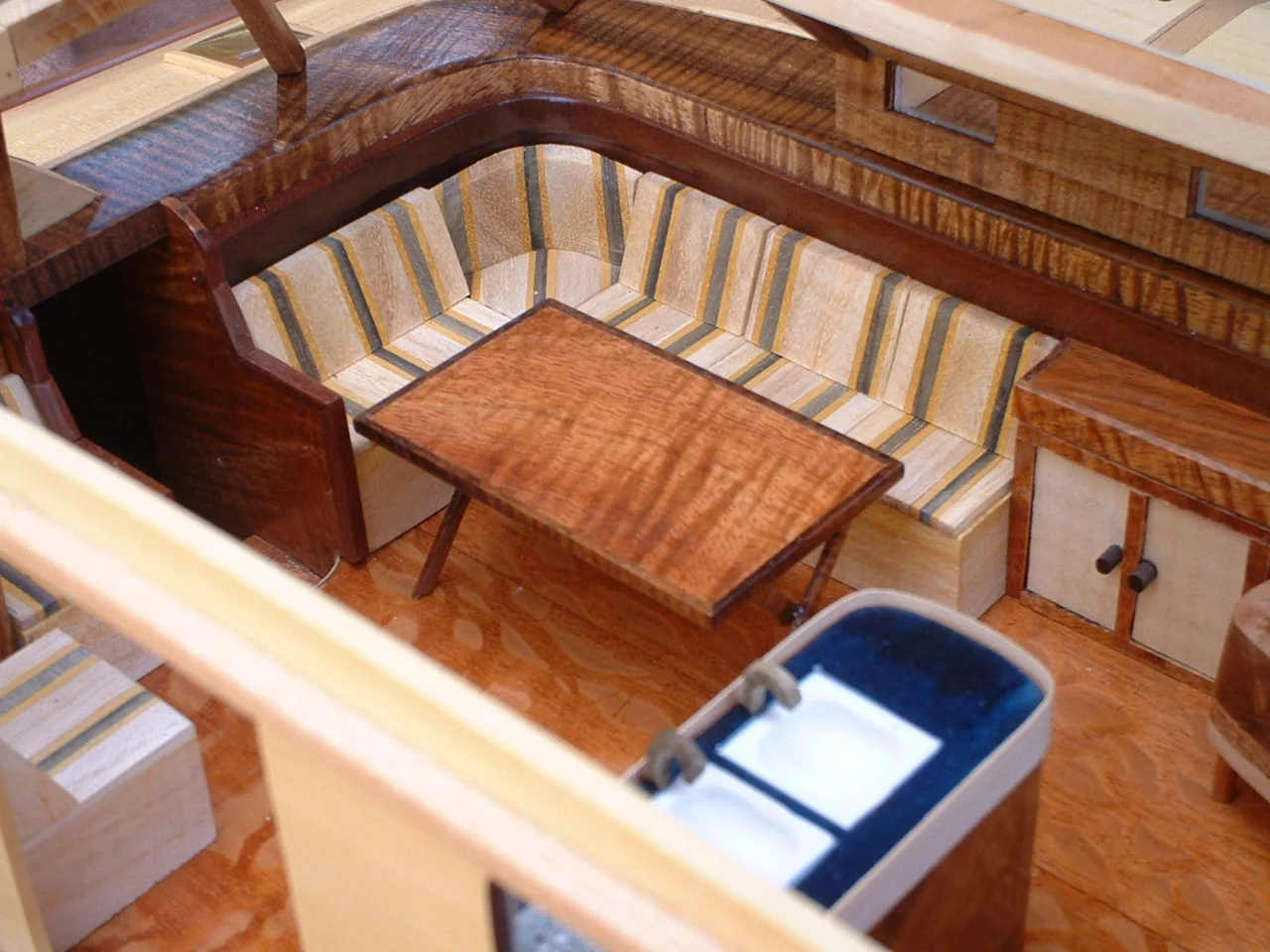
Francis built the model of this "Cat" around 25 years ago. She was 36 inches long . There were no other building specification or line drawings available of the real size cat as those available in commercial maritime magazines. Francis had to calculate all the dimensions of the many parts of the boat based on the 4 basic dimensions giving in the commercial and those where the length overall of LOA, the length of the waterline or LWL, the beam and the draft.
The model is now gracing the interior of a villa in Beverly Hill.
Hawaiian outrigger canoes, 36 inches long, built with overlapping tops (manu) and gunnels. More photos to follow.
The Mo‘olele, built by LeVan Keola Sequeira, was birthed 50 years ago and was in a park along the ocean, at 525 Front Street, when it burned.
Scale model commissioned in 2022. Photo by Rob. S.
A scale model I created in 2022 . Photo by Rob. S.
THE MANINI SELECTION
“Manini” - Standing for very small, yet capturing the spirit of Pacific voyaging.
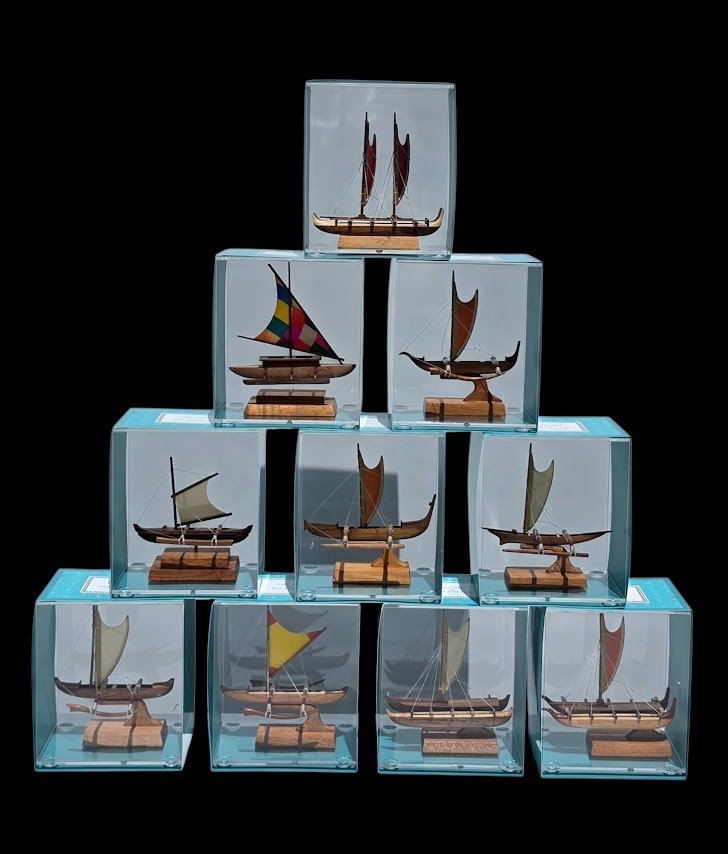
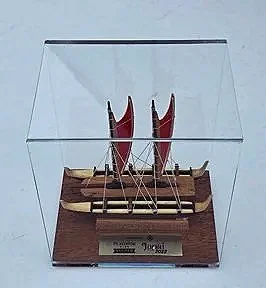
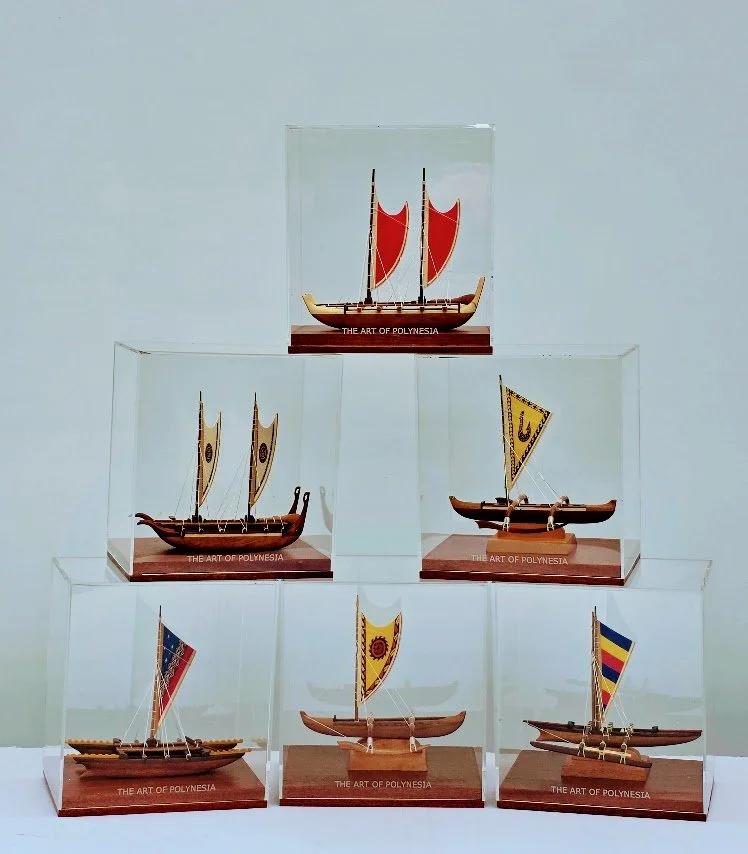
The Manini Selection features 10 distinct miniature canoes, each exquisitely crafted and representing Hawaii, the Marquesas, the Cook Islands, Samoa and Fiji
To make these high-quality pieces accessible to a wide range of buyers, including for retail inventory and corporate gifting, these specific models are crafted in volume rather than as individual custom builds. This allows me to keep costs accessible for large orders and maintain prompt delivery.
PRODUCT FEATURES & PREMIUM PACKAGING
* Dimensions: Each miniature canoe is meticulously detailed and measures no longer than 4 inches
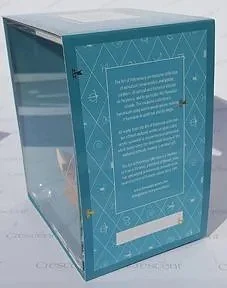
* Museum-Quality Display: Housed in a premium, 4-sided acrylic surround (4” x 5” x H: 7”), offering protection and a crystal-clear view from every angle.
* Aesthetic packaging: Enclosed in a beautiful, custom-designed protective sleeve illustrated with authentic Hawaiian petroglyphs.
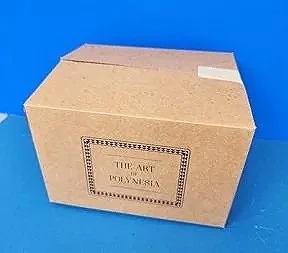
* Signature Presentation: A proud part of my trademarked THE ART OF POLYNESIA collection.
RETAIL & CORPORATE CUSTOMIZATION
Whether you are stocking your retail shelves or looking for an unforgettable corporate gift, the “Manini” Selection offers the flexibility and personalization you need:
* Volume ordering: Available to order in any quantity to fulfill large retail or corporate needs.
* Custom Branding: Personalize the presentation of your models with the addition of a custom plaque or specialized engraving (outsourced to engraving companies)